Rain, Auvers
The wide wheat plain above Auvers-sur-Oise seen through slanting rain — one of Van Gogh's last landscapes.
Auvers-sur-Oise
The painting depicts a real landscape or cityscape. The precise viewpoint the artist used may be unknown, so the marker shows the general area.
Rain, Auvers — at a glance
- Artist
- Vincent van Gogh (1853–1890)
- Year
- 1890
- Movement
- Post-Impressionism
- Place
- The plateau above Auvers-sur-Oise, France
- Viewpoint
- The open wheat plain above the village — still farmland; a broad stretch, not a fixed spot
- Medium
- Oil on canvas
- Dimensions
- c. 50 × 100 cm
- Now at
- National Museum Cardiff
Overview
Rain – Auvers is one of the roughly seventy canvases Vincent van Gogh painted in the last two months of his life at Auvers-sur-Oise. It is a wide (‘double-square’) landscape of the open fields on the plateau above the village, worked over with long diagonal strokes of grey that represent falling rain. It is oil on canvas, about 50 by 100 cm, and it hangs in the National Museum Cardiff.
Where was Rain, Auvers painted?
Scholarship Above the houses of Auvers-sur-Oise, north-west of Paris, a flat agricultural plateau of wheat and other crops stretches away — the country Van Gogh painted again and again in June–July 1890, including in the wheatfield pictures often linked to his death. The plateau is still farmland and largely open, so the character of the place survives; the picture takes in a broad stretch of it rather than a marked, fixed viewpoint.
What is in the painting?
Fields in bands of green, gold and brown run back to a low line of hills, roofs and trees. Across the whole surface, top to bottom, run parallel diagonal strokes of grey-white — the rain — a device Van Gogh borrowed from Japanese prints. A few small marks read as birds, a cart, a figure. The sky is a flat grey.
Look closely
The lines of rain
Parallel grey-white diagonals run top to bottom across the entire picture — the weather as pattern.
The banded fields
Green, gold and brown crop strips run back to a low ridge of roofs and trees.
The tiny marks
A few strokes read as birds, a cart and a figure in the middle distance.
Analysis
Composition and technique
A wide, low-horizon plain overlaid entirely with slanting lines of rain.
Scholarship Van Gogh keeps the landscape structure simple — horizontal bands of field, a low ridge — and then draws the rain straight across it in bold parallel diagonals, so the weather becomes a graphic pattern laid over the scene. He had used the same borrowed device in a copy after Hiroshige.
History & provenance
The painting entered the collection of the Welsh sisters Gwendoline and Margaret Davies and was given with it to the National Museum of Wales; it hangs in National Museum Cardiff.
Sources
- Amgueddfa Cymru – National Museum Wales, Cardiff — collection entry for Vincent van Gogh, ‘Rain – Auvers’ (1890)
- ‘Vincent van Gogh: The Letters’ (Van Gogh Museum) — Auvers, June–July 1890
Related paintings

Plain near Auvers
1890
Van Gogh's other wide field view of the same plateau, the same weeks, without the rain.

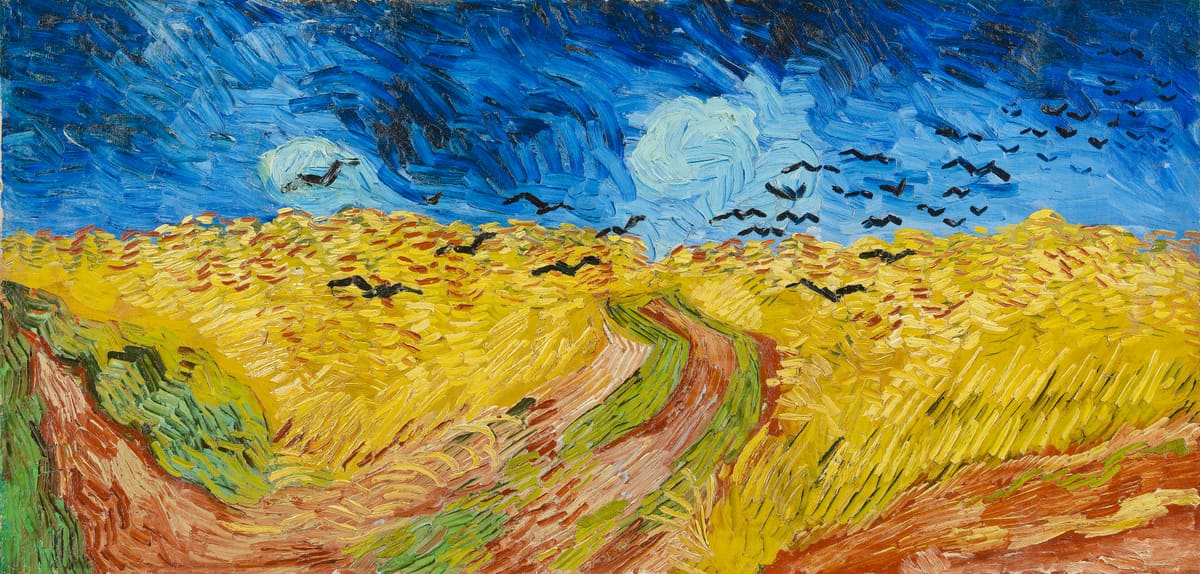
Wheatfield with Crows
1890
Van Gogh's turbulent wheatfield of July 1890, from the same plateau.

Rain, Steam and Speed – The Great Western Railway
1843
Turner's rain-and-storm railway of 1844 — an earlier great picture of weather over a landscape.
More by Vincent van Gogh
Café Terrace at Night
The Church at Auvers
Starry Night Over the Rhone
Agostina Segatori Sitting in the Café du Tambourin
Also connected to Auvers-sur-Oise
The Church at Auvers