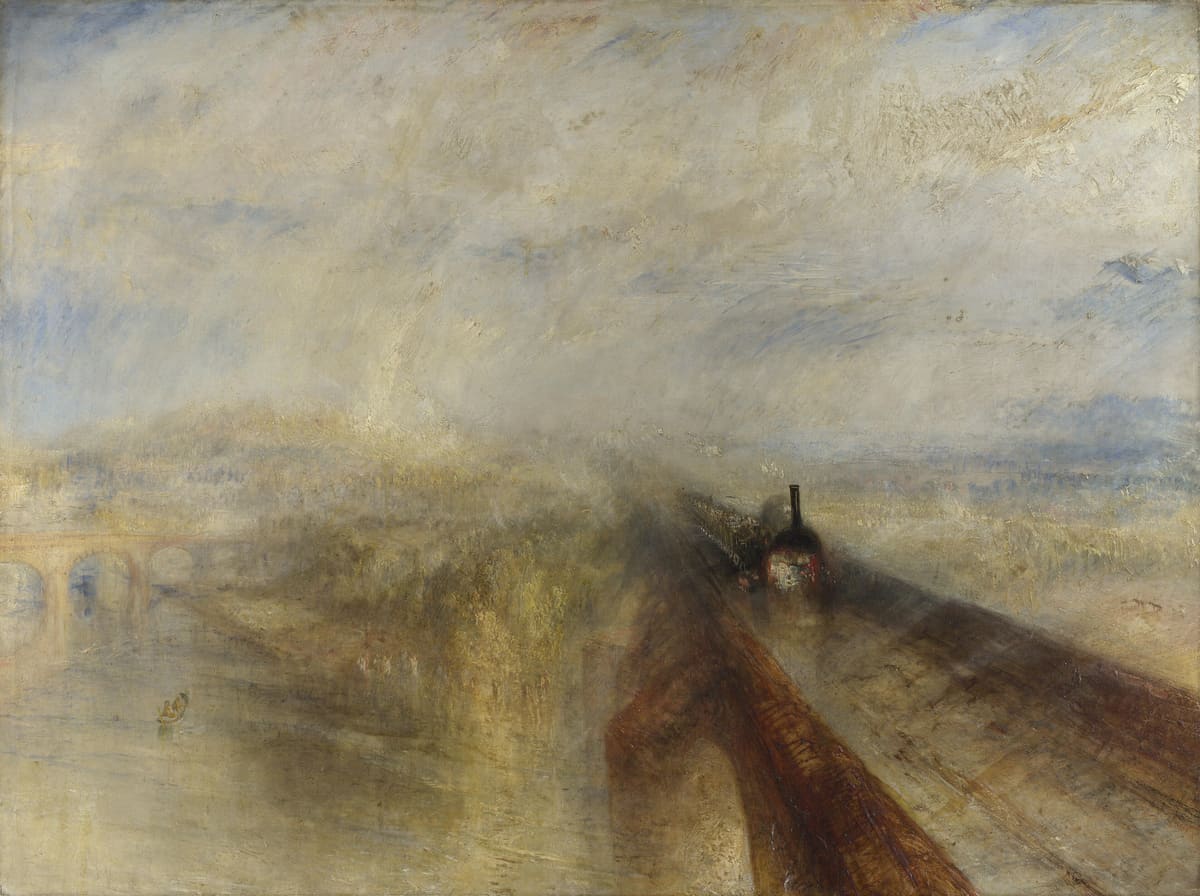
Rain, Steam and Speed – The Great Western Railway
A train charging across Brunel's brick railway bridge over the Thames at Maidenhead — a bridge that still carries trains.
Maidenhead Railway Bridge
The painting shows a real, identified place that you can find today. The exact spot the artist worked from is not necessarily known.
Rain, Steam and Speed – The Great Western Railway — at a glance
- Artist
- J. M. W. Turner (1775–1851)
- Year
- 1844
- Movement
- English Romanticism
- Place
- Maidenhead Railway Bridge, River Thames, west of London
- Viewpoint
- Looking along the viaduct as the train crosses — the bridge still carries trains
- Medium
- Oil on canvas
- Dimensions
- c. 91 × 122 cm
- Now at
- The National Gallery, London
Overview
Rain, Steam and Speed — The Great Western Railway is a painting J. M. W. Turner showed at the Royal Academy in 1844, when he was about 69 and steam railways were still new. A dark locomotive races towards the viewer across a bridge, out of a storm of rain, steam and light. It is oil on canvas, about 91 by 122 cm, and it hangs in the National Gallery, London.
Where was Rain, Steam and Speed – The Great Western Railway painted?
The bridge the train crosses is the Maidenhead Railway Bridge, known as the ‘Sounding Arch,’ designed by Isambard Kingdom Brunel and completed in 1838. It carries the Great Western main line over the River Thames between Maidenhead and Taplow, west of London.
Museum interpretation It is still in use. Its two main spans are among the flattest, widest brick arches ever built; the line was widened in the 1890s, but Brunel's original arches remain, and trains from London still run over them. A second, older bridge visible behind in the painting is the road bridge at Maidenhead.
What is in the painting?
A black engine, its firebox glowing, comes head-on down a low viaduct out of a golden-grey turbulence of rain and steam. A hare runs along the track ahead of it. Another bridge crosses the river behind, to the left; a small rowing boat and figures on the bank are almost dissolved in the haze.
On the far side, faint figures dance, and a ploughman works a field — the old world alongside the new machine.
Look closely
The hare on the rails
A hare runs just ahead of the locomotive — usually read as a gauge of the train's speed.
The glowing firebox
The engine is a hard black shape with a spark of orange at its front — the one solid thing in the picture.
The old road bridge
A second bridge crosses the river behind to the left, half-erased by the haze.
The boat and figures
A rowing boat and people on the near bank are barely visible in the rain.
The ploughman and dancers
On the far side, a ploughman works and small figures dance — the older world, nearly lost in the light.
Details that are easy to miss. A hare runs along the rails just ahead of the locomotive; a second bridge — the old road bridge at Maidenhead — crosses the river behind to the left; a rowing boat and a group of figures are barely visible on the near bank; and on the far side small figures dance in a field while a ploughman works, almost lost in the light.
Analysis
Composition & perspective
The bridge drives in on a steep diagonal from the lower right, so the engine seems to burst out of the picture towards the viewer.
Scholarship Turner runs the viaduct sharply into the foreground, with the locomotive at its near end and the vanishing point lost in glare. Everything else — the river, the far bridge, the banks — is subordinated to that rushing diagonal and to the swirl of weather around it. Solid form barely survives; only the black engine holds.
Colour and light
A haze of gold, white and grey, dissolving the landscape, with the one black note of the engine at its centre.
Scholarship Turner floods the canvas with a luminous storm-light — yellow-gold near the sun, grey-white in the rain — so that water, sky and land run together. Against it the locomotive is a hard dark shape, its firebox a spark of orange. The picture is almost abstract at the edges.
Handling and technique
Thin washes and scumbles of light-toned paint, worked wet, with the engine and hare added as firm dark accents.
Turner builds the atmosphere in fluid, layered veils of paint, dragging and rubbing to keep it luminous, then sets the few solid things — the engine, the parapet, the hare — on top in decisive strokes. It was among his most radical exhibited works.
Meaning and interpretation
Interpretations differ. What the artist documented, what museums and scholars propose, and later or speculative theories are marked and kept separate.
The new speed of the age
The picture is read as Turner's response to the railway as a force — power, speed and modernity tearing through the old rural landscape and through the weather itself. The hare racing ahead of the engine is usually taken as a measure of that speed, and perhaps of what it threatens to overtake.
Turner's ambivalence
Whether Turner welcomed or feared the railway is left open. The engine is thrilling and slightly menacing at once; the boat, the ploughman and the dancers of the older world are painted more tenderly, and half-erased.
History & provenance
- 1844Shown at the Royal Academy, London, to a mixture of admiration and bafflement.
- 1851Turner dies, leaving the bulk of his work to the nation.
- 1856The painting enters the national collection through the Turner Bequest.
- TodayOn view in the National Gallery, London.
The painting came to the nation through the Turner Bequest of 1856 and hangs in the National Gallery in London, near his earlier ‘The Fighting Temeraire.’
Sources
- The National Gallery, London — collection entry for ‘Rain, Steam and Speed – The Great Western Railway’ (Turner Bequest, 1856; NG538; oil on canvas, c. 91 × 122 cm)
- Historic England — listing for the Maidenhead Railway Bridge (Brunel, 1838)
- John Gage, ‘Turner: Rain, Steam and Speed’ (1972)
Frequently asked
What bridge is in Rain, Steam and Speed?
The Maidenhead Railway Bridge, or ‘Sounding Arch,’ designed by Isambard Kingdom Brunel and finished in 1838, carrying the Great Western main line over the Thames west of London.
Does the bridge still exist?
Yes. It is still in use. The line was widened in the 1890s, but Brunel's original brick arches — among the flattest and widest ever built — remain, and trains from London still run across them.
Why is there a hare on the track?
The hare runs just ahead of the locomotive and is generally read as a measure of the train's speed — and perhaps of the older, natural world about to be overtaken.
What is the other bridge behind?
The old road bridge at Maidenhead, crossing the river to the left, half-dissolved in the haze.
Did Turner approve of railways?
The painting does not say. The engine is both thrilling and slightly menacing, and the figures of the older rural world are painted tenderly but nearly erased.
Where is the painting now?
In the National Gallery, London, through the Turner Bequest of 1856.
Related paintings

The Railway
1873
Manet in 1873 — the railway as a wall of steam beside a Paris station, without the locomotive.

The Hay Wain
1821
Constable's still Suffolk countryside — the pre-railway English landscape Turner's train is charging through.

Impression, Sunrise
1872
Monet's harbour of 1872 — the next generation's dissolving of a scene into pure light.
More by J. M. W. Turner

Dido building Carthage

Dolbadarn Castle

