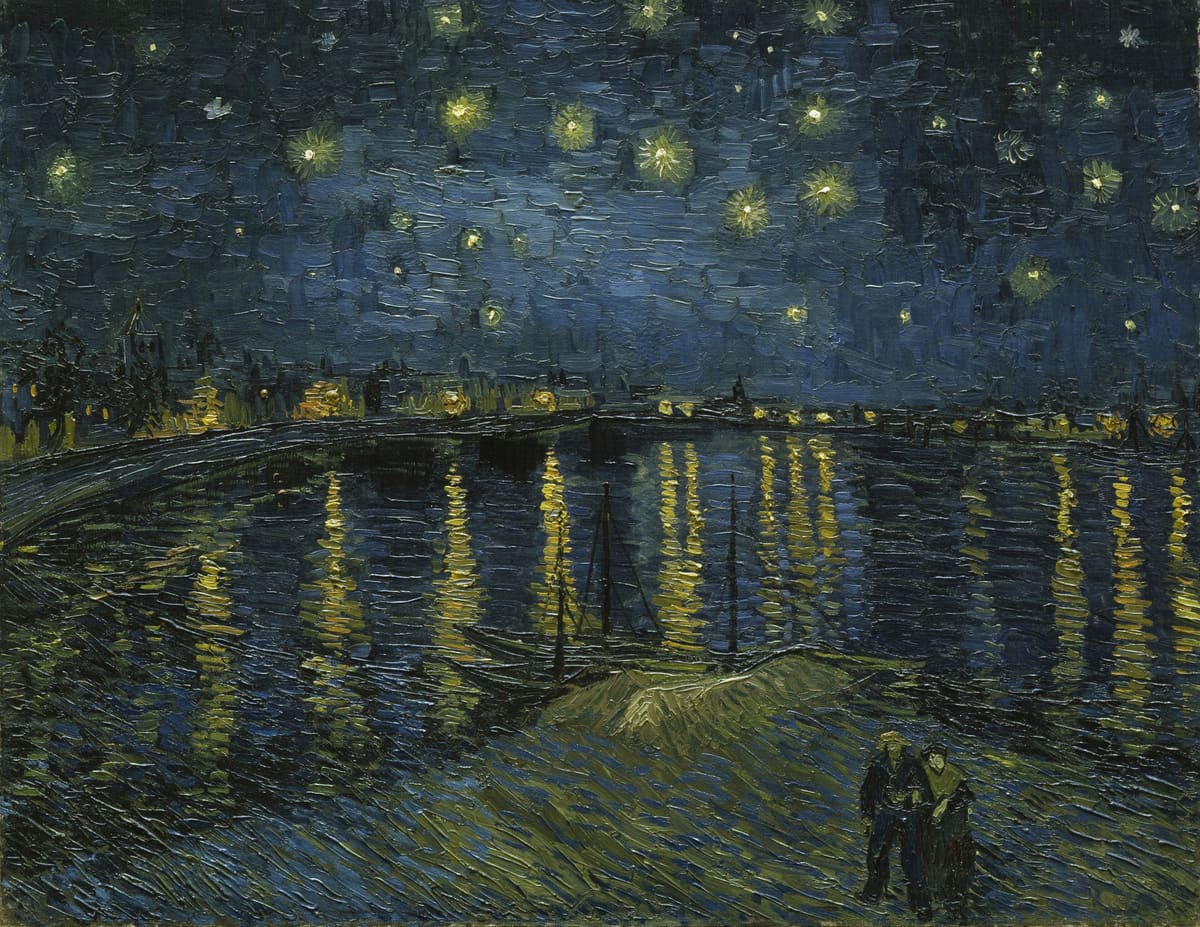
Starry Night Over the Rhone
The Rhône at Arles by gaslight, painted on the embankment a few minutes' walk from the Yellow House.
Rhône embankment at Arles (Quai de la Roquette)
The painting depicts a real landscape or cityscape. The precise viewpoint the artist used may be unknown, so the marker shows the general area.
Starry Night Over the Rhone — at a glance
- Artist
- Vincent van Gogh (1853–1890)
- Year
- September 1888
- Movement
- Post-Impressionism
- Place
- Rhône embankment, Place Lamartine, Arles, France
- Viewpoint
- The quay looking downstream toward Trinquetaille — documented, walkable
- Medium
- Oil on canvas
- Dimensions
- c. 72 × 92 cm
- Now at
- Musée d'Orsay, Paris
Overview
Starry Night Over the Rhône is an oil painting Vincent van Gogh made in Arles in September 1888, about nine months before the more famous Saint-Rémy Starry Night. He painted it at night, outdoors, on the bank of the Rhône close to the Yellow House where he was living. It is oil on canvas, about 72 by 92 cm, and it hangs in the Musée d'Orsay, Paris.
It is the second of his 1888 night scenes, after Café Terrace at Night, and the one in which he combined the starry sky with a stretch of water and its reflections.
The story behind the painting
Through September 1888 Van Gogh was pushing to paint the night in colour. He had done the café terrace on the Place du Forum; now he walked a few minutes from the Yellow House to the Rhône embankment and set up after dark.
Artist's own account He described the picture in letters: the gas lighting of the town reflected in the river, the sky a greenish-blue, the water royal blue, the ground mauve, the lights citron-yellow with red-gold reflections, and the Great Bear — the Plough — sparkling green and pink over the town. He was pleased to have got a night effect without black.
A pair of lovers walks the near bank — the small human figures he had wanted to combine with a night sky, and would keep wanting when he painted the Saint-Rémy picture.
Where was Starry Night Over the Rhone painted?
The viewpoint is the quay on the edge of the Place Lamartine, just outside the old town's northern gate, looking downstream — roughly north-west — across the river towards the district of Trinquetaille.
Museum interpretation The bend of the river and the line of the embankment are unchanged, and this stretch of bank is a documented, walkable spot in the Van Gogh trail through Arles. The specific gas-lit skyline has gone, and the modern bridges are new, but the direction of view and the river remain.
How we know
- Painted from the right bank of the Rhône at Arles, near the place Lamartine, in September 1888; the stored coordinate was a point on the Rhône in Switzerland. Area precision along the quay — the standpoint is described in van Gogh's letters but not surveyed.
What is in the painting?
Along the far embankment, a row of gas lamps burns citron-yellow and trails long reflections straight down the dark water. Above, a blue-green sky is stippled with large yellow stars, and the seven stars of the Plough hang over the town.
In the foreground, moored rowing boats lie on the near bank, and a couple walks arm in arm at the lower right.
Look closely
The lamp reflections
The far-bank gas lamps drop long, almost straight yellow streaks down into the dark foreground water.
The Plough
The seven stars of the Great Bear hang over the town — placed a little loosely against the real sky.
The moored boats
Two rowing boats are drawn up on the near bank at the lower left.
The couple
At the lower right, two lovers walk arm in arm — the figures Van Gogh wanted under a night sky.
The haloed stars
Large warm dabs of yellow, several ringed with a faint halo, scatter across the blue-green sky.
Details that are easy to miss. The seven stars of the Plough are set over the town, though Van Gogh placed them a little loosely compared with the real sky; the reflections of the gas lamps run as almost ruler-straight yellow lines; two rowing boats are drawn up on the near bank; and the couple at the lower right are the ‘living figures’ he kept wanting to combine with a starry sky.
Analysis
Composition & perspective
A low horizon splits the canvas into water and sky, and the gas lamps' vertical reflections stitch the two halves together.
Scholarship The far bank runs across the picture just below the middle. The lamps stand along it like a dotted line, and their reflections drop as straight yellow streaks into the foreground water, linking the lit sky to the lit river. The moored boats and the walking couple anchor the near bank and give the scale.
Colour and light
Citron-yellow gaslight and its red-gold reflections set against a royal-blue river and a green-blue sky — a night built entirely from colour.
Artist's own account As in Café Terrace at Night, Van Gogh avoids black. He plays the warm yellow of the artificial lights and their reflections against the cool blues of water and sky, with mauve in the foreground ground. The stars are laid on as thick warm dabs, several ringed with haloes.
Handling and technique
Painted on the spot at night, in short directional strokes, with the star-dabs and lamp-reflections built up thick.
Van Gogh worked outdoors in the dark, as he did for the café terrace. The water is worked in short horizontal touches, the sky in denser stippling, and the lamps and their reflections are the heaviest impasto in the picture.
Meaning and interpretation
Interpretations differ. What the artist documented, what museums and scholars propose, and later or speculative theories are marked and kept separate.
Van Gogh's aim
Van Gogh's letters frame it, like the café terrace, as a technical challenge — painting a night effect in full colour and getting the gaslight and its reflections right — with the added ambition of putting a pair of figures under the stars.
Companionship under the stars
The walking couple has led many to read the picture as an image of togetherness against the vastness of the night. That is an interpretation of mood; the figures were, on Van Gogh's own account, partly a compositional goal.
History & provenance
- Sept 1888Painted at night on the Rhône embankment at Arles; described in letters.
- 1889Shown at the Salon des Indépendants in Paris.
- 20th c.Passes through private collections.
- 1975Enters the French national collections by gift.
- TodayMusée d'Orsay, Paris.
The painting came into the French national collections in 1975 and hangs in the Musée d'Orsay, often near other Arles-period Van Goghs.
Sources
- Musée d'Orsay, Paris — collection entry for ‘La Nuit étoilée’ (Arles, 1888; oil on canvas, c. 72.5 × 92 cm)
- Vincent van Gogh: The Letters (Van Gogh Museum / Huygens ING), vangoghletters.org — letters of September–October 1888 describing the gaslight, the river and the Great Bear
- Van Gogh Museum, Amsterdam — Arles-period catalogue resources
Frequently asked
Where did Van Gogh paint Starry Night Over the Rhône?
On the Rhône embankment at the edge of the Place Lamartine in Arles, a few minutes' walk from the Yellow House, looking downstream towards the Trinquetaille side.
Can you visit the spot?
Yes. The bend of the river and the line of the embankment are unchanged, and this stretch of bank is a marked stop on the Van Gogh trail through Arles — though the gas-lit skyline and the old bridges are gone.
Is this the same as The Starry Night?
No. This is the Arles picture of September 1888, painted outdoors over the river. The famous swirling Starry Night was made nine months later at Saint-Rémy, largely from imagination.
Which constellation is shown?
The Plough, or Great Bear (Ursa Major), hangs over the town. Van Gogh placed its stars a little loosely compared with the real sky.
Did he paint it at night?
Yes, outdoors on the embankment after dark, as he had done for Café Terrace at Night. He wrote about the difficulty and pleasure of painting the gas lamps and their reflections.
Who is the couple in the foreground?
A pair of lovers walking the near bank — the ‘living figures’ Van Gogh had wanted to combine with a starry sky.
Where is the painting now?
In the Musée d'Orsay, Paris.
Related paintings

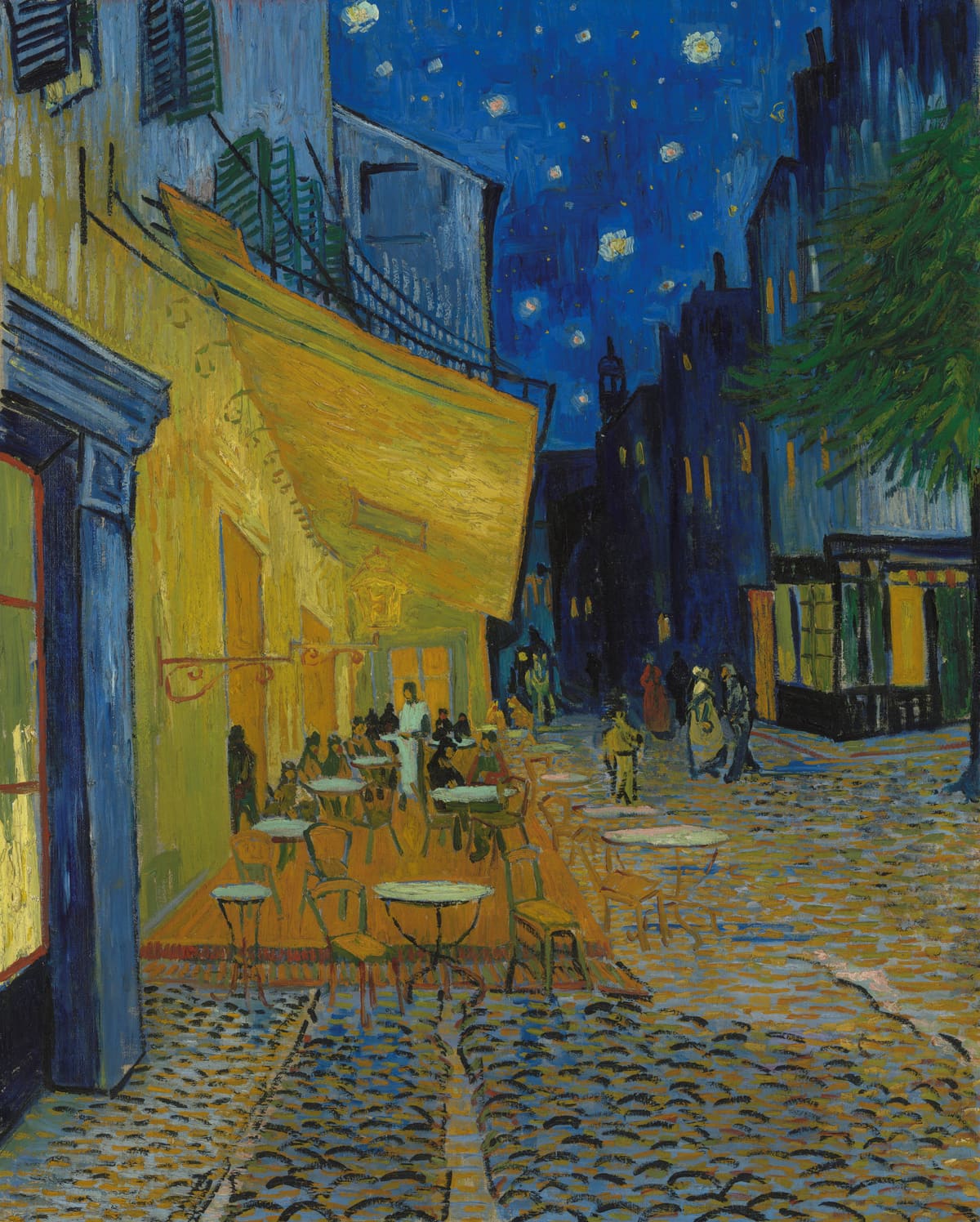
Café Terrace at Night
1888
The first of the 1888 night scenes, painted a few weeks earlier on the Place du Forum.

The Starry Night
1889
The Saint-Rémy picture of June 1889 — a starry sky again, but imagined rather than observed.

The Yellow House
1888
The house on the Place Lamartine, a few minutes from this stretch of the river.
More by Vincent van Gogh
Café Terrace at Night
The Church at Auvers
Agostina Segatori Sitting in the Café du Tambourin
