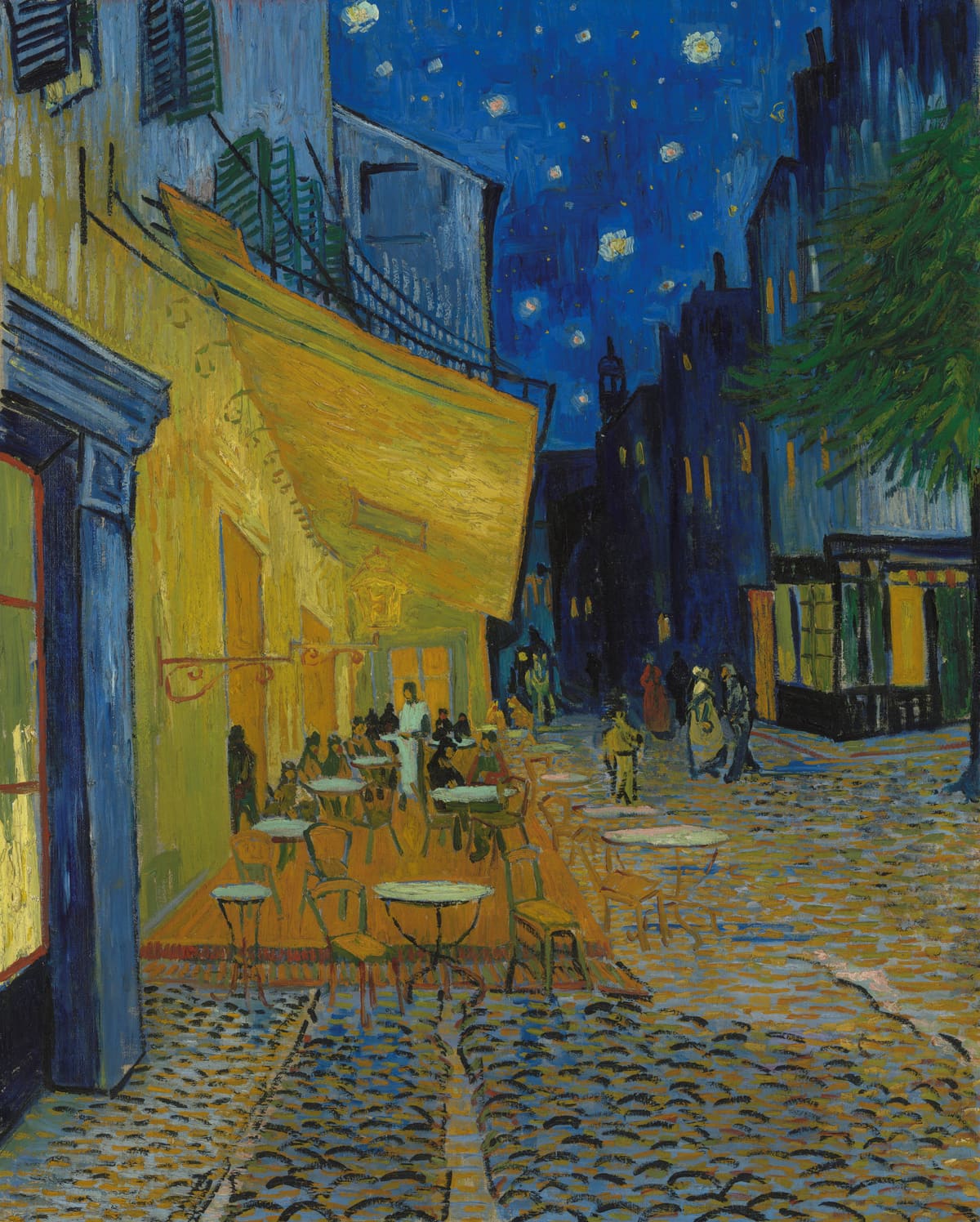
Café Terrace at Night
The café Van Gogh painted on the Place du Forum in Arles, on the spot, after dark — and it still stands.
Place du Forum, Arles (cafe terrace, NE corner)
This is a documented exact viewpoint — you can stand roughly where the artist stood and look at the same scene.
Café Terrace at Night — at a glance
- Artist
- Vincent van Gogh (1853–1890)
- Year
- 1888 · painted early–mid September
- Movement
- Post-Impressionism
- Place
- Place du Forum, Arles, France
- Viewpoint
- Café terrace, north-east corner — documented viewpoint, still standable
- Medium
- Oil on canvas
- Dimensions
- 80.7 × 65.3 cm (upright)
- Now at
- Kröller-Müller Museum, Otterlo (inv. KM 108.565)
Overview
Café Terrace at Night is an oil painting Vincent van Gogh made in Arles, in the south of France, in the second week of September 1888. It shows the lamplit terrace of a café on the Place du Forum under a deep blue sky full of stars, with a street of shuttered houses running back on the right. It is the first painting in which Van Gogh took on a night scene out of doors, and the first in which he built a whole picture around artificial light rather than daylight.
The canvas is unsigned. Van Gogh mentioned it in three surviving letters but never gave it a settled title; it was first shown in 1891, after his death, as Café, le soir (“Café, in the evening”). It is a fairly small upright canvas, 80.7 by 65.3 cm, and it has belonged to the Kröller-Müller Museum in Otterlo, in the Netherlands, since the museum opened in 1938.
“A painting of night without black. With nothing but beautiful blue, violet and green, and in these surroundings the lighted square is coloured pale sulphur, lemon green.”
The story behind the painting
Van Gogh had come to Arles in February 1888 chasing stronger light and colour, and by the late summer he was renting the Yellow House on the Place Lamartine and hoping to make it a “studio of the South” with Paul Gauguin, who arrived that October. September 1888 was one of the most productive months of his life.
Artist's own account He had wanted for months to paint the night. He told his brother Theo and the painter Émile Bernard that he meant to tackle a starry sky, and he had been struck by a passage in Guy de Maupassant's novel Bel-Ami describing a starry Paris night with brightly lit cafés. What he kept picturing was a night sky combined with a group of living figures.
Artist's own account In a letter to his sister Willemien of 9 and about 14 September 1888 he described the finished café picture and said he had made it in front of the motif, at night: “I enormously enjoy painting on the spot at night.” He explained that he worked after dark on purpose, because colours look different by gaslight than they do by day.
Within the same few weeks he also painted the indoor night scene The Night Café, and a little later Starry Night over the Rhône; the run of 1888 night pictures leads on to The Starry Night the following June. At the end of September he wrote to Theo that he still hoped to paint the stars with a group of figures in the picture — the idea he had carried for a year.
Where was Café Terrace at Night painted?
The café was the Grand Café du Forum, on the north-east corner of the Place du Forum in the centre of Arles. Van Gogh set up at that corner and looked roughly south-west across the square, so the terrace and its awning fill the left of the canvas while a street opens back on the right.
Scholarship Two independent kinds of evidence tie the picture to that exact spot. Van Gogh names “the place du Forum” in the letter to Willemien. And the stars he painted match the real sky above the square: forensic-astronomy studies (see “The stars, and the astronomy” below) reconstruct the view as looking south-west on a night in the middle of September 1888.
The building still stands. Its ground floor has for decades been painted the bright yellow of the picture and run as a tourist café (latterly as “Le Café La Nuit” / “Café Van Gogh”), and the terrace was rebuilt in 1990–91 to resemble the painting. The square is otherwise little changed; the two Roman columns embedded in the façade of the Hôtel Nord-Pinus, just off the right edge of the canvas, are still there. The café's operating status has varied in recent years, so it is worth checking before a visit.
How we know
- The cafe building on Place du Forum still stands and is repainted in the picture's yellow ('Le Cafe La Nuit'); van Gogh's standpoint on the square is documented. A well-known then-and-now spot.
- The stars in the picture have been matched to the real sky over the Place du Forum on 16–17 September 1888. — Donald W. Olson, Celestial Sleuth (2014) — reconstruction of the Arles sky
What is in the painting?
A broad awning is stretched over the terrace, glowing yellow and orange from lamps beneath it. Under it stand rows of small round café tables and chairs, with a figure in pale clothes — a waiter or the proprietor — among them near the doorway, and customers seated along the café wall. Out in the darker middle of the square are a few small figures and a horse-drawn cart; one person is walking away into the mouth of the street.
The cobbles of the square are laid in with strokes that fan out towards the viewer, pulling the eye in. On the right, a street of tall shuttered houses recedes, with a single upper window lit; a leafy tree branch reaches in from the top-right corner. Above the rooftops the sky is deep blue and carries stars of several sizes, each a dab of pale yellow, several ringed with a faint halo. Nowhere in the picture is there any black.
Look closely
The lit terrace
A broad awning glows yellow and orange from lamps beneath it. A figure in pale clothes — a waiter or the proprietor — stands among the tables near the doorway.
Tables and figures
Small round café tables run along the wall with customers seated at them; a few more figures are scattered out in the square.
The cobbled square
The paving is laid in with brushstrokes that fan outwards towards the viewer, pulling the eye into the picture.
The horse and cart
Out in the darker middle distance a horse-drawn cart waits; one person is walking away into the mouth of the street.
The dark houses
On the right a street of tall shuttered houses recedes, with a single upper window lit.
The star-filled sky
Deep blue, carrying stars of several sizes — each a warm dab of pale yellow, several ringed with a faint halo.
No black anywhere
Even the deepest shadow is blue, violet or green. There is no black paint in the picture.
Details that are easy to miss. The tree branch pushing in from the top-right corner; the faint haloes around several of the stars; the lone figure walking away up the street; the one lit upper window down the row of houses; the way the cobblestone strokes fan towards you to draw you into the square; and the fact that there is genuinely no black anywhere in the picture, even in the deepest shadow. The Roman columns of the Hôtel Nord-Pinus are just outside the frame on the right.
Analysis
Composition & perspective
One-point perspective funnels the whole scene toward a vanishing point down the street on the right.
Scholarship The canvas is a tall upright. It is built on a single-point perspective: the front edge of the terrace, the line of the awning, the rows of tables, the kerb and the fanned cobblestones all run back towards a vanishing point low on the right, down the street. The awning forms a broad diagonal wedge that anchors the left half of the picture; the street draws the eye back and down, and then the field of stars lifts it again. The lit terrace and the dark square read as two roughly balanced masses.
Colour and light
Van Gogh built the entire night out of colour, using no black at all.
Artist's own account Van Gogh set out to paint darkness in full colour rather than in tones of grey and black. To Willemien he called it “a painting of night without black. With nothing but beautiful blue, violet and green, and in these surroundings the lighted square is coloured pale sulphur, lemon green.”
Museum interpretation The Kröller-Müller Museum describes the finished effect as a sharp contrast between the warm yellow, green and orange under the awning and the deep blue of the starry sky, and notes Van Gogh's idea that a mass of gaslight — itself yellow and orange — makes the surrounding blue look more intense. The stars are warm dots against the cool sky, some with haloes.
Handling and technique
It was painted wet-in-wet over a few evenings on the spot, with directional strokes shaping every area.
It is oil on canvas, worked wet into wet and largely in one campaign of evenings on the spot. Directional brushwork organises nearly every area of the picture: the cobbles radiate towards the viewer, the house-fronts are drawn in verticals, and the stars are laid on as thick separate touches that stand slightly proud of the sky.
The stars, and the astronomy
The stars are real and have been matched to the sky over Arles on the night of 16–17 September 1888.
Scholarship Van Gogh painted particular stars, not a decorative scatter, and astronomers have tried to match them to the real sky over Arles. Albert Boime and later writers identified the group as the constellation Aquarius, low in the south-west, which would place the scene at around 11 p.m. in early-to-mid September 1888.
Scholarship The forensic astronomer Donald Olson and colleagues, who have re-dated several of Van Gogh's night scenes from their skies, concluded that the constellations are shown as they actually appeared on the night of 16–17 September 1888 — which is why the museum now dates the painting to about 16 September 1888. The astrophysicist Jean-Pierre Luminet has published a similar reading. Unlike Starry Night over the Rhône, where the Plough is placed loosely, the Café Terrace sky stays close to observed fact.
Meaning and interpretation
Interpretations differ. What the artist documented, what museums and scholars propose, and later or speculative theories are marked and kept separate.
Painting the night in colour
Van Gogh's own letters present the picture as a technical and sensory adventure — painting the night in colour, in front of the motif — rather than as a message. He attaches no symbolic or religious meaning to it in any of the three letters that mention it.
Warmth against the night
The usual reading, reflected in museum and general accounts, is about warmth and human company: a bright, sociable pool of light and people set against a vast cool night. This is an interpretation of mood, not a documented intention.
The ‘Last Supper’ theory
A separate theory, put forward by the independent researcher Jared Baxter in a 2013 conference paper, proposes that Van Gogh encoded a Last Supper in the scene — a central pale-clad server among about twelve figures, a cross-shaped window frame, a background cross — on the basis of his religious upbringing and reading that year. No surviving letter mentions any such intention, and neither the Kröller-Müller Museum nor mainstream Van Gogh scholarship endorses it. It should be treated as a later speculative interpretation, not an established meaning.
History & provenance
- Sept 1888Painted in Arles; described by Van Gogh in three letters, left unsigned.
- 1890Stays with the Van Gogh family after the artist's death; then enters the early art market.
- First shown 1891Exhibited after his death as Café, le soir (“Café, in the evening”).
- Early 1900sAcquired by the Dutch collector Helene Kröller-Müller.
- 1938Kröller-Müller Museum opens at Otterlo; the painting is among its centrepieces (inv. KM 108.565).
- TodayOn view at Otterlo, travelling occasionally for loan exhibitions.
Helene Kröller-Müller was one of the earliest and largest collectors of Van Gogh, and this canvas became a centrepiece of the museum she founded in the Hoge Veluwe national park. It is catalogued there as inv. KM 108.565, and in the standard Van Gogh catalogues as F467 (de la Faille) and JH1580 (Hulsker).
Featured in Famous Painting Locations: 13 Real Places You Can Visit
Research Included in the Painting Location Precision Study
Sources
- Kröller-Müller Museum, Otterlo — collection entry for ‘Caféterras bij nacht (Place du Forum) / Terrace of a Café at Night’, inv. KM 108.565 (dated c. 16 September 1888; oil on canvas, 80.7 × 65.3 cm)
- Vincent van Gogh, letter 678 to Willemien van Gogh, Arles, 9 and about 14 September 1888 — in Vincent van Gogh: The Letters (Van Gogh Museum / Huygens ING), vangoghletters.org
- Vincent van Gogh, letters to Theo van Gogh and to Eugène Boch, September–October 1888 (same edition) — references to painting the stars and to a night scene with figures
- Van Gogh Museum, Amsterdam — ‘Where is Terrace of a Café at Night?’ and related collection resources
- Albert Boime, ‘Van Gogh’s Starry Night: A History of Matter and a Matter of History’, Arts Magazine (1984) — identification of the stars as Aquarius and the resulting time of night
- Donald W. Olson, Celestial Sleuth (2014) and related studies by the Texas State University group — reconstruction of the Arles sky and the 16–17 September 1888 dating
- Jean-Pierre Luminet, ‘The Starry Nights of Vincent van Gogh’ (2019) — astronomical reading of the Café Terrace sky
- Jared Baxter, ‘Van Gogh’s Café Terrace at Night: a religious reading’ (2013 conference paper) — cited only as the origin of the speculative ‘Last Supper’ interpretation
- J.-B. de la Faille, The Works of Vincent van Gogh (F467); J. Hulsker, The Complete Van Gogh (JH1580)
Frequently asked
Where was Café Terrace at Night painted?
On the north-east corner of the Place du Forum in the centre of Arles, in the south of France. Van Gogh set up his easel at that corner and looked roughly south-west across the square, painting outdoors, on the spot, after dark.
Is the café still there?
Yes. The building on the corner of the Place du Forum still stands, and its ground floor has for decades been painted the bright yellow of the picture. The terrace was rebuilt in 1990–91 to resemble the painting.
Can you visit the location today?
You can stand on the exact corner Van Gogh painted from; the square is otherwise little changed, and the Roman columns of the Hôtel Nord-Pinus are just off the right edge of the picture. The café itself has traded under names such as “Le Café La Nuit” and “Café Van Gogh”, but its opening status has varied in recent years, so check before travelling.
Did Van Gogh paint it at night?
Yes. He wrote to his sister Willemien that he greatly enjoyed “painting on the spot at night”, and the Kröller-Müller Museum confirms he worked in front of the motif in the dark, because colours look different by gaslight than by day.
Why did Van Gogh use so much yellow and blue?
He set out to paint the night in colour rather than in black and grey. To Willemien he called it “a painting of night without black”. The Kröller-Müller Museum notes his idea that a mass of gaslight — itself yellow and orange — makes the surrounding blue look more intense, so the warm terrace and the deep blue sky push against each other.
Are the stars accurate?
Yes — Van Gogh painted specific stars, not a decorative scatter. Forensic-astronomy studies (Boime; Donald Olson's group; Jean-Pierre Luminet) match them to the sky above the Place du Forum on the night of 16–17 September 1888, with the constellation usually identified as Aquarius. Unlike Starry Night over the Rhône, the Café Terrace sky stays close to observed fact.
What does Café Terrace at Night mean?
Van Gogh's letters frame it as a technical and sensory adventure — painting the night in colour, on the spot — not as a message, and he attaches no symbolic meaning to it. The common reading, about warmth and human company set against a vast cool night, is an interpretation of mood rather than a documented intention. A 2013 theory that the scene encodes a Last Supper is a later speculative idea that no letter supports and that the museum and mainstream scholarship do not accept.
Is the painting signed?
No, it is unsigned. It is identified from Van Gogh's letters, which describe it three times.
How big is Café Terrace at Night?
It is oil on canvas, 80.7 by 65.3 cm — a fairly small upright picture.
Where is the original painting today?
In the Kröller-Müller Museum in Otterlo, in the Netherlands, where it has been since the museum opened in 1938 (inventory KM 108.565). It travels occasionally for loan exhibitions.
Related paintings

The Night Café
1888
The indoor counterpart — the all-night café where he lodged, painted a week or two earlier for its harsh artificial colour.

Starry Night Over the Rhone
1888
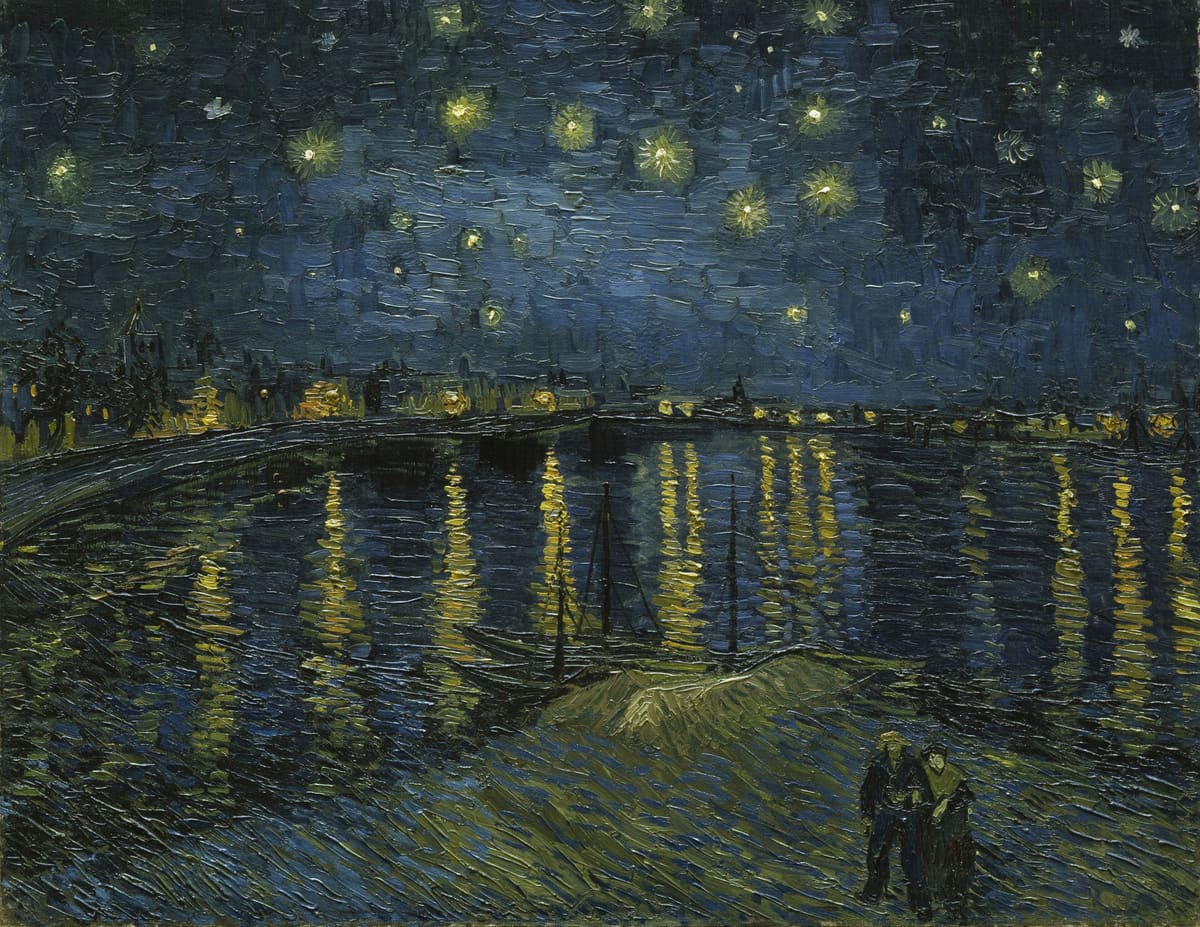
Later in September 1888 — the same night-in-colour idea, this time gaslight reflected in the river.

The Starry Night
1889
A year later, from the asylum at Saint-Rémy — painted from memory and imagination, not on the spot.
More by Vincent van Gogh
The Church at Auvers
Starry Night Over the Rhone
Agostina Segatori Sitting in the Café du Tambourin
