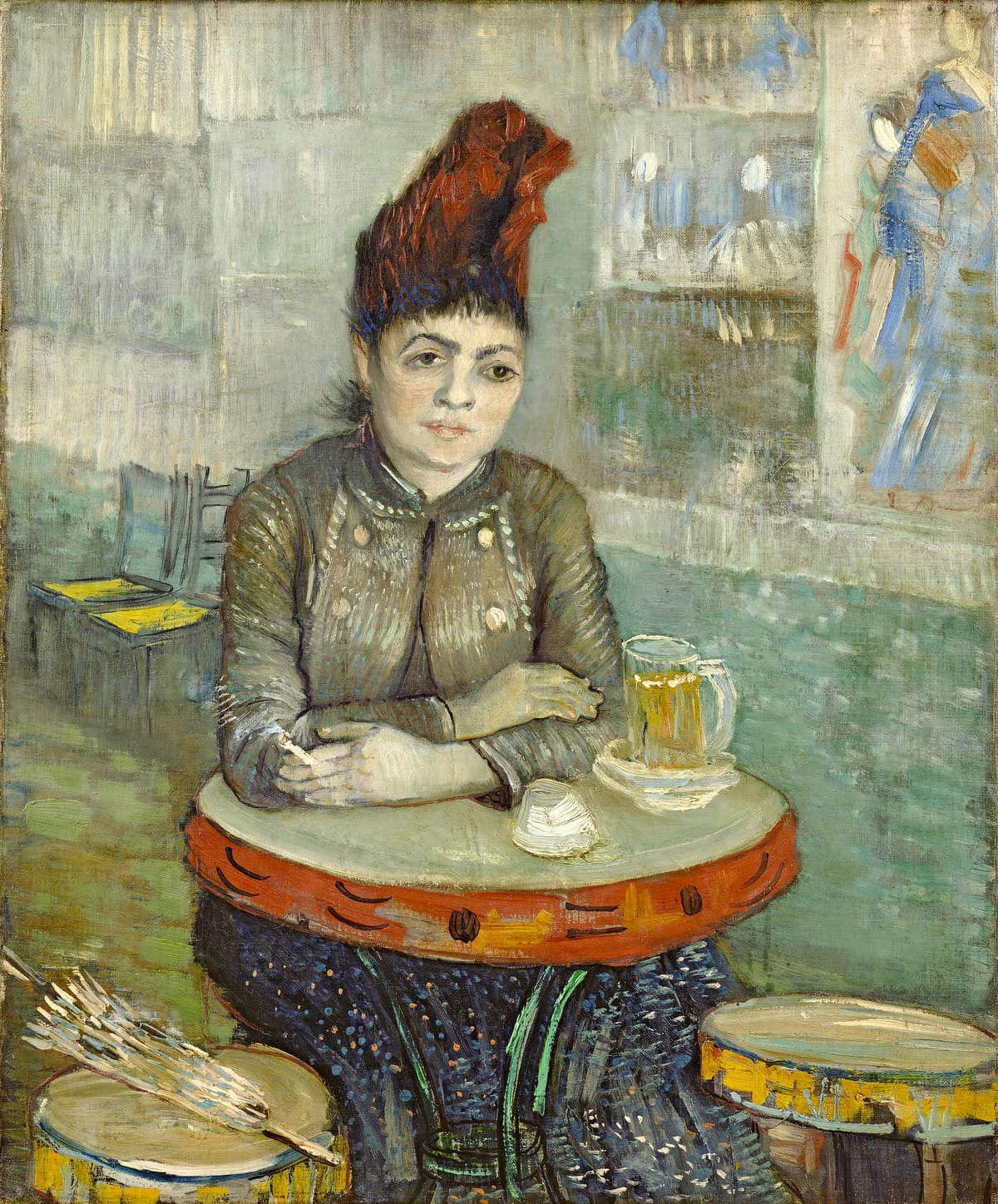
Agostina Segatori Sitting in the Café du Tambourin
A café on the boulevard de Clichy that Van Gogh hung with Japanese prints — and its owner, with whom he briefly had a relationship.
Café du Tambourin
The painting shows a real, identified place that you can find today. The exact spot the artist worked from is not necessarily known.
Agostina Segatori Sitting in the Café du Tambourin — at a glance
- Artist
- Vincent van Gogh (1853–1890)
- Year
- 1887
- Movement
- Post-Impressionism
- Place
- Café du Tambourin, 62 boulevard de Clichy, Paris 18e
- Viewpoint
- Inside the café — the establishment closed and no longer exists
- Medium
- Oil on canvas
- Dimensions
- c. 55 × 47 cm
- Now at
- Van Gogh Museum, Amsterdam
Overview
This is a portrait Vincent van Gogh painted in Paris in early 1887, during the two years he spent living with his brother Theo. It shows a woman sitting alone at a café table with a glass of beer and a cigarette, in front of a wall of framed prints. It is oil on canvas, about 55 by 47 cm, and it hangs in the Van Gogh Museum, Amsterdam.
The woman is Agostina Segatori, an Italian former artists' model who ran the café, and the setting is a real Paris establishment that has since disappeared.
The story behind the painting
Agostina Segatori had modelled for painters including Corot and Gérôme before opening the Café du Tambourin, a Montmartre café whose tables and stools were shaped like tambourines.
Scholarship Van Gogh, then absorbed in Japanese woodblock prints, arranged an exhibition of prints on the café's walls in early 1887, and for a few months he and Segatori were involved. The relationship and the print show both ended badly, and the café closed not long after.
Where was Agostina Segatori Sitting in the Café du Tambourin painted?
The Café du Tambourin stood at 62 boulevard de Clichy, at the foot of Montmartre in Paris.
Museum interpretation It closed within a couple of years of the painting and no longer exists; the boulevard de Clichy remains, still lined with cafés and nightspots. The framed pictures on the wall behind Segatori are the Japanese prints Van Gogh had put up there.
What is in the painting?
A woman in a dark dress and a broad plumed hat sits at a small round table, elbow resting on it, a tall glass of beer in front of her and a cigarette between her fingers. Her gaze is lowered and her expression is tired and shut off.
The table is shaped like a tambourine, with jingles around the rim. Behind her, a wall hung with framed prints and a strip of decorative border.
Look closely
The tambourine table
The round table is a real tambourine, jingles and all — the café's theme, which also gave it its name.
The prints on the wall
Framed Japanese woodblock prints — the exhibition Van Gogh mounted at the café in 1887.
The cigarette
She holds a lit cigarette, an unusual note for a woman in a picture of the period.
The glass of beer
Not absinthe: the drink at her table is beer, distinguishing it from Degas's café scene.
The closed-off face
Her eyes are lowered and her expression withdrawn, boxed in by the table and the prints.
Details that are easy to miss. The table is a tambourine, complete with jingles around the edge — the café's theme; the framed pictures behind the sitter are the Japanese prints Van Gogh exhibited there; she holds a lit cigarette, unusual for a woman in a picture of the period; and the glass in front of her is beer, not the absinthe of Degas's famous café scene.
Analysis
Composition & perspective
The sitter is pushed close to the picture plane and boxed in by the round table in front and the grid of framed prints behind.
Scholarship Van Gogh sets Segatori almost frontally, cropped at the waist, with the tambourine-table cutting across the foreground and the framed prints forming a flat pattern behind her head. She is hemmed in on both sides — a composition that reinforces her withdrawn, cornered air.
Colour and light
Warm café yellows and reds against the dark of the sitter's dress, worked in the small separate strokes Van Gogh had picked up in Paris.
Scholarship The wall and table are laid in warm yellows, ochres and reds; the woman's dress and hat are dark. The paint is applied in short, divided touches — the influence of the Neo-Impressionists and of Van Gogh's Paris friends — brighter and more broken than his Dutch work.
Handling and technique
Loose, stippled brushwork over a light ground — a Paris experiment in colour and touch.
The handling shows Van Gogh trying out the divided stroke and heightened palette he encountered in Paris through Signac, Bernard and others, on his way to the fuller manner of Arles.
Meaning and interpretation
Interpretations differ. What the artist documented, what museums and scholars propose, and later or speculative theories are marked and kept separate.
A portrait, a place and a relationship
The picture works on several levels at once: a portrait of a specific woman, a record of a real café and its tambourine furniture, and a document of Van Gogh's brief involvement with the sitter and of his campaign to promote Japanese prints in Paris.
Echoes of Degas
The lone woman with a drink at a café table recalls Degas's and Manet's café scenes of the 1870s, and the picture is often read as Van Gogh's contribution to that modern-life subject.
History & provenance
- early 1887Painted in Paris; Van Gogh also mounts a Japanese-print show at the café.
- c. 1888The Café du Tambourin closes.
- 20th c.Kept by the Van Gogh family.
- 1962Enters the Van Gogh Museum collection.
The portrait stayed with the Van Gogh family and is now in the Van Gogh Museum, Amsterdam.
Sources
- Van Gogh Museum, Amsterdam — collection entry for ‘Agostina Segatori in the Café du Tambourin’ (oil on canvas, c. 55 × 47 cm)
- Van Gogh Museum — resources on Van Gogh's Paris years and his Japanese-print exhibitions
- Bregje Gerritse & Nienke Bakker (eds.), Van Gogh Museum catalogues of the Paris period
Frequently asked
Where was the Café du Tambourin?
At 62 boulevard de Clichy, at the foot of Montmartre in Paris. It was named for its tambourine-shaped tables and stools.
Can you visit it?
No. The café closed within a couple of years of the painting and no longer exists. The boulevard de Clichy is still there and still full of cafés and nightspots.
Who is the woman?
Agostina Segatori, an Italian former artists' model — she had posed for Corot and others — who ran the café. She and Van Gogh were briefly involved in 1887.
What are the pictures on the wall?
Japanese woodblock prints. Van Gogh, then deep in the study of Japanese art, organised an exhibition of prints on the café's walls in early 1887.
What is she drinking?
Beer. The lone woman with a drink at a café table recalls Degas's ‘L'Absinthe,’ but the glass here is beer, not absinthe.
Where is the painting now?
In the Van Gogh Museum, Amsterdam.
Related paintings


More by Vincent van Gogh
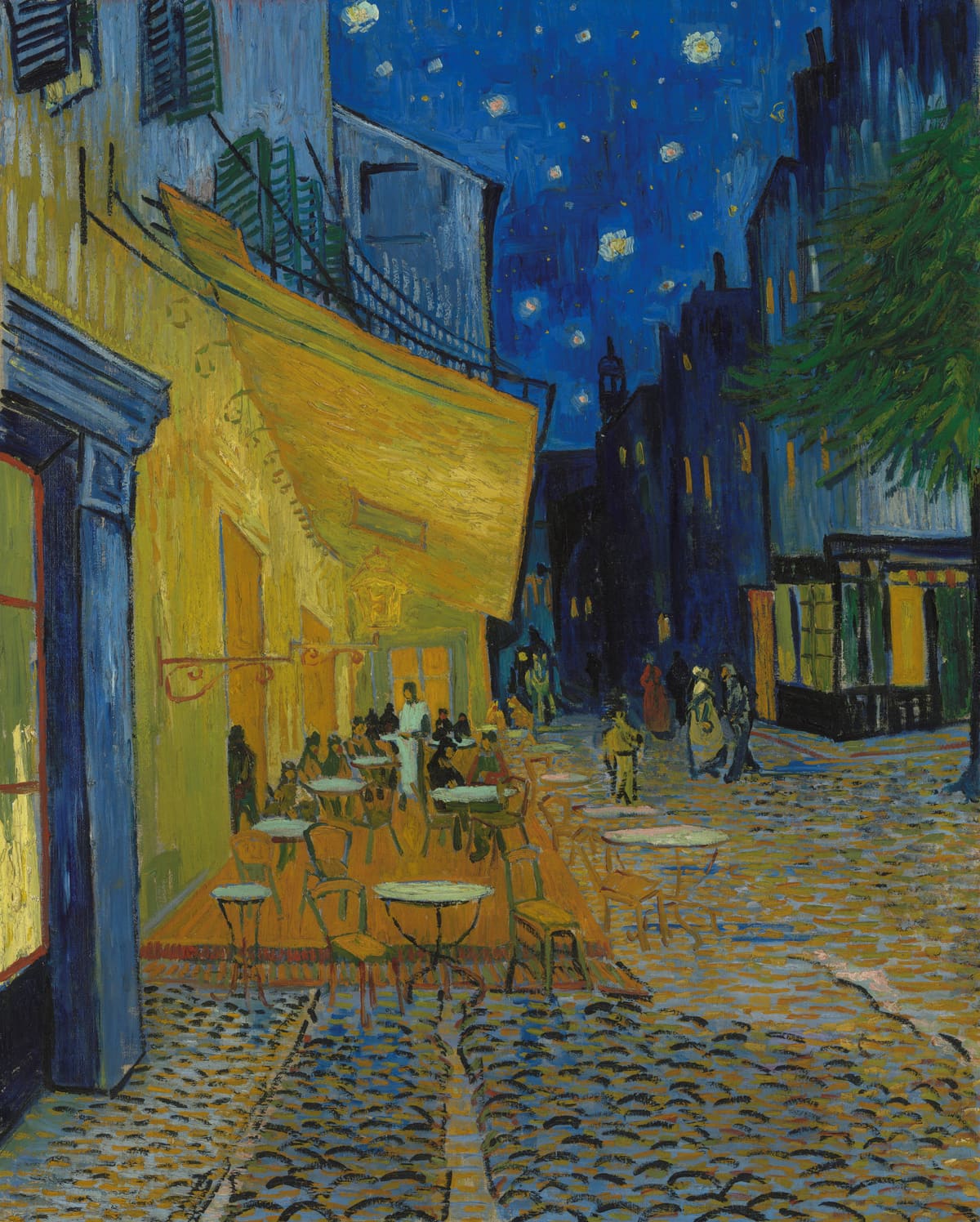
Café Terrace at Night
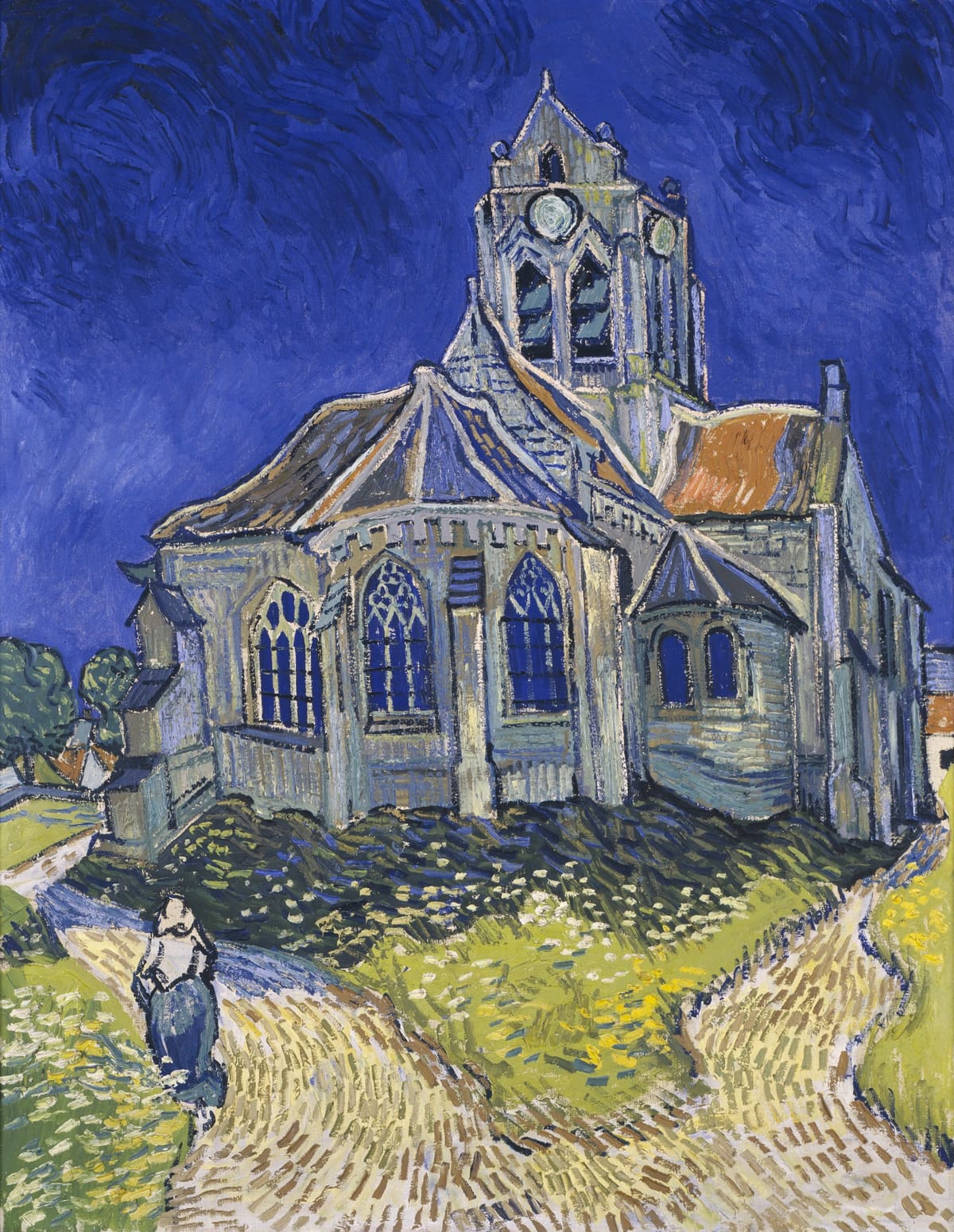
The Church at Auvers
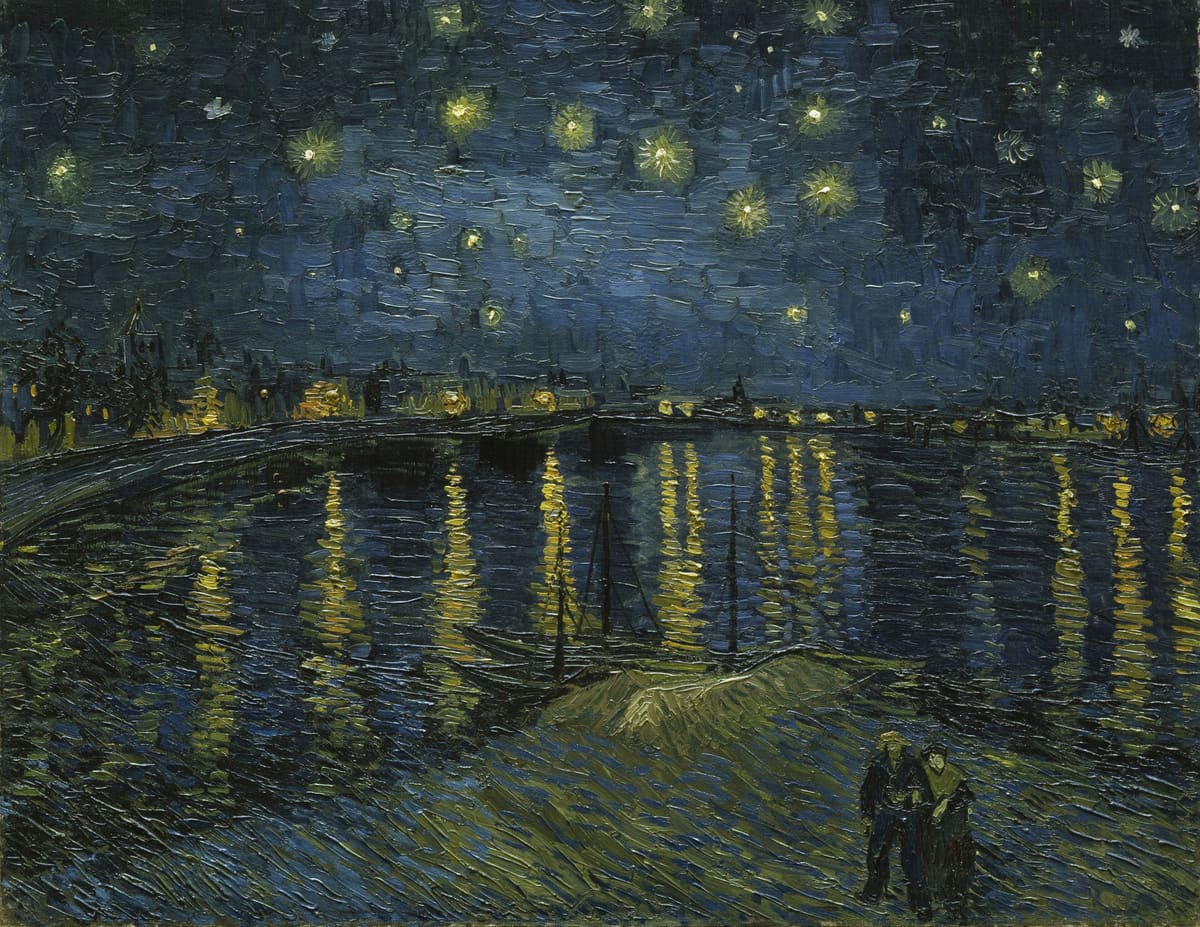
Starry Night Over the Rhone
