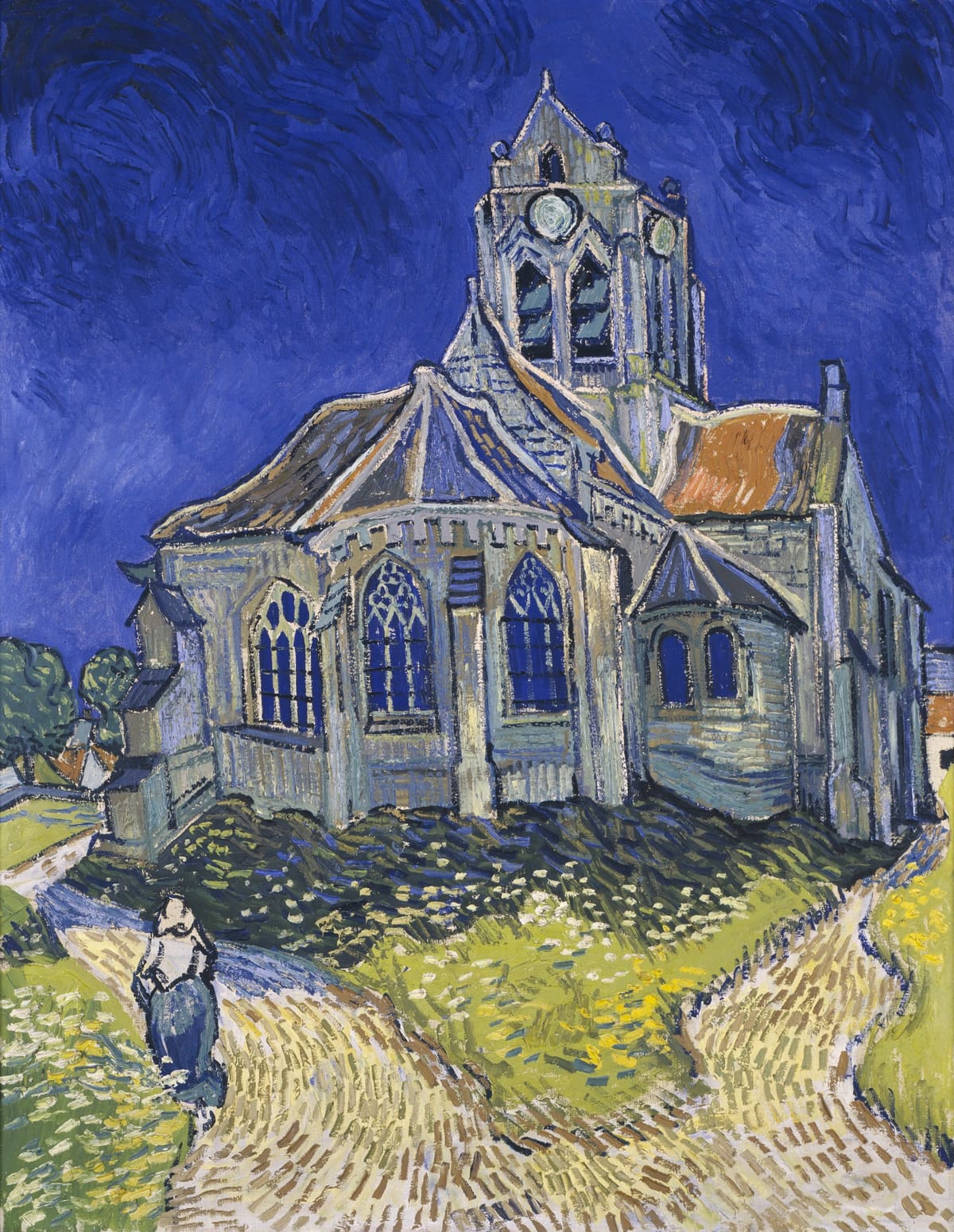
The Church at Auvers
The Gothic parish church of Auvers-sur-Oise, painted from the lane behind it in Van Gogh's last weeks — and still standing.
Notre-Dame d'Auvers-sur-Oise, from the Rue Daubigny
This is a documented exact viewpoint — you can stand roughly where the artist stood and look at the same scene.
The Church at Auvers — at a glance
- Artist
- Vincent van Gogh (1853–1890)
- Year
- June 1890
- Movement
- Post-Impressionism
- Place
- Auvers-sur-Oise, France
- Viewpoint
- The lane north of the church (Rue Daubigny) — documented, standable
- Medium
- Oil on canvas
- Dimensions
- c. 93 × 74 cm (upright)
- Now at
- Musée d'Orsay, Paris
Overview
The Church at Auvers is an oil painting Vincent van Gogh made in the first week of June 1890, during the last two months of his life. He had left the asylum at Saint-Rémy in May and settled at Auvers-sur-Oise, a village north of Paris, under the loose care of Dr Paul Gachet. The picture shows the village's medieval parish church seen from the lane behind it. It is oil on canvas, about 93 by 74 cm, and it hangs in the Musée d'Orsay, Paris.
It is one of a run of large, fast canvases Van Gogh made at Auvers. He described it to his sister Willemien in a letter of about 5 June 1890.
“It's almost the same thing as the studies I did in Nuenen of the old tower and the cemetery, only now the colour is probably more expressive, more sumptuous.”
The story behind the painting
Van Gogh arrived at Auvers on 20 May 1890 and threw himself into work — roughly one canvas a day through June and July. Auvers was a painters' village; Daubigny had lived there and Pissarro nearby, and Dr Gachet was himself an amateur etcher.
Artist's own account Writing to Willemien, Van Gogh set the church picture beside work he had done years earlier in the Netherlands — studies of the old church tower and cemetery at Nuenen — and said the difference now was that the colour had become “more expressive, more sumptuous.” He noted the building standing violet against a sky of simple deep blue, the windows like patches of ultramarine, the roof violet with touches of orange, and a woman on the path in the foreground.
Where was The Church at Auvers painted?
The church is Notre-Dame-de-l'Assomption, a 12th- and 13th-century Gothic building on a low rise at the edge of Auvers. Van Gogh painted it from the north — from the lane (today the Rue Daubigny) that climbs past the chevet, the rounded east end — so the apse and its ring of chapels bulge towards the viewer and the bell tower stands behind.
Museum interpretation The church is essentially unchanged. The fork in the path where the small figure walks is still there, and the spot is a short walk uphill from the Auberge Ravoux, the inn where Van Gogh lodged and died. Auvers has marked the Van Gogh sites through the village.
How we know
- The church stands unchanged; van Gogh's spot on the road just NE of the apse is a signed 'sur les pas de van Gogh' marker. Textbook then-and-now.
What is in the painting?
The Gothic church fills almost the whole canvas, its apse and twin side-chapels pushed towards the viewer, the roofs a churning blue. The stonework leans and buckles; the two lancet windows glow a deep blue as though lit from within, even though it is daytime and there is no door in view on this side.
A path runs up from the foreground and forks around the building; a single woman in a white cap and blue skirt walks the left branch, her back to us. The foreground earth is a warm pink; the sky above the roof is an even, saturated blue with no clouds.
Look closely
The chevet
The rounded east end and its ring of chapels bulge towards the viewer — the side of the church with no door.
The blue windows
The lancet windows glow a solid ultramarine, lit but blank, though it is daytime.
The forking path
The lane splits around the church; a village woman in a white cap walks the left branch, her back to us.
The pink earth
The foreground ground is laid in a warm pink, set against the strong green of the grass.
The leaning walls
The stonework and roof-lines curve and tilt, so the heavy building seems to sway.
Details that are easy to miss. The church has no door on the side we see; the windows are solid blue, lit but impenetrable; the tower is cut by the top of the canvas; the single figure on the left-hand path is a village woman in Auvers dress; and the sky, though a deep evening blue, carries no star or moon — it is daylight.
Analysis
Composition & perspective
The church is pushed up hard against the picture plane and tipped off true, so the solid building seems to sway.
Scholarship Van Gogh sets the chevet almost frontally and very close, cropping the tower at the top edge. The verticals lean, the roof-lines curve, and the whole mass reads as slightly unstable. The forking path pulls the eye up and around the building; the lone figure gives the scale.
Colour and light
A violet-blue church sits against a flat, cloudless deep-blue sky, over pink earth and green grass — near-complementary contrasts throughout.
Artist's own account As he told Willemien, the building is violet against pure deep blue, the windows ultramarine, the roof violet with orange. The grass is a strong green, the path pink. There is no soft transitional light: the colour is laid on in blocks and the shadows are coloured, not grey.
Handling and technique
Thick, fast, directional strokes — curling in the roofs and sky, straight in the path — worked wet into wet.
The canvas was painted quickly, in the double-square format Van Gogh used repeatedly at Auvers. The brushwork is heavily loaded and follows the forms; the sky is worked in long horizontal strokes, the roofs and ground in restless curves.
Meaning and interpretation
Interpretations differ. What the artist documented, what museums and scholars propose, and later or speculative theories are marked and kept separate.
What Van Gogh said
In his letter Van Gogh describes the picture in purely visual terms — colour, the building against the sky, the figure on the path — and links it to his earlier church studies. He does not give it a symbolic reading.
A closed church
Many writers have noted that the church is shown with no visible entrance, its windows glowing but blank, the sky behind it a daytime blue while the building seems to cast its own dusk. Read against Van Gogh's break from his father's church and his troubled last months, this has been taken as a picture of faith that offers no way in. It is an interpretation of mood, not a documented intention.
History & provenance
- June 1890Painted at Auvers-sur-Oise; described in a letter to Willemien van Gogh.
- 29 July 1890Van Gogh dies at the Auberge Ravoux in Auvers.
- 20th c.Enters the collection of Dr Gachet's son, Paul Gachet fils.
- 1951Given to the French state through the Gachet gift.
- TodayMusée d'Orsay, Paris.
The painting passed to Dr Gachet's son, Paul, and was among the group of Van Goghs the Gachet family gave to the French national collection in 1951. It is now one of the most-visited Van Goghs in the Musée d'Orsay.
Featured in Famous Painting Locations: 13 Real Places You Can Visit
Research Included in the Painting Location Precision Study
Sources
- Musée d'Orsay, Paris — collection entry for ‘L'église d'Auvers-sur-Oise, vue du chevet’ (RF 1951-42; oil on canvas, c. 93 × 74.5 cm)
- Vincent van Gogh: The Letters (Van Gogh Museum / Huygens ING), vangoghletters.org — letter to Willemien van Gogh, Auvers, about 5 June 1890
- Van Gogh Museum, Amsterdam — catalogue and letters resources for the Auvers period
Frequently asked
Where did Van Gogh paint The Church at Auvers from?
From the lane that climbs the north side of the church — today the Rue Daubigny — so the rounded east end, the chevet, faces the viewer with the bell tower behind.
Can you visit the church today?
Yes. Notre-Dame-de-l'Assomption in Auvers-sur-Oise is essentially unchanged, the forking path is still there, and it is a short walk uphill from the Auberge Ravoux where Van Gogh lodged.
When did Van Gogh paint it?
In the first week of June 1890, about seven weeks before his death. He described it in a letter to his sister Willemien of around 5 June.
Why does the church look like it is leaning?
Van Gogh set it close to the picture plane and tipped the verticals off true, with curving roof-lines, so that the solid building seems to sway — an expressive distortion, not a fault of drawing.
Is there a hidden meaning in the closed church?
Some scholars read the doorless, blank-windowed church against Van Gogh's break from his father's church and his difficult last months. Van Gogh's own letter describes only colour and composition, so any such reading is interpretation.
Is it day or night in the painting?
Day. The sky is a deep, even blue with no moon or stars; the building simply seems to carry its own shadow.
Where is the painting now?
In the Musée d'Orsay, Paris, which received it through the Gachet family gift of 1951.
Related paintings


More by Vincent van Gogh
Café Terrace at Night
Starry Night Over the Rhone
Agostina Segatori Sitting in the Café du Tambourin
