Wheatfield with Crows
A wheatfield on the plateau above Auvers-sur-Oise, painted in Van Gogh's last weeks — and often misremembered as his final work.
Auvers-sur-Oise
The painting depicts a real landscape or cityscape. The precise viewpoint the artist used may be unknown, so the marker shows the general area.
Wheatfield with Crows — at a glance
- Artist
- Vincent van Gogh (1853–1890)
- Year
- July 1890
- Movement
- Post-Impressionism
- Place
- The plateau above Auvers-sur-Oise, France
- Viewpoint
- The farmed plateau north of the village — a broad, walkable area, not a pinpoint
- Medium
- Oil on canvas
- Dimensions
- c. 50 × 103 cm (double square)
- Now at
- Van Gogh Museum, Amsterdam
Overview
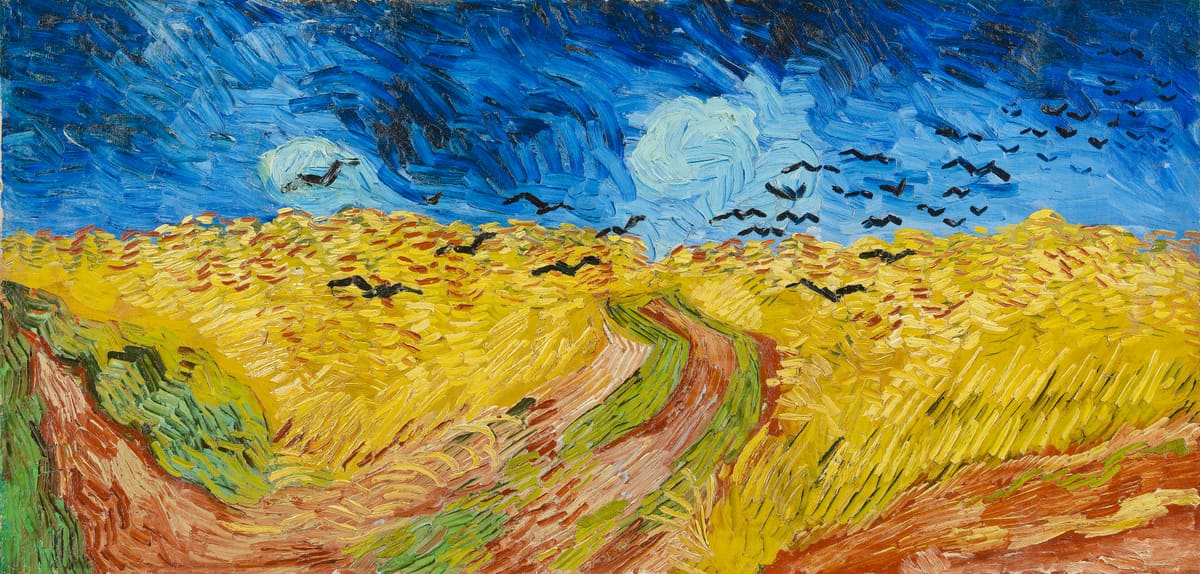
Wheatfield with Crows is one of the double-square canvases Vincent van Gogh made at Auvers-sur-Oise in July 1890, in the last weeks of his life. It shows a wheatfield under a heavy blue-black sky, with tracks running through it and a flock of crows rising. It is oil on canvas, about 50 by 103 cm, and it hangs in the Van Gogh Museum, Amsterdam.
It is often called his final painting. The museum's own research places it among his last works but not the very last — that legend comes largely from a 1950s film.
The story behind the painting
At Auvers, Van Gogh worked at a furious pace — roughly a canvas a day — and made a series of wide, panoramic pictures of the wheatfields on the plateau above the village.
Artist's own account Writing to Theo and Jo, he said these canvases of ‘vast stretches of wheat under troubled skies’ let him express sadness and extreme loneliness — but also, he added, the health and strength he found in the countryside. He hoped the pictures would say what he could not put into words.
Where was Wheatfield with Crows painted?
The field is on the open agricultural plateau north of Auvers-sur-Oise, a short climb from the village and the church.
Museum interpretation The plateau is still farmed and the meeting of tracks Van Gogh used has long been pointed out to visitors on the Auvers Van Gogh trail — though the exact rows of wheat obviously change with the season and the year. It is a broad, walkable stretch of countryside rather than a single pinpoint viewpoint.
What is in the painting?
A field of ripe wheat fills the lower two-thirds of the canvas under a dark, roiling blue sky. Three earth tracks cross it: one curving off to each side and one running straight into the corn from the foreground. Green grass verges the paths.
A scatter of black crows flies across the upper half, over the wheat and towards the viewer.
Look closely
The three tracks
One curves left, one right, and one drives straight into the corn — none with a clear destination.
The crows
A scatter of black birds flies across the sky towards the viewer, against the direction of the paths.
The high horizon
The join of field and sky sits near the top, so the wheat fills most of the canvas.
The storm sky
Deep ultramarine and blue-black, worked in heavy sweeping strokes with no soft light.
The green verges
Bright green grass borders each of the earth paths through the yellow wheat.
Details that are easy to miss. There are three separate tracks, not one — one to each side and one heading straight into the wheat; the crows fly towards the viewer, against the direction of the paths; green grass borders each track; and the horizon is set high, so the field takes up most of the picture.
Analysis
Composition & perspective
A very wide, low format, split between a churning sky and a field cut by three diverging paths that lead nowhere in particular.
Scholarship Van Gogh uses the double-square shape to stretch the horizon. The three tracks fan out from the front — one left, one right, one straight ahead into the wheat — without a clear destination, and the crows fly against them. The sky and the field press towards each other along a high, restless horizon.
Colour and light
Ripe yellow wheat and green paths under an almost black-blue sky — the sharpest possible contrast, with no soft light anywhere.
Scholarship The wheat is worked in strong yellows and orange, the verges in green, against a sky of deep ultramarine and blue-black. There is no gradation: the storm colour of the sky sits hard against the bright field.
Handling and technique
Thick, fast, agitated strokes — the wheat in upward flicks, the sky in heavy sweeps, the crows in short black dashes.
The paint is loaded and urgent, applied in the double-square panoramic format Van Gogh favoured at Auvers for open landscape. The brushwork of the sky and the flight of the birds gives the picture its unsettled energy.
Meaning and interpretation
Interpretations differ. What the artist documented, what museums and scholars propose, and later or speculative theories are marked and kept separate.
What Van Gogh wrote
Van Gogh's letters describe the wheatfield pictures as expressing both loneliness and the restoring force of the countryside. He did not present this canvas as a farewell or a statement about his own death.
The ‘last painting’ legend
The idea that Wheatfield with Crows was Van Gogh's final work, painted just before his death, took hold through the 1956 film ‘Lust for Life.’ The Van Gogh Museum's research shows he made other canvases after it. The reading of the dark sky and the flying crows as a suicide note is later projection, not fact.
History & provenance
- July 1890Painted on the plateau above Auvers-sur-Oise.
- 29 July 1890Van Gogh dies at Auvers.
- 20th c.Kept by the Van Gogh family; passes to the Van Gogh Foundation.
- 1962Enters the Van Gogh Museum collection with the family holdings.
The painting stayed with the Van Gogh family and came to the Van Gogh Museum in Amsterdam with the rest of their holdings; it is one of the museum's most famous works.
Sources
- Van Gogh Museum, Amsterdam — collection entry for ‘Wheatfield with Crows’ (oil on canvas, c. 50 × 103 cm) and its research correcting the ‘last painting’ story
- Vincent van Gogh: The Letters (Van Gogh Museum / Huygens ING), vangoghletters.org — letter to Theo and Jo van Gogh, Auvers, about 10 July 1890
Frequently asked
Where did Van Gogh paint Wheatfield with Crows?
On the open farmed plateau just north of Auvers-sur-Oise, a short climb above the village and its church.
Can you visit the field?
The plateau is still farmed and the fork of tracks Van Gogh used is a stop on the Auvers Van Gogh trail, though the crop and the exact rows change from year to year.
Was this Van Gogh's last painting?
No. It is one of his last works, made in July 1890, but the Van Gogh Museum's research shows he painted other canvases after it. The ‘final painting’ story came largely from the 1956 film ‘Lust for Life.’
Is the dark sky a sign of his suicide?
That reading is later projection. Van Gogh's own letters describe the wheatfield pictures as expressing both loneliness and the healthy, strengthening force of the countryside.
How many paths are there?
Three: one curving off to the left, one to the right, and one running straight into the wheat from the foreground.
Where is the painting now?
In the Van Gogh Museum, Amsterdam.
Related paintings


More by Vincent van Gogh
Café Terrace at Night
The Church at Auvers
Starry Night Over the Rhone
Agostina Segatori Sitting in the Café du Tambourin
Also connected to Auvers-sur-Oise
The Church at Auvers


Doctor Gachet's Garden in Auvers
