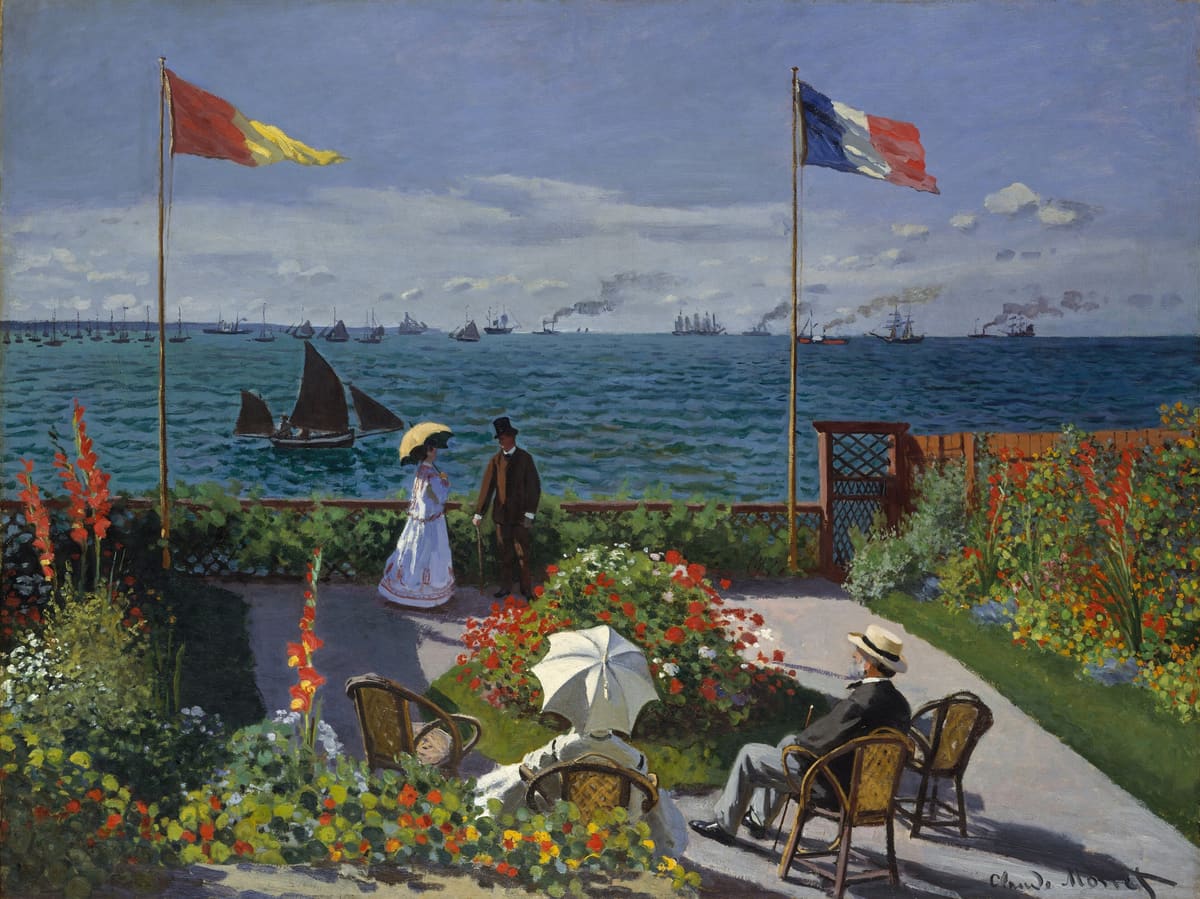
Garden at Sainte-Adresse
A family terrace above the Channel at Sainte-Adresse, next to Le Havre — his father in the foreground, the shipping lanes beyond.
Sainte-Adresse
The painting depicts a real landscape or cityscape. The precise viewpoint the artist used may be unknown, so the marker shows the general area.
Garden at Sainte-Adresse — at a glance
- Artist
- Claude Monet (1840–1926)
- Year
- 1867
- Movement
- Pre-Impressionism
- Place
- Sainte-Adresse, near Le Havre, France
- Viewpoint
- A family terrace over the Channel — coast survives; garden gone
- Medium
- Oil on canvas
- Dimensions
- c. 98 × 130 cm
- Now at
- Metropolitan Museum of Art, New York
Overview
Garden at Sainte-Adresse is a bright, sharply designed painting Claude Monet made in the summer of 1867. It shows a flower-filled seaside terrace, with figures at the railing, looking out over a calm sea busy with sailing boats and steamers. It is oil on canvas, about 98 by 130 cm, and it hangs in the Metropolitan Museum of Art in New York.
Monet was 26, short of money, and staying with relatives; several of the people on the terrace are his own family.
How it was made
Monet spent the summer of 1867 with his aunt at Sainte-Adresse while his companion Camille was pregnant in Paris and his father disapproved. He painted the family's terrace with a hard, flat design he later described, in a letter, as his ‘Chinese painting with flags’ — a nod to the Japanese colour prints he was collecting, and to Hokusai in particular.
The seated man in the pale hat in the foreground is generally taken to be Monet's father, Adolphe.
Where was Garden at Sainte-Adresse painted?
Sainte-Adresse is a seaside town immediately north-west of Le Havre, on the Normandy coast at the mouth of the Seine. The terrace of the family house looked straight out over the approach to the port of Le Havre.
Museum interpretation The coastline and the constant traffic of shipping are still there, and Sainte-Adresse is still a resort. The specific garden and its two flagpoles have gone, so the picture marks a real stretch of coast rather than a fixed, standable viewpoint.
What is in the painting?
A gravel terrace edged with beds of red and yellow flowers — gladioli and nasturtiums — overlooks a level blue sea. Two figures stand at the iron railing; two more, a seated man and a woman with a parasol, sit among the flowers in the foreground.
Two tall flagpoles, one flying a French tricolour, frame the view. Sailing boats, fishing smacks and a steamer with a plume of smoke cross the water; a low headland closes the horizon at the right.
Look closely
Monet's father
The seated man in the pale panama hat in the foreground is generally identified as Adolphe Monet.
The two flagpoles
Tall verticals framing the view; one flies the French tricolour.
The flowerbeds
Scarlet gladioli and orange nasturtiums, painted almost as flat blocks of colour.
The steamer
A steamship trails smoke among the sailing boats and fishing smacks on the calm sea.
The high horizon
The sea meets the sky near the top of the canvas, stacking the scene into flat layers.
Details that are easy to miss. The seated man in the pale hat is thought to be Monet's father, Adolphe; the standing pair at the railing include a woman with a parasol; one of the two flagpoles flies the French tricolour; a steamer trails smoke among the sailing boats; and the flowerbeds are planted with gladioli and nasturtiums, painted almost as flat colour.
Analysis
Composition & perspective
The scene is stacked in three flat, parallel bands — terrace, sea, sky — seen from an unusually high viewpoint.
Scholarship Monet tips the terrace up towards the viewer and lays the three zones one above the other, almost like a Japanese print, with the horizon set very high. The two flagpoles are strong verticals cutting the bands; the diagonal edge of the flowerbed leads the eye back to the railing and the sea.
Colour and light
Clear, high-keyed colour in broad areas — scarlet and gold flowers, a flat blue sea, a pale sky — under bright, even sunlight.
Scholarship The colours are strong and only lightly modelled: the reds of the gladioli, the orange of the nasturtiums, the near-uniform blue of the water. Monet keeps the light flat and the shadows short, so the picture reads as pattern as much as space.
Handling and technique
Smooth, deliberate paint in flat zones — tighter and more designed than Monet's later Impressionist manner.
The handling is crisp and controlled: the flags, the flowers and the boats are drawn firmly, the sea laid in evenly. This is Monet before the broken, feathery touch of the 1870s — a young painter constructing a bold, graphic image.
Meaning and interpretation
Interpretations differ. What the artist documented, what museums and scholars propose, and later or speculative theories are marked and kept separate.
A modern seaside, brightly ordered
The picture is read as a confident early statement: the leisure and traffic of the Normandy coast turned into a clean, decorative design, with Monet's own family taking the sea air.
Japanese prints absorbed
Art historians point to the high viewpoint, the flat bands and the strong verticals of the flagpoles as evidence of how quickly Monet had taken in the compositional lessons of Japanese woodblock prints.
History & provenance
- 1867Painted on the family terrace at Sainte-Adresse.
- 1879Shown at the fourth Impressionist exhibition, as ‘Garden’.
- 20th c.Passes through European and American collections.
- 1967Acquired by the Metropolitan Museum of Art, New York.
The painting entered the Metropolitan Museum of Art in 1967, bought with funds given by friends of the museum; it is one of the earliest Monets in a major American collection.
Sources
- The Metropolitan Museum of Art, New York — collection entry for ‘Garden at Sainte-Adresse’ (purchased 1967; oil on canvas, c. 98 × 130 cm)
- Paul Hayes Tucker, ‘Claude Monet: Life and Art’ (Yale University Press, 1995)
- Claude Monet, letter to Frédéric Bazille, 1867 (the ‘Chinese painting with flags’ remark)
Frequently asked
Where is the terrace in Garden at Sainte-Adresse?
At Sainte-Adresse, a seaside town immediately north-west of Le Havre on the Normandy coast, on the terrace of a house belonging to Monet's family, looking out over the approach to the port.
Can you visit the spot?
The coastline and the shipping traffic are still there and Sainte-Adresse is still a resort, but the specific garden and its flagpoles are gone.
Who is the seated man?
He is generally taken to be Monet's father, Adolphe. Monet was staying with relatives that summer.
Why does it look so flat and graphic?
Monet used a high viewpoint and three flat parallel bands — terrace, sea, sky — with strong verticals, a design owed to the Japanese woodblock prints he was collecting. He called it his ‘Chinese painting with flags.’
Is it an Impressionist painting?
It predates Impressionism proper. The handling is crisp and controlled, without the broken brushwork Monet developed in the 1870s.
Where is the painting now?
In the Metropolitan Museum of Art, New York, since 1967.
Related paintings

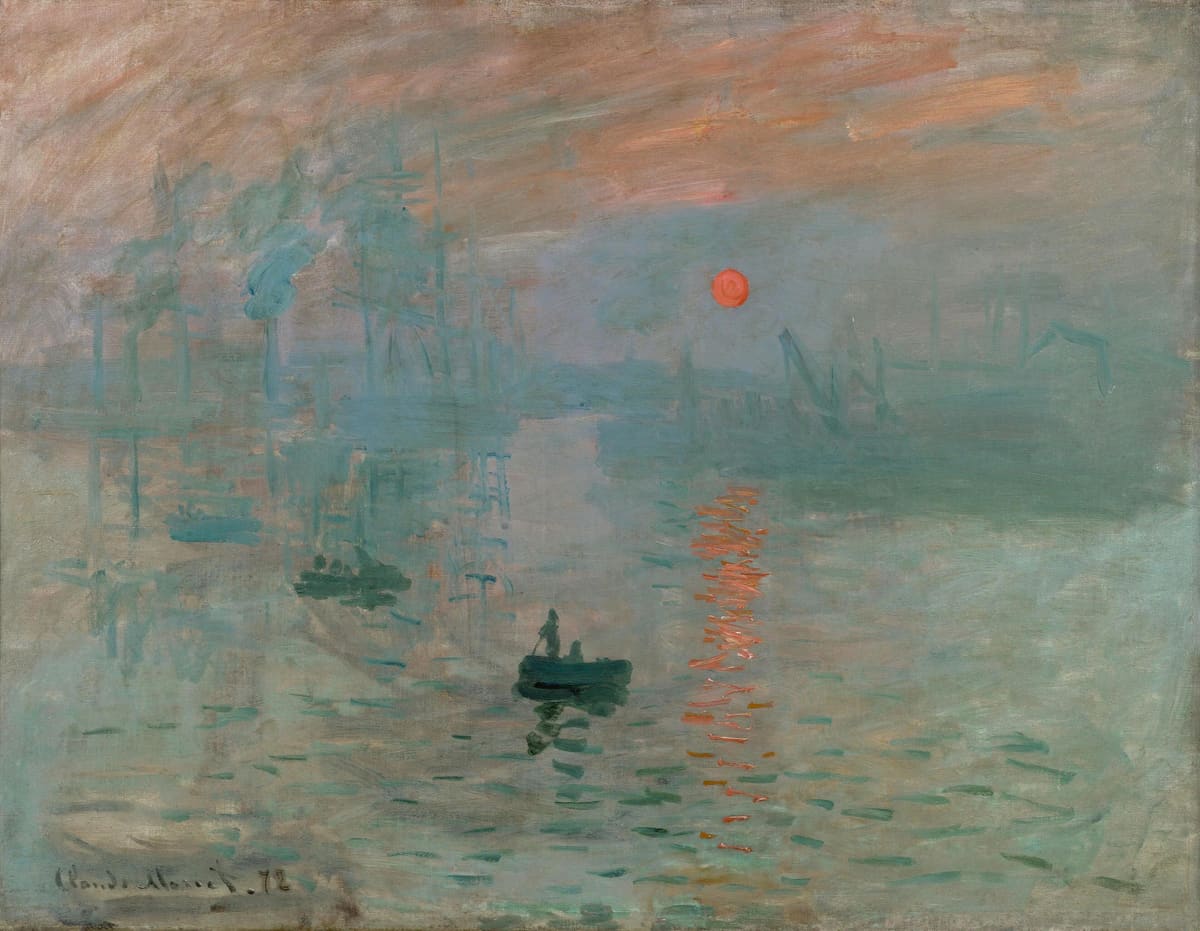
Impression, Sunrise
1872
Monet at the harbour of Le Havre, a few kilometres along the same coast, five years later.

The Grand Canal
1908
Monet in Venice in 1908 — the same problem of water, boats and light, forty years on.

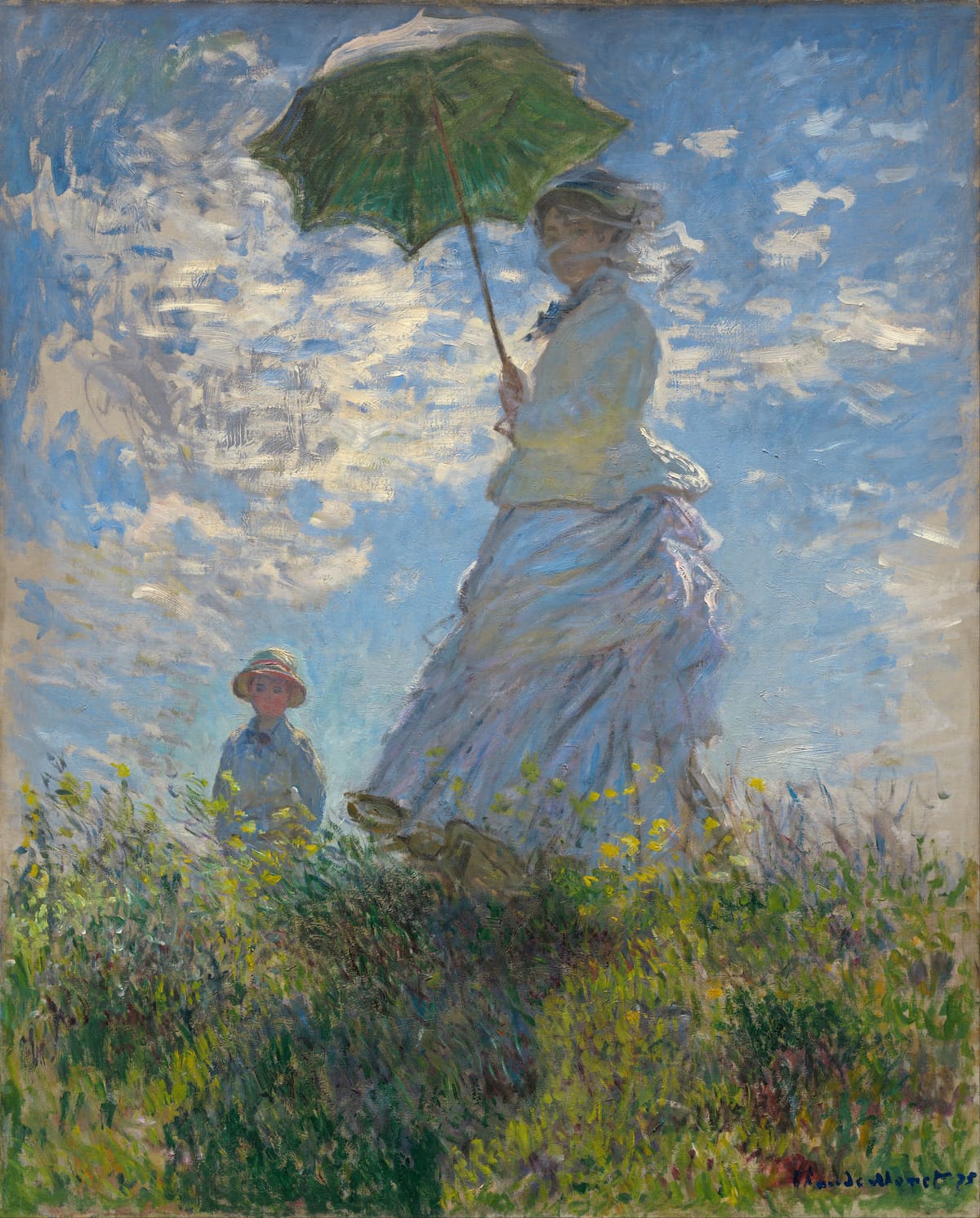
Woman with a Parasol – Madame Monet and Her Son
1875
Monet in 1875 — the loose, broken brushwork he had not yet developed here.
More by Claude Monet
Impression, Sunrise
Woman with a Parasol – Madame Monet and Her Son

Houses on the Achterzaan

Also connected to Sainte-Adresse


Regatta at Sainte-Adresse
