The Magpie
A single magpie on a wattle gate in deep snow, in the countryside near Étretat in Normandy — one of the great snow paintings.
Étretat
The painting depicts a real landscape or cityscape. The precise viewpoint the artist used may be unknown, so the marker shows the general area.
The Magpie — at a glance
- Artist
- Claude Monet (1840–1926)
- Year
- 1868–1869
- Movement
- Impressionism (early)
- Place
- The countryside near Étretat, Normandy, France
- Viewpoint
- Snowy farmland inland from the coast — the area survives; not a marked spot
- Medium
- Oil on canvas
- Dimensions
- c. 89 × 130 cm
- Now at
- Musée d'Orsay, Paris
Overview
The Magpie is an early masterpiece by Claude Monet, painted outdoors in the winter of 1868–69. It shows a wide field under fresh, deep snow, a low wattle fence and a rough gate casting blue shadows, a snow-laden hedge and cottage roofs behind — and, alone on the gate, a single magpie. It is oil on canvas, about 89 by 130 cm, and it hangs in the Musée d'Orsay, Paris.
It is among the largest and most ambitious of the roughly 140 snow scenes Monet painted over his life, and was rejected by the Salon of 1869.
Where was The Magpie painted?
Museum interpretation Monet spent the winter of 1868–69 with his family at Étretat, the small resort town on the chalk-cliff coast of Normandy. The Magpie was painted in the snowy farmland just inland — near the hamlet of Le Tilleul or thereabouts — rather than on the famous seafront. The rolling fields, hedges and farm cottages of the area survive; the painting records a stretch of that countryside under a particular fall of snow, not a fixed, marked viewpoint.
What is in the painting?
The lower half of the canvas is an unbroken sweep of snow, faintly rutted. Across it runs a woven-branch fence, and at the centre a simple gate hangs in it, its top rail catching the low sun. Behind the fence, a snow-covered hedge and the thatched and tiled roofs of farm buildings; a few trees; a pale blue-white sky. The magpie sits on the gate, small and black, the single dark accent in a field of white.
Look closely
The magpie
Small and black on the gate rail — the only dark note and the only living thing in the field of white.
The blue shadows
The shaded snow along the fence is painted in blues and lilacs, not grey.
The sunlit gate rail
The top of the gate catches warm low sunlight, cream and gold against the cooler field.
The buried hedge and roofs
A snow-laden hedge and farm rooftops close the view behind the fence.
Analysis
Composition & perspective
A high snowfield fills the foreground; the fence and gate cross it horizontally, and the lone bird marks the centre.
Scholarship Monet gives most of the picture to empty snow and lets the low fence, the gate and the hedge lay a quiet horizontal structure across it. The magpie, tiny and off the exact centre, is the one point the eye is drawn to and the one living thing.
Colour and light
Snow painted not as white but as a field of pale blues, lilacs, creams and gold in the low winter sun.
Scholarship The picture's fame rests on its shadows: Monet paints the shaded snow in blues and violets rather than grey, and the sunlit snow in warm cream and pale yellow, so the whole surface shimmers with coloured light. It is one of the first paintings to treat cast shadows as coloured.
History & provenance
Turned down by the 1869 Salon, the painting passed through private hands and was acquired by the Louvre in 1984; it hangs in the Musée d'Orsay, Paris, and is one of its most popular works.
Sources
- Musée d'Orsay, Paris — collection entry for Claude Monet, ‘La Pie’ (‘The Magpie’, 1868–69; oil on canvas, c. 89 × 130 cm)
- House, John, ‘Monet: Nature into Art’ (Yale University Press, 1986)
Frequently asked
Where was The Magpie painted?
In the snowy farmland just inland from Étretat, on the chalk-cliff coast of Normandy, where Monet spent the winter of 1868–69 with his family.
Can you find the exact spot?
No. The rolling fields, hedges and farm cottages of the area around Étretat survive, but the painting records a stretch of that countryside under one snowfall rather than a marked viewpoint.
Why is the snow blue and gold rather than white?
Monet painted the shaded snow in blues and violets and the sunlit snow in warm cream and yellow — one of the first paintings to treat cast shadows as coloured rather than grey.
What is the magpie for?
It is the single dark accent and the only living thing in a wide field of white — the note that gives the picture its title and its focus. Monet did not attach a symbolic meaning to it.
Where is the painting now?
In the Musée d'Orsay, Paris.
Related paintings

More by Claude Monet
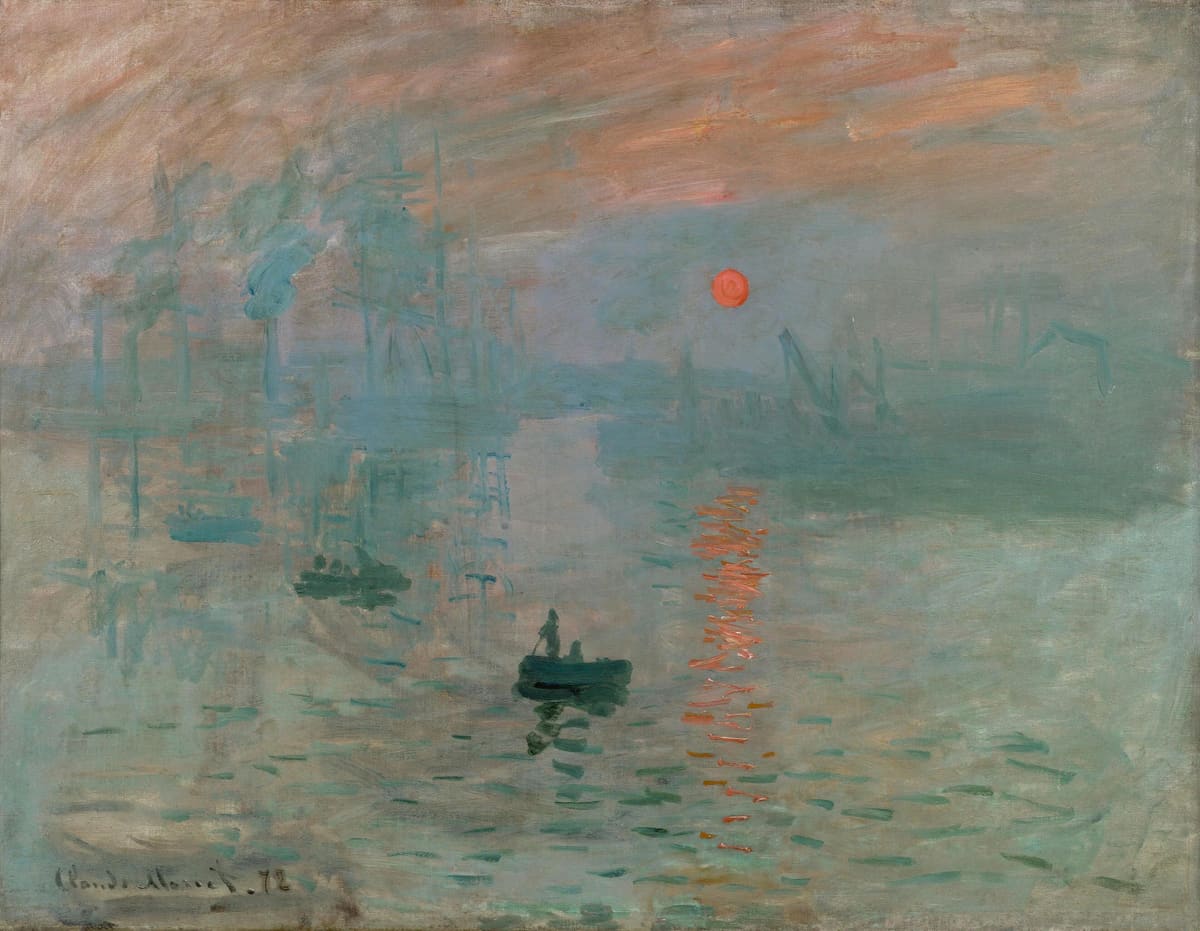
Impression, Sunrise
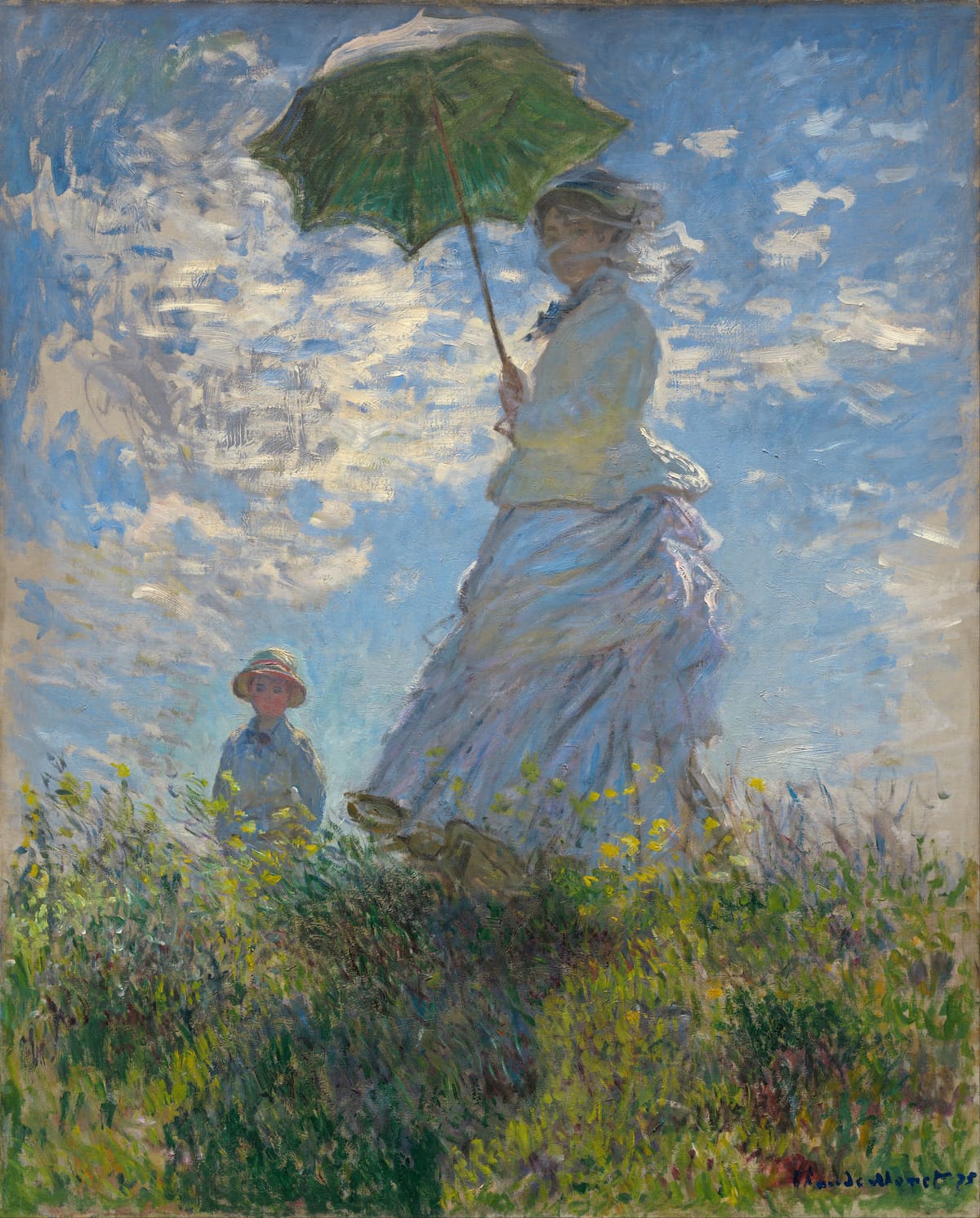
Woman with a Parasol – Madame Monet and Her Son

Houses on the Achterzaan