
Woman in the Garden
A woman in white by a flowering bush in the garden of Monet's aunt at Sainte-Adresse, near Le Havre.
Sainte-Adresse
The painting depicts a real landscape or cityscape. The precise viewpoint the artist used may be unknown, so the marker shows the general area.
Woman in the Garden — at a glance
- Artist
- Claude Monet (1840–1926)
- Year
- 1867
- Movement
- Impressionism (early)
- Place
- A garden at Sainte-Adresse, near Le Havre, Normandy
- Viewpoint
- A sunlit seaside-suburb garden — not preserved or marked
- Medium
- Oil on canvas
- Dimensions
- c. 82 × 101 cm
- Now at
- Hermitage Museum, St Petersburg
Overview
Woman in the Garden, also called Jeanne-Marguerite Lecadre in the Garden, is a bright open-air canvas Claude Monet painted in the summer of 1867. It shows a young woman in a long white dress and a hat, seen from behind and to the side, standing on a lawn beside a large round bush covered in white blossom, with a bed of red flowers and garden trees around her. It is oil on canvas, about 82 by 101 cm, and it hangs in the State Hermitage Museum, St Petersburg.
Where was Woman in the Garden painted?
Museum interpretation Monet spent the summer of 1867 with relatives at Sainte-Adresse, a small resort just west of the port of Le Havre on the Normandy coast, where his aunt Marie-Jeanne Lecadre had a property. He painted several pictures there — this garden, a terrace overlooking the sea, boats — all in his home region. The specific garden is not preserved; the painting records a sunlit bourgeois garden of the area rather than a marked viewpoint.
What is in the painting?
The woman stands at the right of centre, her white dress and its shadow the brightest thing in the picture, holding a slender branch. To the left, a dense sphere of white-flowering shrub; in front, a curved bed of scarlet geraniums on the green lawn; behind, garden trees and a glimpse of pale sky. Strong sunlight throws the bush's and the woman's shadows across the grass.
Look closely
The white dress and its shadow
The brightest note in the picture, with a deep blue-green shadow thrown across the grass.
The blossoming shrub
A dense round bush covered in white flowers, balancing the figure across the lawn.
The red flowerbed
A curved bed of scarlet geraniums swings the eye across the green.
Analysis
Composition and light
A white figure and a white flowering bush balanced across a sunlit lawn, with a curved red flowerbed leading the eye.
Scholarship Monet sets the two white masses — dress and blossoming shrub — against the green, and uses the arc of the red bed to swing the eye between them. The real subject is the midday sun: brilliant on the lawn and the dress, deep blue-green in the cast shadows.
History & provenance
The painting was bought by the Russian collector Sergei Shchukin and, after the Revolution, entered the state museums; it is in the Hermitage, St Petersburg.
Sources
- State Hermitage Museum, St Petersburg — collection entry for Claude Monet, ‘Lady in the Garden (Sainte-Adresse)’ (1867)
- House, John, ‘Monet: Nature into Art’ (Yale University Press, 1986)
Related paintings


More by Claude Monet
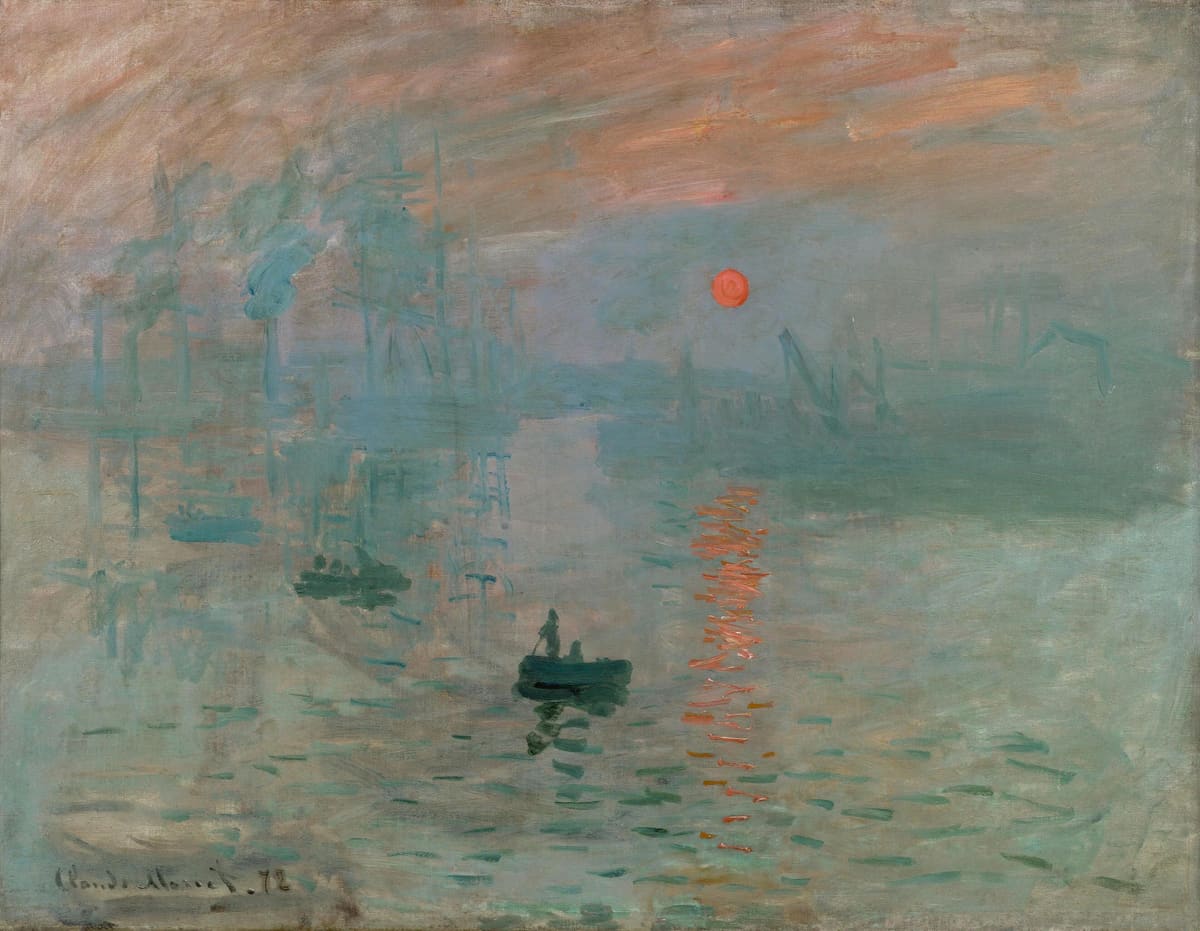
Impression, Sunrise
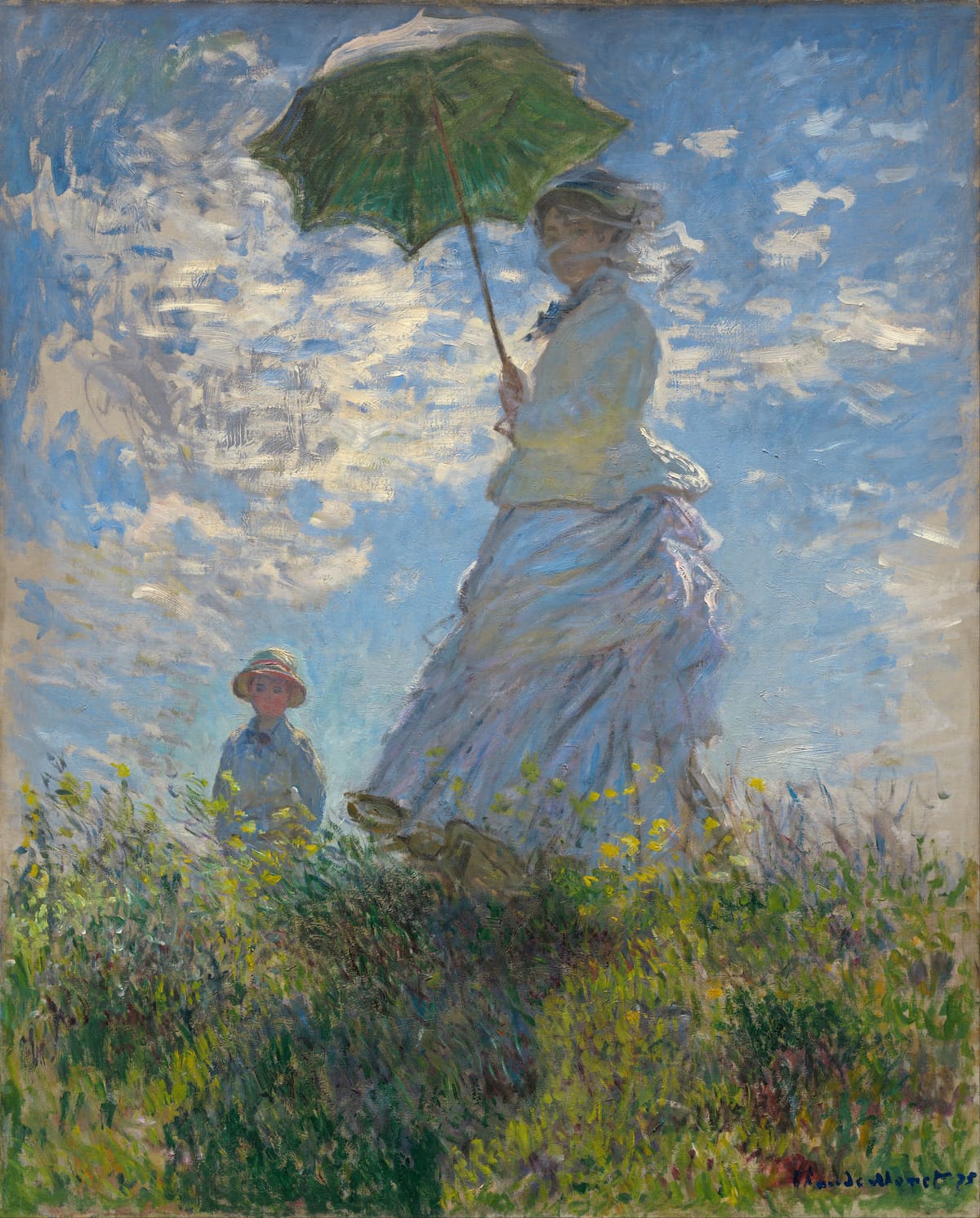
Woman with a Parasol – Madame Monet and Her Son

Houses on the Achterzaan
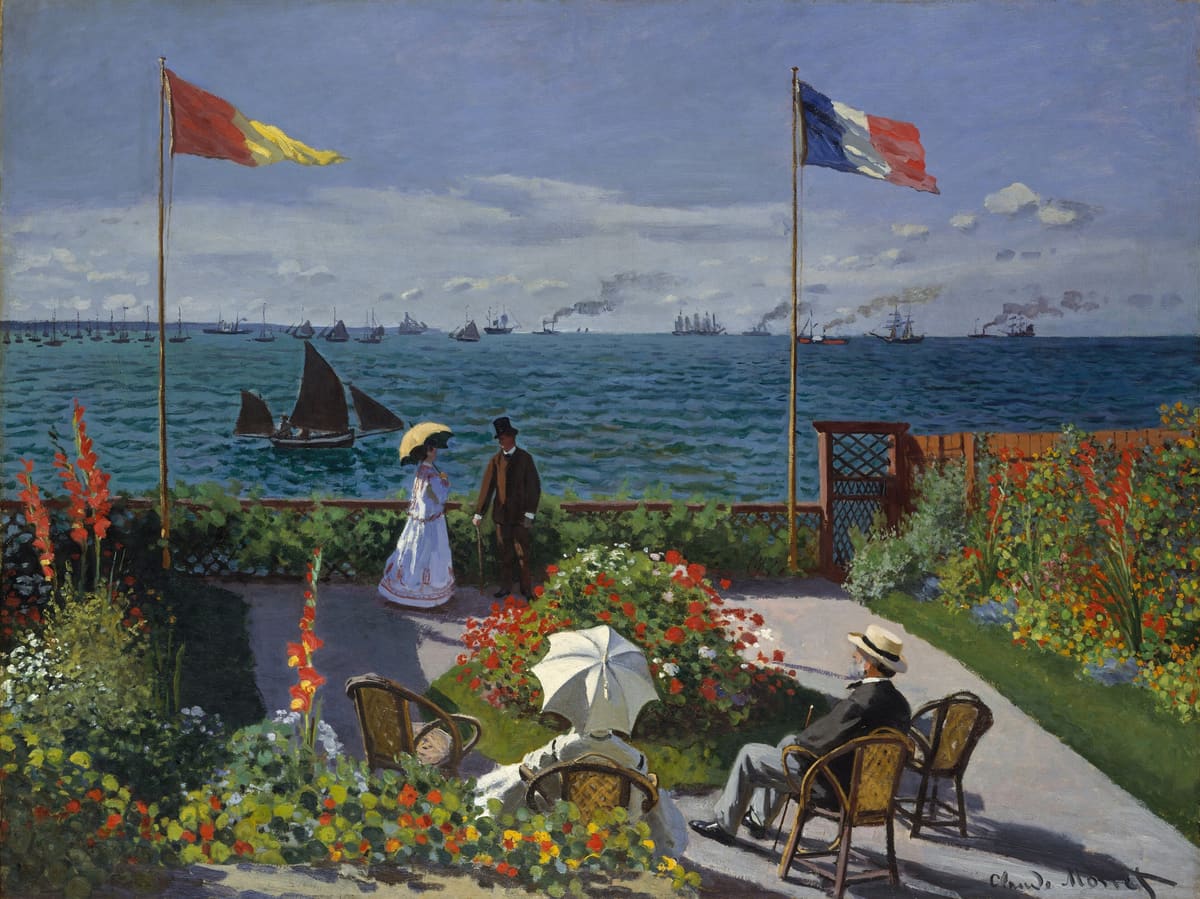
Also connected to Sainte-Adresse

Regatta at Sainte-Adresse
