Impression, Sunrise
The port of Le Havre at dawn — the small, quick canvas that gave Impressionism its name.
hotel room at 41-45 Grand-Quai, Le Havre, facing SE over the outer harbour
This is a documented exact viewpoint — you can stand roughly where the artist stood and look at the same scene.
Impression, Sunrise — at a glance
- Artist
- Claude Monet (1840–1926)
- Year
- 1872
- Movement
- Impressionism (the founding work)
- Place
- Outer harbour of Le Havre, France
- Viewpoint
- A hotel window on the Grand Quai, looking roughly south-east — general area survives
- Medium
- Oil on canvas
- Dimensions
- c. 48 × 63 cm
- Now at
- Musée Marmottan Monet, Paris
Overview
Impression, Sunrise is a small oil painting — about 48 by 63 cm — that Claude Monet made in the harbour of Le Havre, his home town, most likely in 1872. It shows the port at dawn: an orange sun low over misty water, dim shipping behind, a few dark boats in front. It is in the Musée Marmottan Monet in Paris.
When Monet showed it in 1874 at the first independent group exhibition, a critic mocked the title, and the word ‘Impressionists’ stuck to the whole circle.
How Impressionism got its name
In April 1874 Monet and around thirty others — Renoir, Degas, Pissarro, Berthe Morisot and more — mounted their own show at the photographer Nadar's former studio, outside the official Salon. Asked for a title for this canvas in the catalogue, Monet is said to have offered ‘Impression’ because it could not really pass as a view of Le Havre.
Scholarship The critic Louis Leroy responded with a satirical piece headed ‘Exhibition of the Impressionists,’ jeering that wallpaper in its early state was more finished than this seascape. The group's opponents — and soon the group itself — adopted the name.
Where was Impression, Sunrise painted?
Monet painted from an upper window of a hotel on the waterfront of Le Havre, on the Normandy coast at the mouth of the Seine, looking out across the outer harbour.
Scholarship Researchers at Texas State University led by Donald Olson used tide, weather and sun-position records to argue that the view faces roughly south-east from the Grand Quai area and shows the morning of 13 November 1872, at around half past seven. The basin, the jetties and the general layout of the port survive, though it has been heavily rebuilt since the Second World War.
How we know
- D. Olson (Texas State) identified the exact hotel room and dated the scene to 13 Nov 1872, 7:35am. Le Havre was destroyed in 1944 and rebuilt (Perret / UNESCO), so the Grand-Quai buildings are gone but the harbour and view direction remain. — manual_research
What is in the painting?
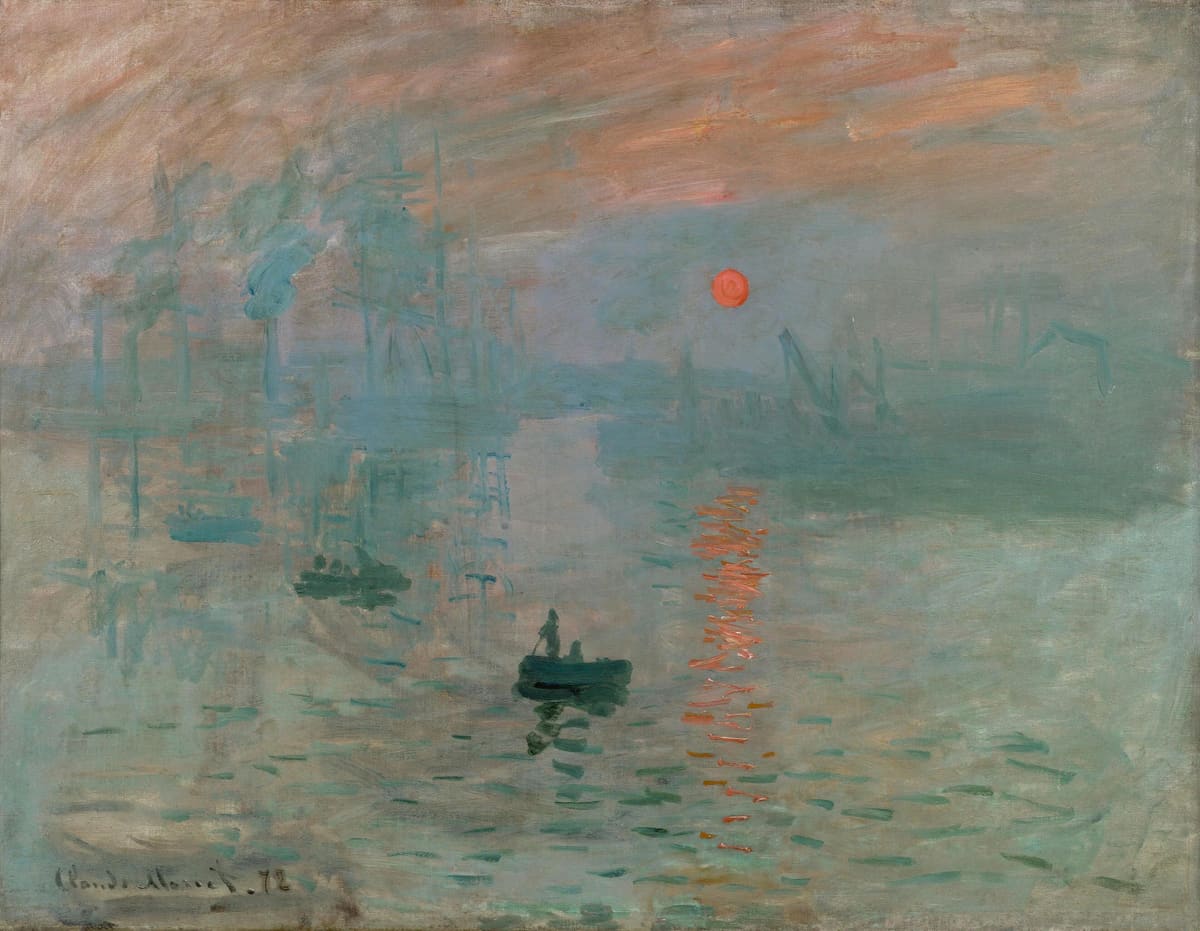
A hazy blue-grey sky meets flat water. A small orange sun hangs just above the horizon and lays a broken orange streak down towards the viewer. Three dark rowing boats are silhouetted in the foreground, the nearest with two figures.
Behind, barely legible, are the masts of sailing ships, the arms of cranes and the smoking chimneys of the port — all dissolved into grey and violet.
Look closely
The sun and its reflection
A small orange disc low on the horizon, with a broken orange streak of light dashed across the water below it.
The dark boats
Three rowing boats sit in silhouette in the foreground; the nearest carries two figures and gives the scale.
The working port
Masts, cranes and smoking factory chimneys are just visible through the haze on the far side.
The bare water
Most of the canvas is loose horizontal strokes of grey-blue over a warm ground — barely worked.
Details that are easy to miss. There are two figures in the nearest rowing boat; a second and third boat sit further out; the reflection of the sun is broken into separate dashes; the cranes and chimneys of a working industrial port are just visible through the mist; and the sun and sky share the same brightness, so the sun reads by colour alone.
Analysis
Composition & perspective
Almost nothing is drawn: the picture is a few dark boats and a bright dot of sun on a near-empty field of water and mist.
Scholarship The horizon sits just below the middle. The dark foreground boats give the only firm shapes and set the scale; everything beyond is suggested with quick horizontal strokes. The sun and its reflection form a vertical axis through the haze.
Colour and light
The famous sun is exactly as bright as the sky around it — in a black-and-white photograph it almost vanishes.
Scholarship The orange sun and its reflection are the same lightness (luminance) as the grey-blue sky, so their force comes purely from the colour contrast, not from any difference in tone. Photographed in black and white, the sun nearly disappears. This has been taken as a demonstration that Monet was painting the sensation of light rather than the object.
Handling and technique
Painted fast and thin, in loose horizontal drags and a few dark accents, with the ground showing through.
The canvas is worked quickly and left deliberately sketchy — the quality that so annoyed the 1874 critics. The water is a scumble of grey-blue over a warm ground; the boats and the sun are added in a few sure strokes.
Meaning and interpretation
Interpretations differ. What the artist documented, what museums and scholars propose, and later or speculative theories are marked and kept separate.
Monet's account
Monet later said the title was chosen because the canvas could not honestly be called a view of Le Havre — it was an impression, a record of a passing effect. He did not claim any subject beyond the light on the harbour.
A manifesto by accident
The painting is usually read as the emblem of Impressionism: proof of the group's interest in the fleeting effect over the finished description. That role was assigned by history — and by a hostile critic — more than by Monet.
History & provenance
- 1872Painted in the harbour of Le Havre (dated 1872 by Monet).
- April 1874Shown at the first Impressionist exhibition; the title is mocked and the movement is named.
- 1878Bought by the collector Georges de Bellio.
- 1940Given by de Bellio's heirs to the Musée Marmottan, Paris.
- 1985–1990Stolen in an armed raid on the museum; recovered in Corsica in 1990.
The painting is the core work of the Musée Marmottan Monet, which holds the largest collection of Monet in the world. It was among the pictures stolen in the 1985 museum robbery and recovered five years later.
Featured in Famous Painting Locations: 13 Real Places You Can Visit
Research Included in the Painting Location Precision Study
Sources
- Musée Marmottan Monet, Paris — collection entry for ‘Impression, soleil levant’ (oil on canvas, c. 48 × 63 cm)
- Donald W. Olson et al. (Texas State University) — dating study placing the scene on the morning of 13 November 1872
- Paul Hayes Tucker, ‘Claude Monet: Life and Art’ (Yale University Press, 1995)
- Contemporary press, Louis Leroy, ‘L'Exposition des impressionnistes,’ Le Charivari, 25 April 1874
Frequently asked
Where did Monet paint Impression, Sunrise?
From an upper window of a hotel on the waterfront of Le Havre, his home town on the Normandy coast, looking out over the outer harbour.
Is it really the reason Impressionism is called that?
Yes. Monet gave it the title ‘Impression’ for the 1874 exhibition catalogue; the critic Louis Leroy used it to mock the whole show as an ‘Exhibition of the Impressionists,’ and the name stuck.
When exactly was it painted?
Monet dated it 1872. Astronomers and historians at Texas State University have argued for the morning of 13 November 1872, around 7:35 a.m., from the tide, weather and sun-angle records.
Why does the sun stand out so much if the picture is so pale?
The sun and the sky around it are the same brightness. The sun reads only because of its colour contrast with the grey-blue haze — in a black-and-white photo it nearly disappears.
Can you visit the spot?
The port of Le Havre was largely rebuilt after the Second World War, but the outer harbour, the jetties and the general layout survive and the viewing direction can still be worked out.
Where is the painting now?
In the Musée Marmottan Monet in Paris. It was stolen in a 1985 raid on the museum and recovered in 1990.
Related paintings


More by Claude Monet
Woman with a Parasol – Madame Monet and Her Son

Houses on the Achterzaan