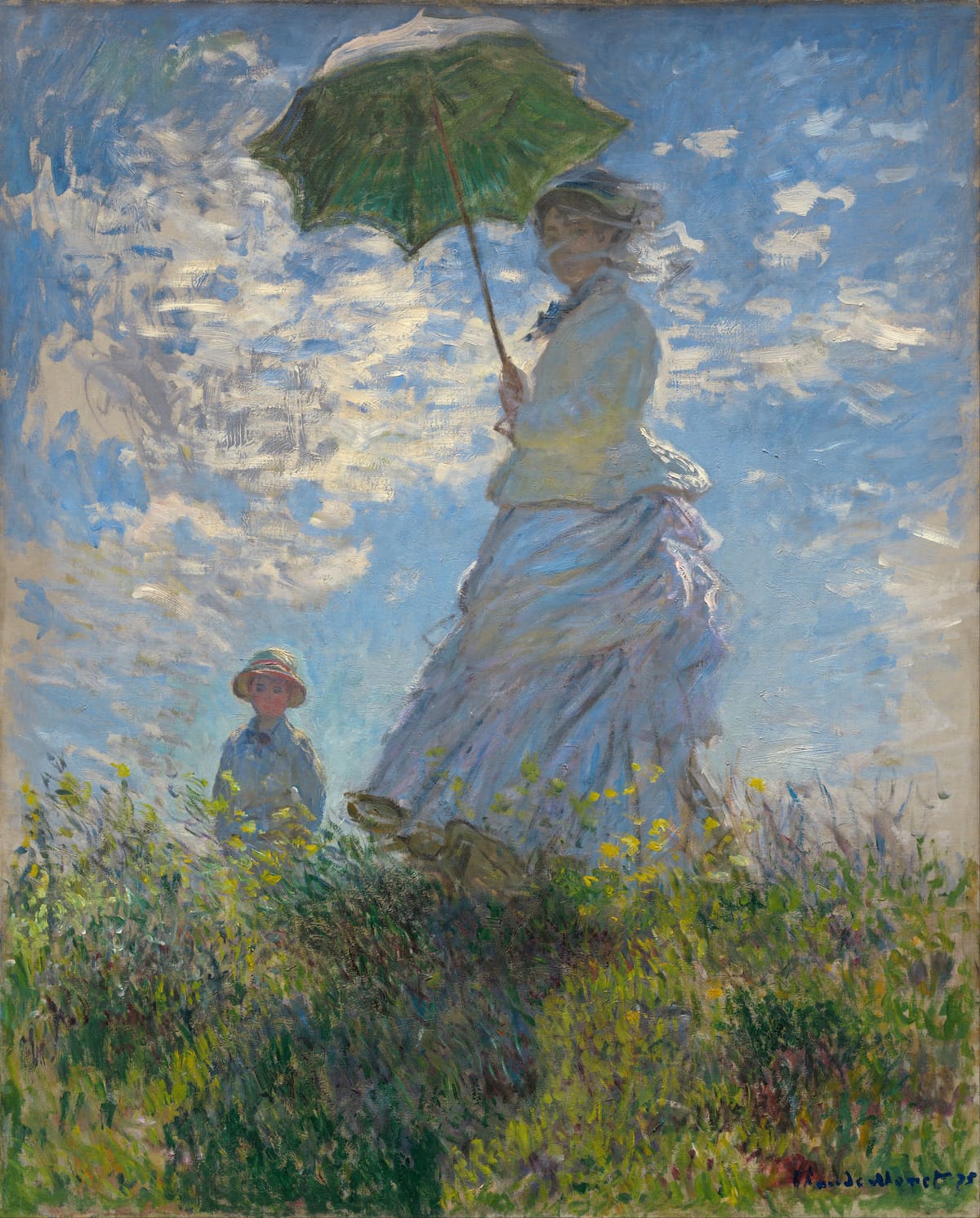
Woman with a Parasol – Madame Monet and Her Son
A quick open-air study of Monet's wife and son on a grassy rise near the family's house at Argenteuil.
Argenteuil
The painting depicts a real landscape or cityscape. The precise viewpoint the artist used may be unknown, so the marker shows the general area.
Woman with a Parasol – Madame Monet and Her Son — at a glance
- Artist
- Claude Monet (1840–1926)
- Year
- 1875
- Movement
- Impressionism
- Place
- Argenteuil, on the Seine north-west of Paris
- Viewpoint
- A grassy rise near the family house — a general area, not a pinpoint
- Medium
- Oil on canvas
- Dimensions
- c. 100 × 81 cm
- Now at
- National Gallery of Art, Washington
Overview
Woman with a Parasol — Madame Monet and Her Son is a painting Claude Monet made outdoors in a single session in the summer of 1875. It shows a woman with a parasol standing on a grassy rise, seen from below against a bright cloud-filled sky, with a boy lower down among the grass. It is oil on canvas, about 100 by 81 cm, and it hangs in the National Gallery of Art in Washington.
The figures are Monet's first wife, Camille, and their son Jean, then about eight.
How it was made
Monet lived at Argenteuil, a town on the Seine north-west of Paris, from 1871 to 1878, and made many of his most famous Impressionist works there — the river, the railway bridge, the garden.
This picture was painted fast and in the open air: Camille turns as if the painter has just called to her, her veil and dress blown to one side, the whole thing caught before the light or the pose could change.
Where was Woman with a Parasol – Madame Monet and Her Son painted?
The setting is a grassy bank near the family's rented house at Argenteuil.
Museum interpretation It is not a specific, locatable view — a low rise with wild flowers and long grass, seen from below so that the figures are set against the sky. On the map it appears as a broad area rather than a pinpoint. Argenteuil itself is now a Paris suburb, much built up.
What is in the painting?
A woman stands on the crest of a grassy slope, a parasol lined with green tilted over her shoulder, her white dress and a gauzy veil streaming sideways in the wind. She is seen from slightly below, so most of the canvas behind her is sky — blue with fast white cloud.
Further down the slope, half-hidden in the tall grass and flowers, a boy stands looking towards her.
Look closely
The green-lined parasol
Its lining reflects green down onto Camille's face and dress; the shadow under her chin is painted violet.
The wind
The veil and the skirt stream sideways, and the clouds race — the whole picture is one gust of a bright day.
The half-hidden boy
Jean stands lower down the slope, nearly lost among the tall grass and scattered flowers.
The see-through veil
The gauze is painted so thinly that the blue of the sky shows straight through it.
The low horizon
Monet looked up at his subjects, so almost the whole background is open sky.
Details that are easy to miss. The parasol is lined with green, which Monet lets reflect down onto Camille's face and dress; the shadow under her chin is painted violet, not grey; the boy is nearly lost in the tall grass and flowers; and the veil is so thinly painted that the sky shows through it.
Analysis
Composition & perspective
A low viewpoint throws the standing woman up against the sky, with the boy set back to give the slope its depth.
Scholarship Monet looked up at his subjects, so the horizon is very low and the woman is silhouetted on open sky. The diagonal of the grassy bank runs from the boy at the lower right up to Camille; the wind-blown veil and the tilted parasol give the whole picture a sense of a passing gust.
Colour and light
Cool blues and whites of sky and dress against warm grass, with green reflected up onto the white fabric from below.
Scholarship Monet notes the coloured light rather than describing local colour: the white dress carries green from the grass and blue from the sky, the shadow of the parasol on Camille's face is violet, the meadow is flecked with yellow and red flowers. The touch is rapid and broken throughout.
Handling and technique
A plein-air sketch worked in one sitting, with visible, feathery, directional strokes and no reworking.
The paint is thin and quick, the brushmarks left frank — the grass in upward flicks, the sky in swept clouds, the veil in a few translucent drags. Monet kept the picture as a sketch and did not finish it further in the studio.
Meaning and interpretation
Interpretations differ. What the artist documented, what museums and scholars propose, and later or speculative theories are marked and kept separate.
Impressionism in a single afternoon
The picture is usually presented as a model Impressionist work: an ordinary family moment on a bright windy day, caught outdoors in one go, with light and movement as the real subject.
A record of Camille
It also has a biographical weight. Camille Monet died in 1879, aged 32; this is one of the last carefree pictures of her, and Monet's two later ‘woman with a parasol’ paintings of 1886 use a different model, his stepdaughter, and turn the motif more abstract.
History & provenance
- 1875Painted outdoors at Argenteuil in one session.
- 1876Shown at the second Impressionist exhibition.
- 20th c.Enters the Mellon collection in the United States.
- 1983Given to the National Gallery of Art, Washington, by Mr. and Mrs. Paul Mellon.
The painting came to the National Gallery of Art in Washington in 1983 from the collection of Paul and Bunny Mellon, and is one of the museum's best-loved Monets.
Sources
- National Gallery of Art, Washington — collection entry for ‘Woman with a Parasol – Madame Monet and Her Son’ (Collection of Mr. and Mrs. Paul Mellon, 1983; oil on canvas, c. 100 × 81 cm)
- Paul Hayes Tucker, ‘Monet at Argenteuil’ (Yale University Press, 1982)
Frequently asked
Where is the slope in Woman with a Parasol?
A grassy bank near the Monet family's rented house at Argenteuil, on the Seine north-west of Paris, where Monet lived from 1871 to 1878.
Can you visit the spot?
Not really. It is a general rise near the house rather than a fixed, identifiable viewpoint, and Argenteuil is now a built-up Paris suburb.
Who are the two figures?
Monet's first wife, Camille, and their son Jean, then about eight years old.
How long did it take to paint?
It was made outdoors in a single session and left as a sketch, without further work in the studio.
Why is the white dress so colourful?
Monet painted the coloured light on it rather than a plain white: green reflected up from the grass, blue from the sky, and a violet shadow under the parasol.
Is this the same as Monet's other ‘woman with a parasol’ paintings?
No. Monet made two more parasol pictures in 1886, but those use his stepdaughter Suzanne as the model and are more abstract. This 1875 painting is of Camille and Jean.
Where is the painting now?
In the National Gallery of Art, Washington, since 1983.
Related paintings


More by Claude Monet
Impression, Sunrise

Houses on the Achterzaan

Also connected to Argenteuil


