
Argenteuil
A man and a woman sitting on the quay at Argenteuil, the sailing basin and its bright blue water close behind them.
Argenteuil
The painting depicts a real landscape or cityscape. The precise viewpoint the artist used may be unknown, so the marker shows the general area.
Argenteuil — at a glance
- Artist
- Édouard Manet (1832–1883)
- Year
- 1874
- Movement
- Impressionism / Realism
- Place
- The sailing quay at Argenteuil, north-west of Paris
- Viewpoint
- The riverside boat basin — the reach survives; quays now built up
- Medium
- Oil on canvas
- Dimensions
- c. 149 × 115 cm
- Now at
- Musée des Beaux-Arts de Tournai, Belgium
Overview
Argenteuil is one of the pictures Édouard Manet painted in the summer of 1874 while working beside Claude Monet on the Seine at Argenteuil. A man in a straw boater and blue-and-white striped boating jersey sits on the stone quay next to a woman in a flowered dress and hat, a small bouquet in her lap; behind them, the masts and hulls of moored sailing boats and a vivid blue-green stretch of the river with the opposite bank. It is oil on canvas, about 149 by 115 cm, and it hangs in the Musée des Beaux-Arts de Tournai, Belgium.
Where was Argenteuil painted?
Scholarship Argenteuil, about 10 km north-west of central Paris, was the great weekend sailing and rowing centre near the capital, with a basin of moored pleasure boats along the quay. Manet sets the couple on that quayside with the boats and the river directly behind. The reach of the Seine and the sailing tradition remain; the quays are now built up, and the picture is a figures-on-the-quay scene rather than a marked viewpoint.
What is in the painting?
The two figures fill the foreground, seated close and facing out, cut by the frame below the knee. Behind them the boats are packed close — dark hulls, pale furled sails, rigging — and beyond, a band of intensely blue-green water and the low far bank with houses and a factory chimney. There is almost no sky.
Look closely
The boating jersey
The man's navy-and-white striped jersey and straw boater — the uniform of the Seine sailing crowd.
The packed boats
Dark hulls, furled sails and rigging fill the space directly behind the couple.
The saturated blue
The band of river is an unusually hard, even blue-green — the detail critics fixed on.
The far bank
Low houses and a factory chimney across the water — the industrial edge of the leisure reach.
Analysis
Composition and technique
A close, cropped double figure against a shallow, tightly packed background of boats and bright water.
Scholarship Manet pushes the couple to the front and fills the rest with boats and river, keeping the space shallow and the horizon high, so the strong blue of the water reads almost as a flat backdrop. The vivid, near-artificial blue drew comment when the picture was shown at the 1875 Salon.
Colour and light
A dominant band of hard blue-green river against the striped jersey, the flowered dress and pale sails.
The blue of the Seine is unusually saturated and even, set against the crisp navy-and-white of the man's jersey, the lighter tones of the woman's dress, and the cream of the sails. The light is bright and flat.
History & provenance
The painting was shown at the Salon of 1875 and later acquired by the Musée des Beaux-Arts de Tournai, Belgium.
Sources
- Musée des Beaux-Arts de Tournai — collection entry for Édouard Manet, ‘Argenteuil’ (1874; oil on canvas, c. 149 × 115 cm)
- Juliet Wilson-Bareau, ‘Manet and Argenteuil’ literature
Related paintings
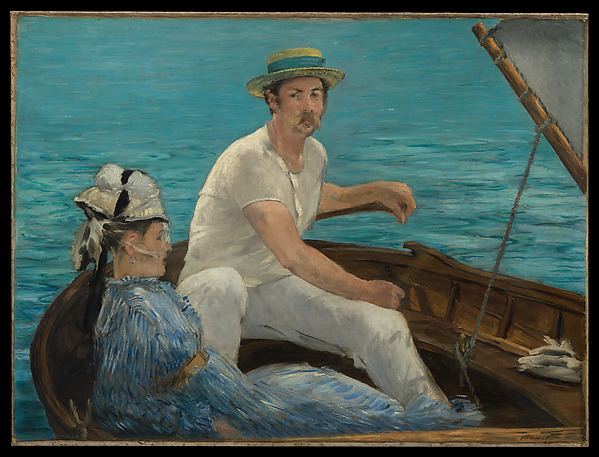
Boating
1874
Manet's other 1874 Argenteuil picture — the couple now out on the water in one of these boats.

Régates à Argenteuil
1872
Monet's yachts on the same reach, painted about the same time.

Claude Monet painting in his studio boat
1874
Manet's portrait of Monet at his floating easel on this river.
More by Édouard Manet

A Bar at the Folies-Bergère
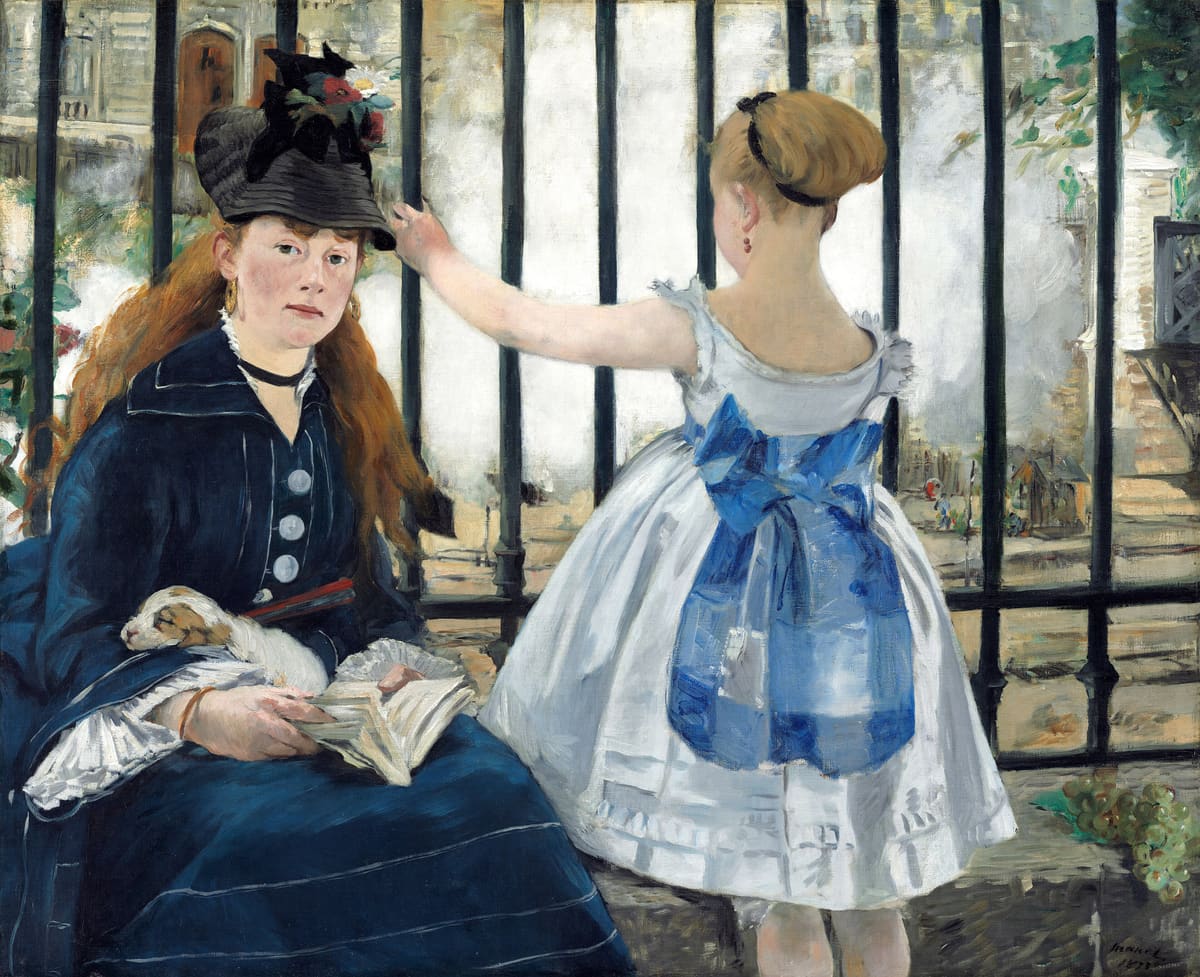
The Railway
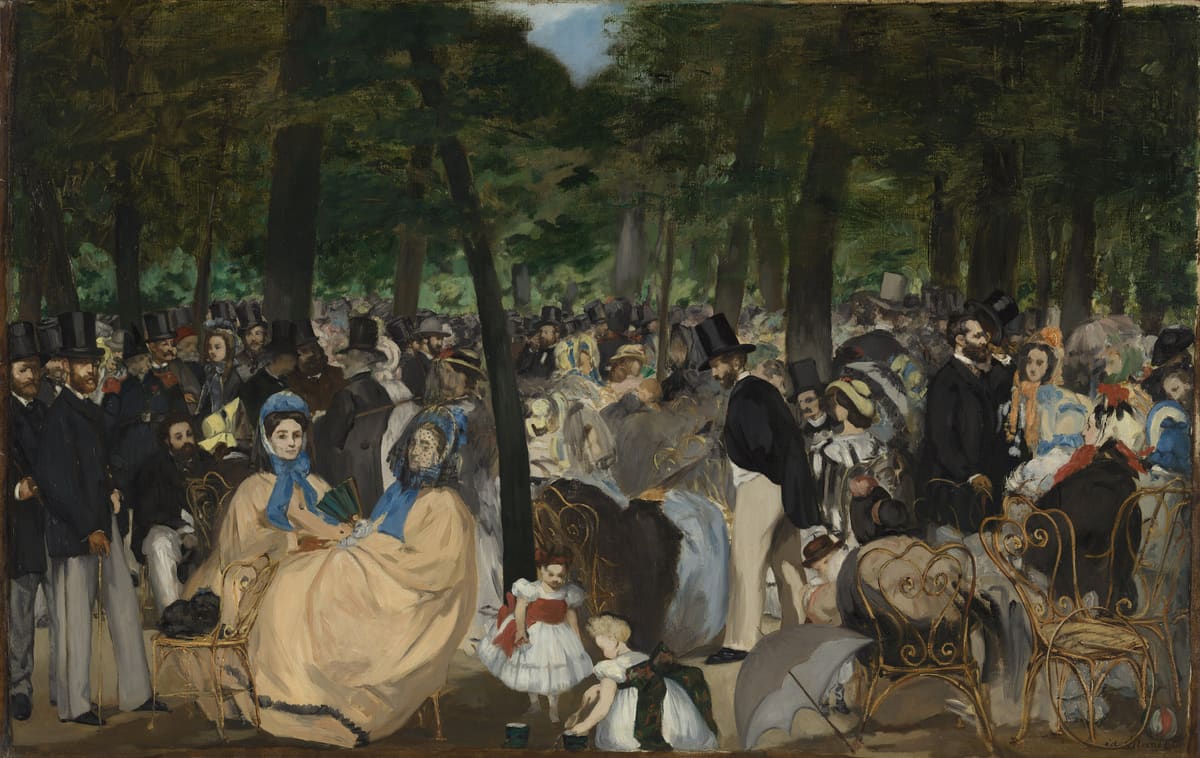
Music in the Tuileries
Also connected to Argenteuil
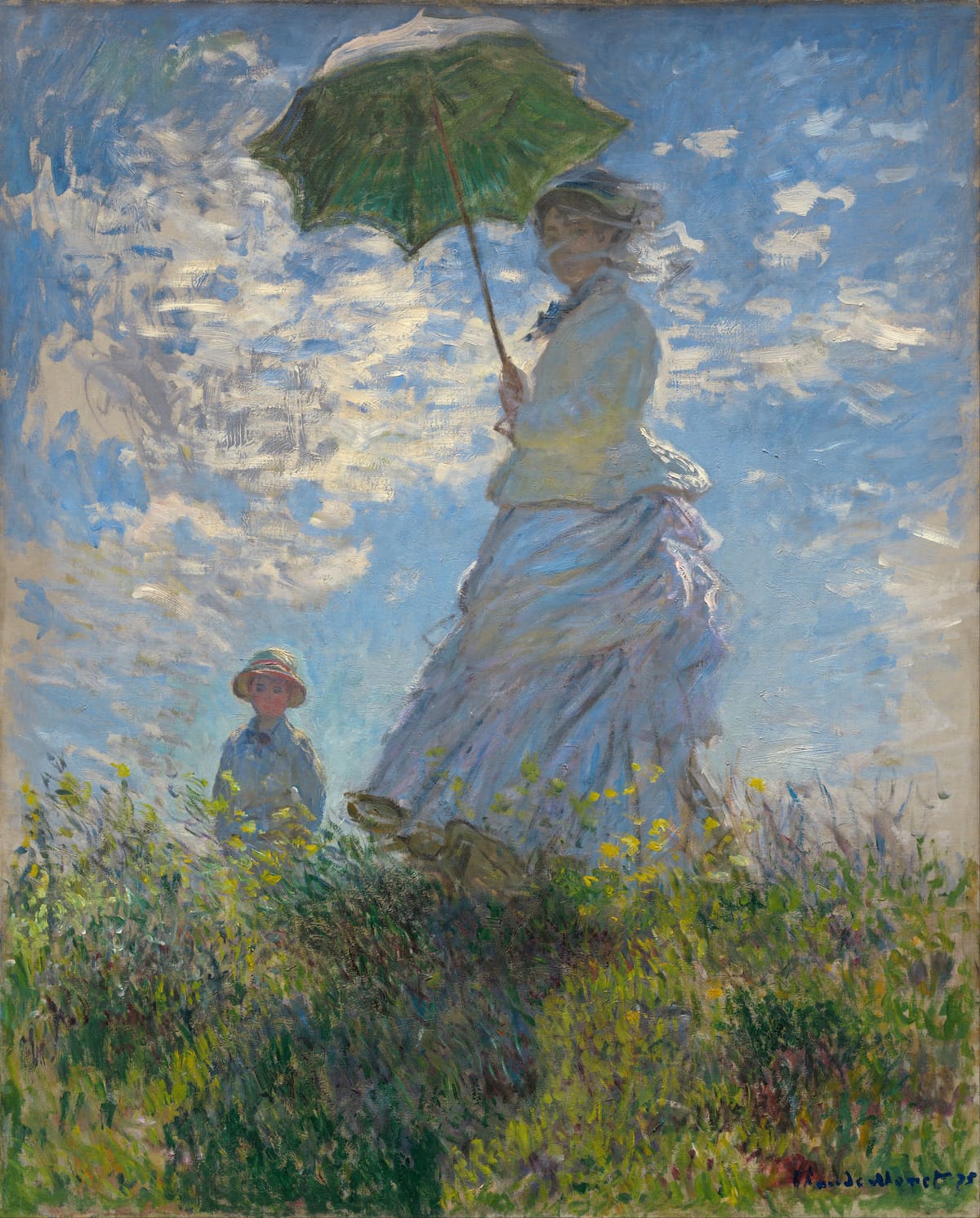
Woman with a Parasol – Madame Monet and Her Son

