Bal du moulin de la Galette
The Sunday dance at an open-air garden on Montmartre — one of its two windmills still stands on the rue Lepic.
Moulin de la Galette, Montmartre
The painting depicts a real landscape or cityscape. The precise viewpoint the artist used may be unknown, so the marker shows the general area.
Bal du moulin de la Galette — at a glance
- Artist
- Pierre-Auguste Renoir (1841–1919)
- Year
- 1876
- Movement
- Impressionism
- Place
- Moulin de la Galette, Montmartre, Paris 18e
- Viewpoint
- The dance garden — one windmill survives on the rue Lepic; the garden is gone
- Medium
- Oil on canvas
- Dimensions
- c. 131 × 176 cm
- Now at
- Musée d'Orsay, Paris
Overview
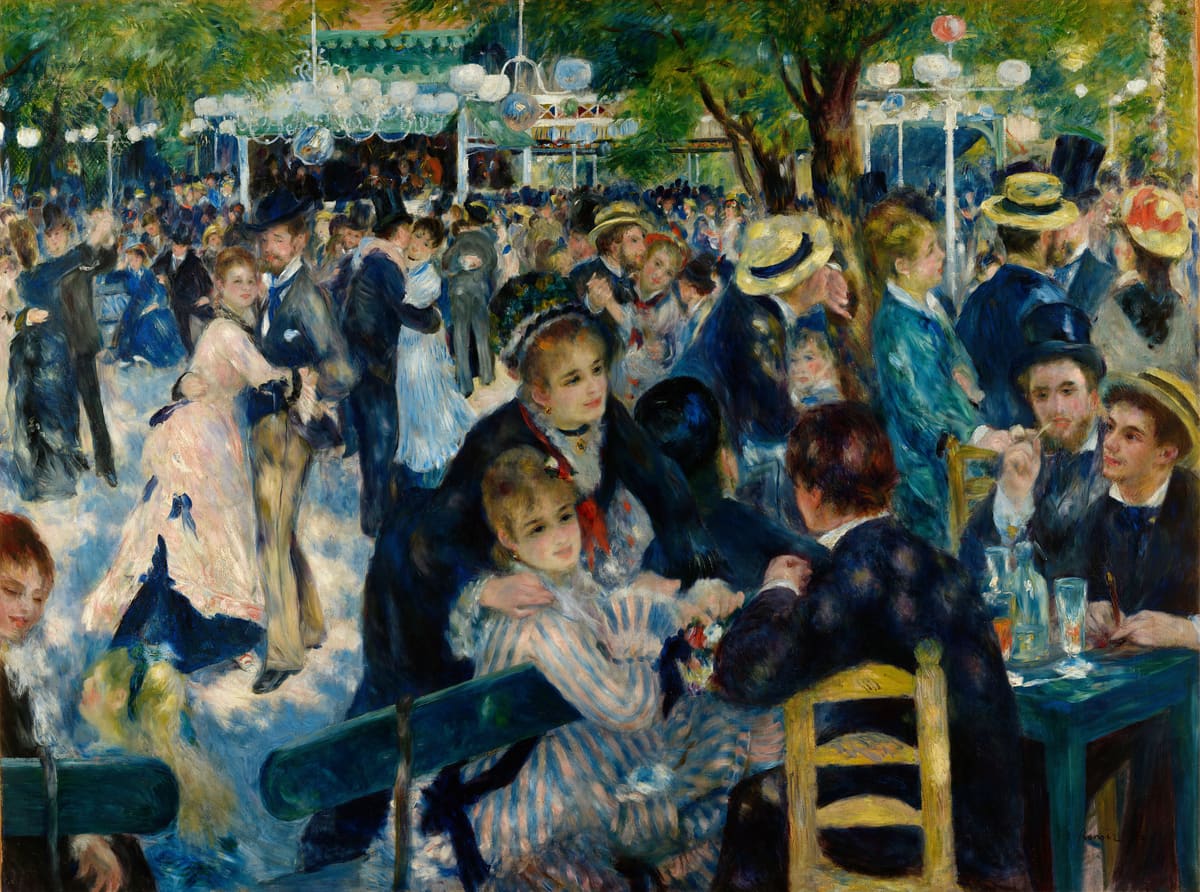
Bal du moulin de la Galette is a large painting Pierre-Auguste Renoir made in 1876 and showed at the third Impressionist exhibition in 1877. It shows couples dancing and groups talking at an open-air dance on the hill of Montmartre on a Sunday afternoon, with sunlight falling through the trees across the whole crowd. It is oil on canvas, about 131 by 176 cm, and it hangs in the Musée d'Orsay, Paris.
How it was made
Renoir rented rooms on the rue Cortot in Montmartre in 1876 specifically to paint the dance. He worked partly on the spot — friends helped carry the large canvas up the hill each day, by one account — and used local people and fellow painters as models: Montmartre girls, and the writers and painters of his circle at the tables in the foreground.
It was the ambitious centrepiece of his contribution to the 1877 Impressionist show.
Where was Bal du moulin de la Galette painted?
The Moulin de la Galette was a dance garden attached to an old windmill on the Butte Montmartre, in the 18th arrondissement of Paris. It took its name from a flat cake, a ‘galette,’ the miller's family sold; two windmills stood on the site.
Museum interpretation One of them, the Blute-fin, still stands above the rue Lepic (the other, the Radet, was moved to a nearby corner). The open-air dance floor and garden are gone, built over with housing, but the steep Montmartre streets around the spot are recognisable.
How we know
- Set in the open-air dance garden of the Moulin de la Galette in Montmartre; the stored coordinate was the whole city of Paris. Area precision — a crowd scene of the garden, not a view of a structure.
What is in the painting?
In the middle distance, couples turn on a packed dance floor under acacia trees strung with globe lamps. In the foreground, a group sits and stands around a table and a bench — young women in striped and pink dresses, men in straw boaters and dark suits — half turned to talk, half watching the dancing. A little girl leans on the bench.
Sunlight breaks through the leaves and falls in bright, shifting patches across faces, hats, dresses and the ground.
Look closely
The hanging lamps
Globe lamps are strung on wires among the acacia trees over the dance floor.
The foreground group
Young women in striped and pink dresses and men in straw boaters sit and talk, half turned from the dancing.
The little girl
A child leans on the bench beside the seated women in the near group.
The patches of light
Blue-violet and rose flecks of broken sunlight fall across faces and clothes — the ‘grease spots’ of the 1877 reviews.
The swirl of dancers
Behind the still foreground, couples turn in a loose oval that never resolves into a centre.
Details that are easy to miss. Globe lamps hang from wires among the acacia trees over the dance floor; a small girl leans on the foreground bench beside the seated women; the men in the foreground group are friends of Renoir, several of them painters and writers; and the light-patches on the near figures' clothes are the ‘grease spots’ the 1877 critics complained of.
Analysis
Composition & perspective
A tight, resolved foreground group opens back into a loose, swirling mass of dancers, with no single centre.
Scholarship Renoir anchors the picture with the seated foreground figures, sharply drawn and close, then lets the crowd behind dissolve into movement and light. The bench and table cut a diagonal into the space; the dancers spin around a rough oval; the eye is kept moving, never settling.
Colour and light
Dappled sun through leaves, painted as loose blue-violet and rose patches scattered across the whole surface.
Scholarship Renoir renders the broken light of a wooded garden by flecking blue and lilac shadow and warm sunlit pink across faces and clothes alike. Critics of 1877 mocked it, saying the figures looked spotted with grease or mould; it is now seen as one of the fullest statements of Impressionist light on figures.
Handling and technique
Feathery, blended brushwork throughout, worked at least partly outdoors on a canvas too big for the site.
The touch is soft and quick, the outlines open, the paint thin. Renoir made a smaller version of the composition as well; the larger canvas in the Musée d'Orsay is generally taken as the one shown in 1877.
Meaning and interpretation
Interpretations differ. What the artist documented, what museums and scholars propose, and later or speculative theories are marked and kept separate.
Ordinary Parisian pleasure
The picture is read as a celebration of a specific, unglamorous social ritual — the working-class and bohemian Sunday dance on Montmartre — given the scale and care of a major exhibition painting.
Light as the real subject
Art historians also treat it as, above all, a demonstration piece: the problem of painting many figures in the moving, coloured light of a garden, solved on a grand scale.
History & provenance
- 1876Painted in Montmartre; Renoir rents rooms nearby to do it.
- 1877Shown at the third Impressionist exhibition.
- 1879Bought by the painter and collector Gustave Caillebotte.
- 1894Enters the French national collections through the Caillebotte bequest.
- TodayMusée d'Orsay, Paris.
Gustave Caillebotte owned the painting and left it, with the rest of his Impressionist collection, to the French state; after some official reluctance it entered the national collections and now hangs in the Musée d'Orsay.
Sources
- Musée d'Orsay, Paris — collection entry for ‘Bal du moulin de la Galette’ (Caillebotte bequest, 1894; oil on canvas, c. 131 × 176 cm)
- John House, ‘Renoir’ (Hayward Gallery, 1985)
- Colin B. Bailey, ‘Renoir's Portraits’ (National Gallery of Canada, 1997) — identification of the foreground sitters
Frequently asked
Where was the Moulin de la Galette?
On the hill of Montmartre in the 18th arrondissement of Paris — an open-air dance garden attached to an old windmill, named after a cake the miller's family sold.
Can you visit it?
One of the two windmills, the Blute-fin, still stands above the rue Lepic. The dance floor and garden are gone, built over with housing, but the surrounding Montmartre streets are recognisable.
Did Renoir paint it on the spot?
At least partly. He rented rooms nearby in 1876 to be close to the dance, and the large canvas was worked on outdoors, with friends helping to carry it up the hill.
Who are the people in the foreground?
Local Montmartre women and men from Renoir's circle, including several fellow painters and writers, posed at the table and bench.
Why do the figures look spotted?
Renoir painted the broken sunlight falling through the trees as loose patches of blue-violet shadow and warm light across faces and clothes. Critics in 1877 said the figures looked spotted with grease or mould.
Where is the painting now?
In the Musée d'Orsay, Paris, which received it through the Caillebotte bequest.
Related paintings

Luncheon of the Boating Party
1880
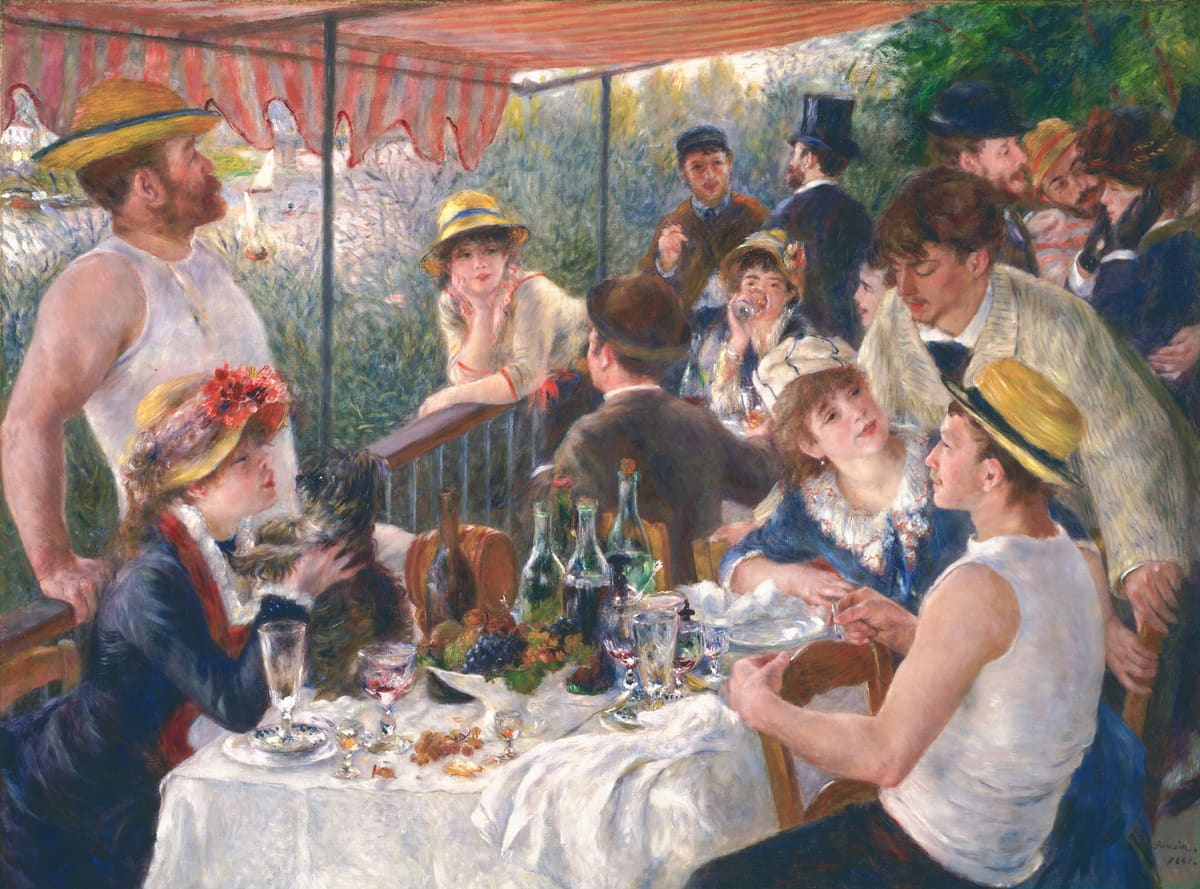
Renoir's other great crowd of friends, four years later, on a restaurant balcony by the Seine.

A Sunday Afternoon on the Island of La Grande Jatte
1884
Seurat's Sunday leisure of the 1880s — the same subject, frozen and systematically dotted.

Music in the Tuileries
1862
Manet's earlier Paris crowd — the model for painting the public at play.
More by Pierre-Auguste Renoir
Luncheon of the Boating Party

