Women in the Garden
Four women among trees and flowerbeds, painted almost entirely outdoors in a rented garden at Ville-d'Avray, west of Paris.
Ville-d'Avray
The painting depicts a real landscape or cityscape. The precise viewpoint the artist used may be unknown, so the marker shows the general area.
Women in the Garden — at a glance
- Artist
- Claude Monet (1840–1926)
- Year
- 1866
- Movement
- Impressionism (early)
- Place
- A rented garden at Ville-d'Avray, west of Paris
- Viewpoint
- A leafy suburban garden — not preserved or marked; beds rearranged for the picture
- Medium
- Oil on canvas
- Dimensions
- c. 255 × 205 cm
- Now at
- Musée d'Orsay, Paris
Overview
Women in the Garden is an early, ambitious canvas by Claude Monet, made in 1866 when he was twenty-five. It is a large picture — about 255 by 205 cm — of four fashionably dressed women (all posed by his companion Camille Doncieux) in a sunlit garden: one seated on the grass with a bunch of flowers, two on a path, one reaching up into a tree. It was rejected by the Salon of 1867 and is now in the Musée d'Orsay, Paris.
The story behind the painting
Scholarship Monet was determined to paint a Salon-scale figure picture entirely from nature. He worked on it in the garden of a house he rented that summer at Ville-d'Avray, digging a trench so the huge canvas could be raised and lowered on a pulley and the upper parts painted at the right level, and following the sunlight. Courbet, visiting, is said to have teased him for waiting for the sun. Money troubles forced Monet to leave Ville-d'Avray with the picture unfinished; he completed some passages in the studio.
Where was Women in the Garden painted?
Scholarship Ville-d'Avray is a small town between Sèvres and Versailles, west of Paris, then semi-rural and known to painters (Corot's family had a house there). Monet rented a property with a garden for the summer of 1866. The specific garden is not preserved or marked, and the painting rearranges its beds and paths for the composition; it records the kind of leafy suburban garden of the area rather than an identifiable spot.
What is in the painting?
A gravel path curves through a lawn under a spreading tree. A woman in a white dress with black spots sits on the grass at the left, a parasol behind her and flowers gathered in her lap. Two women stand on the path in pale summer dresses, one holding a small posy to her face; a fourth, in the shade, stretches up to pull down a flowering branch. Sunlight falls in sharp patches through the leaves onto the dresses and the path.
Look closely
The leaf shadows on white
Hard-edged patches of shade fall across the pale dresses, painted in blue and violet rather than grey.
The seated woman
In a black-spotted white dress on the grass, flowers gathered in her lap, a parasol behind her.
The reaching figure
A woman in shade stretches up to pull down a flowering branch.
The curving path
The gravel path sweeps through the lawn and organises the whole group.
Analysis
Composition & perspective
A near-life-size group arranged around a curving path, built so that light and dress, not story, are the subject.
Scholarship Monet spreads the four figures across the foreground with no narrative connecting them; the curving path and the arc of the tree organise the design. The point of the picture is the fall of bright sunlight and sharp shadow across white fabric out of doors — a problem earlier figure painting had avoided.
Colour and light
White and pale dresses cut by hard-edged leaf shadows, against green lawn and dark foliage.
Scholarship Monet paints the shadows on the white dresses in blues, greys and violets, and the sunlit parts in warm cream, refusing to make shadow simply ‘grey’. The green of the lawn and the almost black of the shaded tree set the figures off. The handling is broad and direct.
History & provenance
After the Salon rejection the painting was bought by Monet's friend Frédéric Bazille to help him financially; Monet reacquired it years later, and it was bought by the French state in 1921. It hangs in the Musée d'Orsay, Paris.
Sources
- Musée d'Orsay, Paris — collection entry for Claude Monet, ‘Femmes au jardin’ (‘Women in the Garden’, 1866; oil on canvas, c. 255 × 205 cm)
- House, John, ‘Monet: Nature into Art’ (Yale University Press, 1986)
Frequently asked
Where was Women in the Garden painted?
Mostly outdoors in the garden of a house Monet rented for the summer of 1866 at Ville-d'Avray, a then semi-rural town between Sèvres and Versailles, west of Paris.
Can you visit the garden?
No. The specific garden is not preserved or marked, and the painting rearranges its beds and paths. It represents the leafy suburban gardens of the area rather than an identifiable spot.
Who are the four women?
All four were posed by Monet's companion (and later wife) Camille Doncieux. There is no story linking them; they are there to carry sunlight and summer dress.
Is it true Monet dug a trench for the canvas?
Yes. The canvas was so large that Monet set it in a trench with a pulley so he could raise and lower it and paint the upper parts outdoors at the right height, following the sun.
Where is the painting now?
In the Musée d'Orsay, Paris.
Related paintings

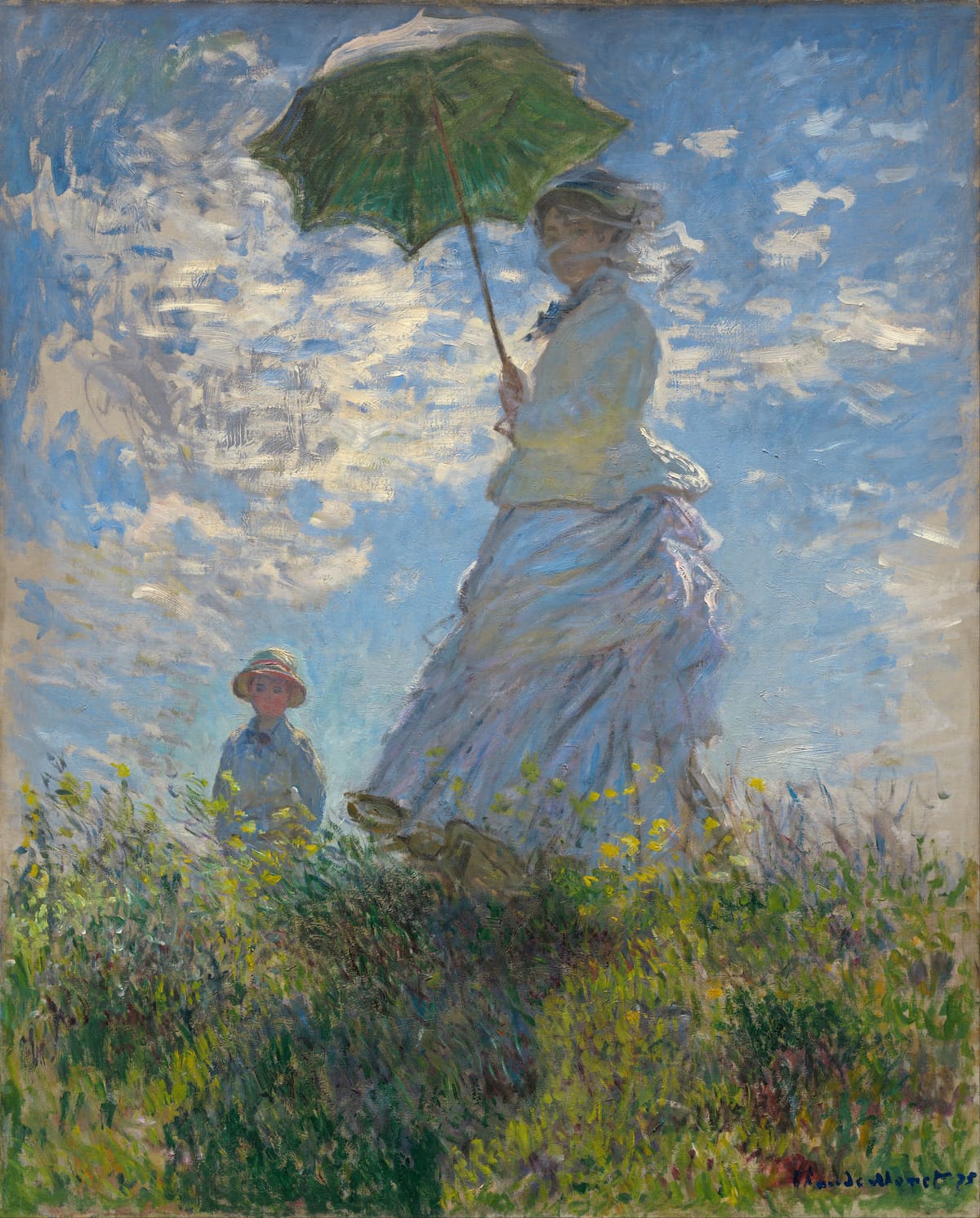
Woman with a Parasol – Madame Monet and Her Son
1875
Monet's 1875 open-air figure of Camille — the same problem of sunlight on a white dress, solved more freely.

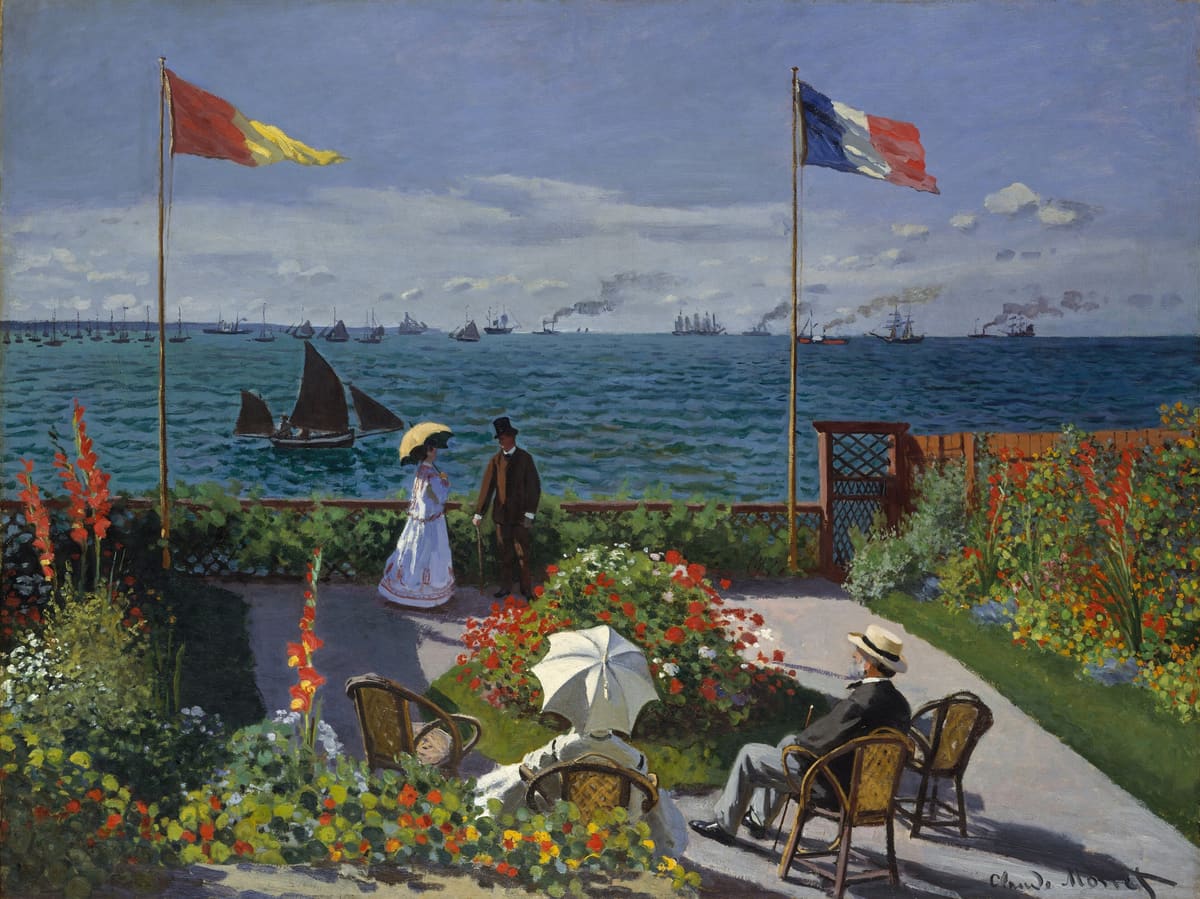
Garden at Sainte-Adresse
1867
Monet's bright terrace of 1867 — the next summer, the same interest in a garden full of light.

Le Déjeuner sur l'herbe
1866
Monet's forest picnic begun in 1865 — his other big early bid for a plein-air Salon figure painting.
More by Claude Monet
Impression, Sunrise
Woman with a Parasol – Madame Monet and Her Son

Houses on the Achterzaan