The Yellow House
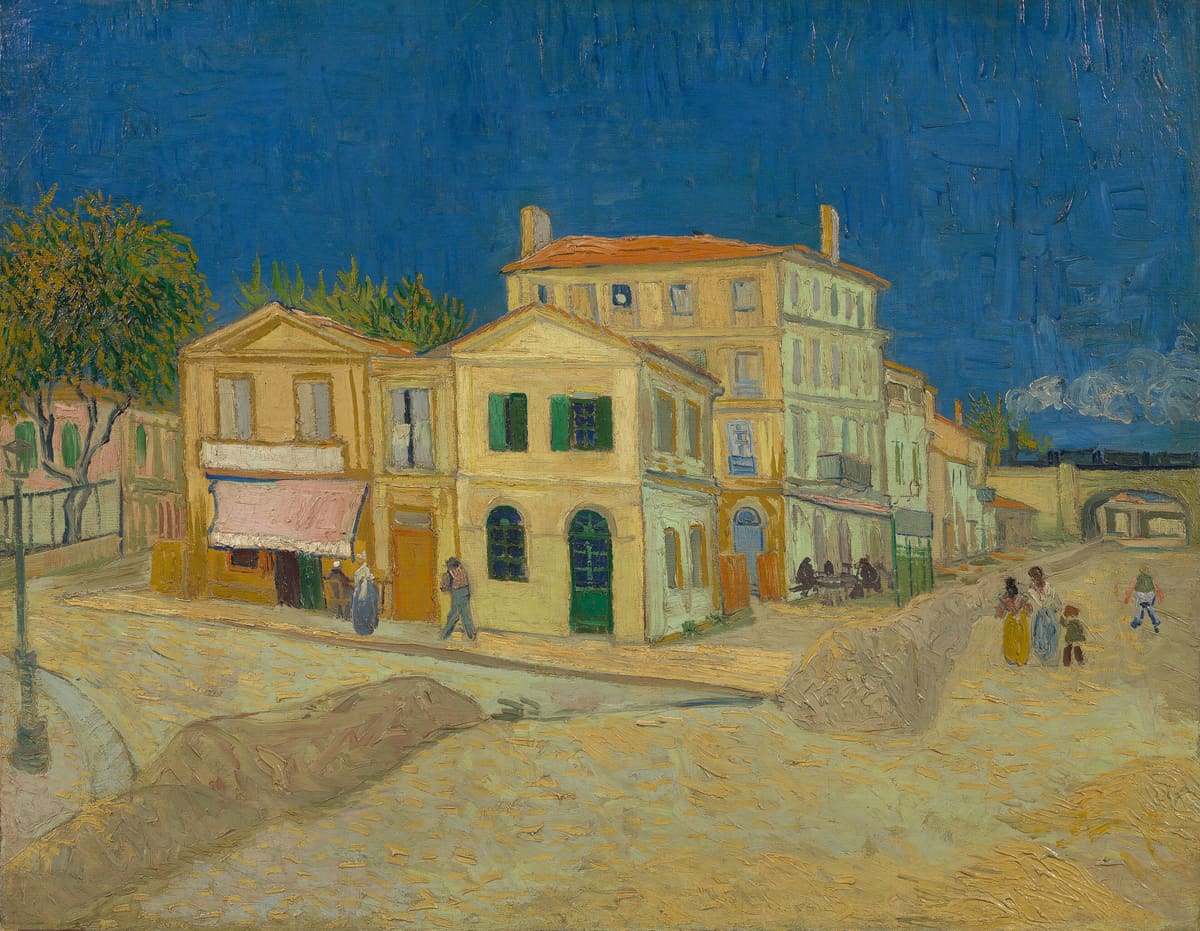
2 Place Lamartine in Arles — the house where Van Gogh tried to found an artists' colony, destroyed by bombing in 1944.
Arles
The painting shows a real, identified place. Its exact position is approximate — the marker shows the general location.
The Yellow House — at a glance
- Artist
- Vincent van Gogh (1853–1890)
- Year
- September 1888
- Movement
- Post-Impressionism
- Place
- 2 Place Lamartine, Arles, France
- Viewpoint
- Across the square toward the house corner — building destroyed 1944; site marked
- Medium
- Oil on canvas
- Dimensions
- c. 72 × 92 cm
- Now at
- Van Gogh Museum, Amsterdam
Overview
The Yellow House is an oil painting Vincent van Gogh made in Arles in September 1888. It shows the house on the Place Lamartine that he had rented and was furnishing, hoping to turn it into a shared studio for like-minded painters. It is oil on canvas, about 72 by 92 cm, and it hangs in the Van Gogh Museum, Amsterdam.
The house no longer exists. It was badly damaged in an Allied bombing raid in 1944 and later demolished.
The Studio of the South
Van Gogh rented four rooms in the right-hand wing of the house in May 1888 and spent the summer furnishing it — buying beds, chairs and crockery — and painting the sunflower canvases meant to decorate the guest room. He imagined it as the ‘Studio of the South,’ where painters would live and work together and share costs.
Artist's own account He wrote to his brother Theo describing the picture: the house and its surroundings in sulphur yellow under a sky of pure cobalt, with the pink grocer's shop, the green shutters of a restaurant, and the railway line and its bridges running behind.
Paul Gauguin arrived to join him on 23 October 1888. The two men worked intensely together for two months; the arrangement collapsed after the crisis of 23 December in which Van Gogh cut his own ear.
Where was The Yellow House painted?
The house stood at 2 Place Lamartine, just outside the old town's northern gate, the Porte de la Cavalerie.
Museum interpretation It was hit in an Allied air raid on 25 June 1944 — the target was the railway bridges over the Rhône — and the ruin was demolished afterwards. The site, beside what is now the Avenue de Stalingrad, is identified and marked, and the railway bridge that appears behind the house in the painting still stands.
What is in the painting?
A two-storey house with green shutters stands at a street corner under an intense blue sky. Van Gogh's rooms are the right-hand part; a restaurant with an awning occupies the ground floor of the left wing.
A railway bridge crosses the road behind the house, and a small train with a plume of smoke runs along the embankment. Figures walk the pavement and sit at the café terrace at the left; the square in front is bare pinkish ground.
Look closely
Van Gogh's rooms
The right-hand wing of the house, with the first-floor shutters shown open — his four rented rooms.
The railway bridge
A bridge crosses the road behind the house; the real bridge survived the 1944 raid that destroyed the house.
The little train
A steam train runs along the embankment, trailing pale green smoke.
The corner restaurant
An awning and terrace occupy the ground floor of the left wing, with figures seated outside.
The bare square
The foreground is open pinkish ground — the Place Lamartine — with a horse and cart crossing it.
Details that are easy to miss. A small steam train runs along the embankment behind the house, trailing green-white smoke; the two railway bridges cross the road; the café at the left is the one Van Gogh painted in The Night Café's neighbour, the Café de la Gare area; a horse and cart and walking figures cross the bare square; and the shutters of Van Gogh's own rooms are shown open on the first floor.
Analysis
Composition & perspective
The house is set at an angle at a corner, so two of its faces show, with the road and railway sweeping past behind.
Scholarship Van Gogh places the building slightly right of centre, cropped at the top, its two visible walls meeting at the corner. The open pink square fills the foreground; the road, the pavement and the railway embankment run back to the left, drawing the eye past the house.
Colour and light
Sulphur-yellow walls against a pure cobalt sky — the sharpest possible warm–cool contrast, in flat blocks.
Artist's own account The house is a strong yellow, the sky an unbroken deep blue, the shutters and the trees green, the ground pink. Van Gogh told Theo the yellow-against-blue was almost harsh. The light is midday, flat and shadowless.
Handling and technique
Firm, blocky brushwork with clear outlines, the sky and ground worked in long directional strokes.
The paint is applied in decisive, fairly flat areas with dark contour lines around the buildings — an approach influenced by Japanese prints — rather than the swirling touch of the later Saint-Rémy work.
Meaning and interpretation
Interpretations differ. What the artist documented, what museums and scholars propose, and later or speculative theories are marked and kept separate.
A portrait of a hope
For Van Gogh the house was the centre of a plan — a community of painters in the south. The picture records the building at the moment that plan seemed possible, weeks before Gauguin's arrival.
Read backwards through what followed
Because the ‘Studio of the South’ ended so badly, the painting is often seen now as poignant — an image of optimism about to fail. That colouring is hindsight; in September 1888 Van Gogh was hopeful.
History & provenance
- May 1888Van Gogh rents four rooms at 2 Place Lamartine, Arles.
- Sept 1888Paints The Yellow House; describes it to Theo.
- 23 Oct 1888Gauguin arrives; the two work together until the December crisis.
- 25 June 1944The house is destroyed in an Allied air raid on the Arles railway bridges.
- TodayVan Gogh Museum, Amsterdam; the site in Arles is marked.
The painting stayed with the Van Gogh family and passed to the Van Gogh Museum in Amsterdam. The house itself was lost in 1944; the railway bridge behind it survives.
Sources
- Van Gogh Museum, Amsterdam — collection entry for ‘The Yellow House (The Street)’ (oil on canvas, c. 72 × 91.5 cm)
- Vincent van Gogh: The Letters (Van Gogh Museum / Huygens ING), vangoghletters.org — letter to Theo van Gogh, Arles, about 28 September 1888
- Martin Bailey, ‘The Yellow House: Van Gogh, Gauguin, and Nine Turbulent Weeks in Arles’ (2006)
Frequently asked
Where was the Yellow House?
At 2 Place Lamartine in Arles, just outside the old town's northern gate. Van Gogh rented four rooms in the right-hand wing in May 1888.
Can you visit it?
No. The house was destroyed in an Allied bombing raid on 25 June 1944 and demolished afterwards. The site, beside the Avenue de Stalingrad, is identified and marked, and the railway bridge behind it still stands.
What was the ‘Studio of the South’?
Van Gogh's plan to make the house a shared home and workshop for a group of painters. He furnished it and painted his sunflower canvases to decorate the guest room for Gauguin.
Did Gauguin live there?
Yes, from 23 October to late December 1888. The two men worked together intensely until the crisis in which Van Gogh cut his ear, after which Gauguin left.
Why is the colour so harsh?
Van Gogh set a strong sulphur-yellow house against a pure cobalt sky — the sharpest warm–cool contrast he could make. He told Theo the effect was almost too much.
What is the train in the picture?
A small steam train running along the embankment behind the house, on the Paris–Lyon–Marseille line, with the two railway bridges crossing the road.
Where is the painting now?
In the Van Gogh Museum, Amsterdam.
Related paintings

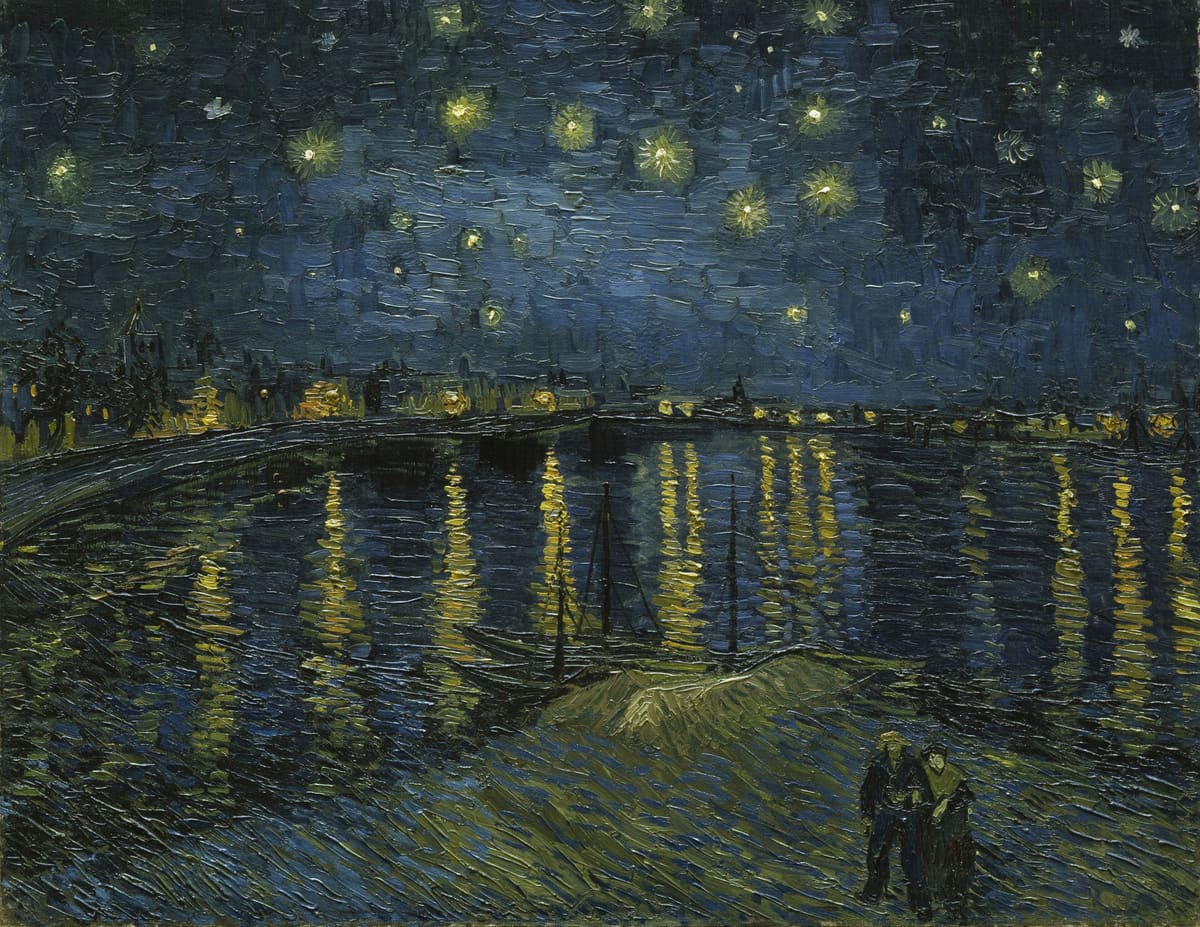
Starry Night Over the Rhone
1888
The riverbank a few minutes' walk away, painted the same month, also at Arles.

Café Terrace at Night
1888
The Place du Forum café in the old town, painted the same September.

The Night Café
1888
The all-night café near the Yellow House where Van Gogh had lodged before renting it.
More by Vincent van Gogh
Café Terrace at Night
The Church at Auvers
Starry Night Over the Rhone
Agostina Segatori Sitting in the Café du Tambourin
Also connected to Arles
Café Terrace at Night

Landscape with Snow

View of Arles, Flowering Orchards