The Night Café
The all-night Café de la Gare on the Place Lamartine in Arles, where Van Gogh lodged — a room he called a place where you could ‘ruin yourself, go mad or commit a crime’.
Arles
The painting shows a real, identified place. Its exact position is approximate — the marker shows the general location.
The Night Café — at a glance
- Artist
- Vincent van Gogh (1853–1890)
- Year
- September 1888
- Movement
- Post-Impressionism
- Place
- Café de la Gare, 30 Place Lamartine, Arles, France
- Viewpoint
- Inside the café where Van Gogh lodged — the building was destroyed by bombing in 1944
- Medium
- Oil on canvas
- Dimensions
- c. 70 × 89 cm
- Now at
- Yale University Art Gallery, New Haven
Overview
The Night Café is one of the pictures Vincent van Gogh painted during his stay in Arles in the autumn of 1888, and one he regarded as among his most important. It shows the inside of a cheap all-night café: a glaring green ceiling and red walls, a half-empty billiard table under a single yellow lamp, a few slumped drinkers along the walls, and the white-suited landlord standing beside the billiard table. It is oil on canvas, about 70 by 89 cm, and it hangs in the Yale University Art Gallery.
In a letter to his brother Theo, Van Gogh wrote that he had tried to show ‘that the café is a place where one can ruin oneself, go mad or commit a crime’, and that he had sought to express ‘the terrible passions of humanity by means of red and green’.
The story behind the painting
Artist's own account Van Gogh was lodging at the Café de la Gare while he waited to move into the Yellow House, and its owners, Joseph and Marie Ginoux, became friends and models. He told Theo that he had stayed up three nights running to paint the café, sleeping in the daytime.
Artist's own account He described the picture frankly as ‘one of the ugliest I have done’, but also as the equivalent in feeling of another of his canvases, and he valued it highly enough to trade it, along with other works, to pay his rent to the Ginoux family.
Where was The Night Café painted?
Museum interpretation The Café de la Gare stood at 30 Place Lamartine in Arles, near the railway station and next to the Yellow House where Van Gogh was about to live. Both buildings were on the square just outside the old town walls. The whole block was destroyed when Arles was bombed in 1944, so neither the café nor the Yellow House still exists; the Place Lamartine is now an open road junction and garden, and only a plaque and old photographs mark where they stood.
What is in the painting?
The room is seen down its length. A large billiard table stands slightly off-centre in the foreground, casting a long shadow across the red floor. Four gas lamps blaze with yellow-orange haloes against the high green ceiling. Along the walls, a handful of night-time customers sit alone or in pairs, heads down over their glasses; at the back, a couple sits under a clock that reads past midnight, and a curtained doorway leads out. The landlord, in a pale coat, stands beside the billiard table facing the viewer.
Look closely
The billiard table
A large table blocks the centre of the room, casting a long shadow across the red floor.
The blazing lamps
Four gas lamps burn with orange-yellow haloes against the green ceiling.
The slumped drinkers
A few solitary customers sit head-down over their glasses along the walls in the small hours.
The landlord in white
Joseph Ginoux, Van Gogh's landlord, stands beside the billiard table facing out.
The clock and the back door
A clock past midnight hangs over a seated couple; a curtained doorway leads out at the end of the rushing perspective.
Red against green
Blood-red walls, green ceiling and green cloth — deliberately clashing colours.
Analysis
Composition & perspective
A steep, rushing perspective drives the floor and ceiling to a small doorway at the back; the billiard table blocks the centre.
Scholarship Van Gogh tips the floor up and drives the lines of the walls, ceiling and floorboards hard towards a curtained door at the rear, so the room feels both cramped and unstable. The heavy billiard table sits square in the path of that perspective, and the lamps pulse outward in concentric rings.
Colour and light
Clashing red and green throughout, with sour yellow lamplight — colour used deliberately for psychological effect.
Artist's own account Van Gogh set blood-red walls against a harsh green ceiling and a green billiard cloth, with yellow-green and acid-yellow in the lamps and floor. He wrote that he wanted these near-complementary colours, jarring against each other, to convey ‘the terrible passions of humanity’ and the feeling of a place where a person might come to grief.
Meaning and interpretation
Interpretations differ. What the artist documented, what museums and scholars propose, and later or speculative theories are marked and kept separate.
A place of ruin
Van Gogh's own letters are unusually explicit: the café is painted as an atmosphere, a place of sleeplessness, drink and despair, where ‘one can ruin oneself, go mad or commit a crime’. The isolated, slumped figures and the empty small hours carry that.
Colour as emotion
The picture is a landmark in the move towards using colour expressively rather than descriptively — a direct source for Fauvism and Expressionism — precisely because Van Gogh explained what he wanted the red and green to do.
The landlord
The white-suited figure of Joseph Ginoux stands at the centre like a still point among the wrecked customers; readings of him range from watchful host to a faintly sinister presence, but these are interpretation, not Van Gogh's stated intent.
History & provenance
Van Gogh gave the painting to the Ginoux family against his rent. It passed through European collections, was owned before the First World War by a Russian collector, and eventually came to the American collector Stephen Carlton Clark, who bequeathed it to the Yale University Art Gallery in 1961.
Sources
- Yale University Art Gallery — collection entry for Vincent van Gogh, ‘The Night Café’ (1888; bequest of Stephen Carlton Clark, 1961; oil on canvas, c. 70 × 89 cm)
- ‘Vincent van Gogh: The Letters’ (Van Gogh Museum / Huygens ING) — letters to Theo van Gogh, September 1888
- Van Gogh Museum, Amsterdam — background on the Ginoux family and the Place Lamartine in Arles
Frequently asked
Was the Night Café a real place?
Yes. It was the Café de la Gare at 30 Place Lamartine in Arles, an all-night café run by Joseph and Marie Ginoux, where Van Gogh was lodging in 1888 before he moved into the Yellow House next door.
Can you visit it?
No. The whole block on the Place Lamartine, including the café and the Yellow House, was destroyed when Arles was bombed in 1944. The square is now a road junction and garden; a plaque and old photographs mark the site.
What did Van Gogh say about it?
In a letter to his brother Theo he wrote that he had tried to show that ‘the café is a place where one can ruin oneself, go mad or commit a crime’, and that he used red and green to express ‘the terrible passions of humanity’. He also called it one of the ugliest pictures he had made.
Why are the colours so harsh?
Deliberately. Van Gogh set red against green — near-opposite colours — to make the room feel oppressive and disturbed. It is an early, self-explained example of using colour for emotion rather than description.
Who is the man in white?
Joseph Ginoux, the café's owner and Van Gogh's landlord, standing beside the billiard table. His wife, Marie Ginoux, is the model for Van Gogh's later ‘L'Arlésienne’ portraits.
Where is the painting now?
In the Yale University Art Gallery, New Haven, which received it as part of the Stephen Carlton Clark bequest in 1961.
Related paintings


More by Vincent van Gogh
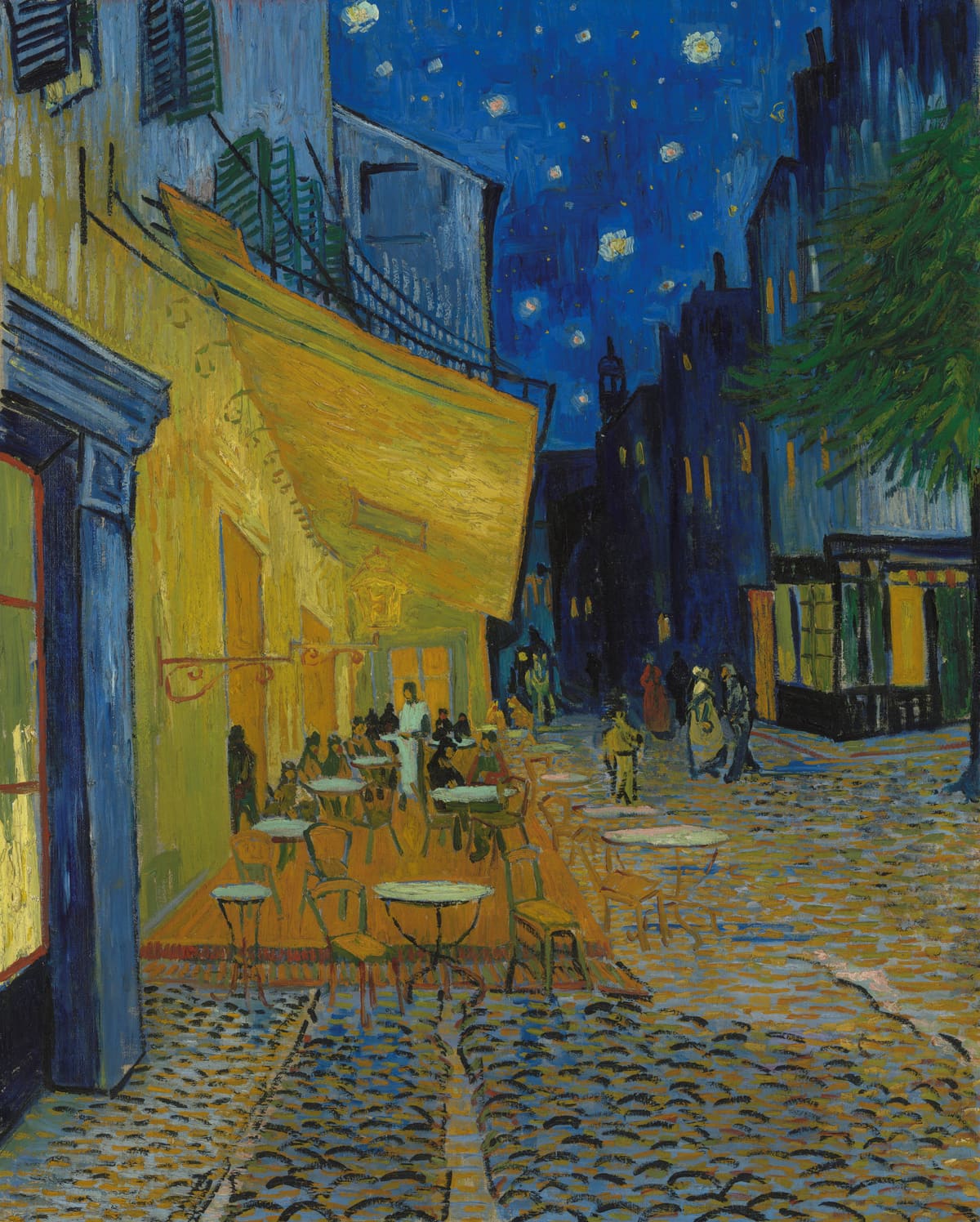
Café Terrace at Night
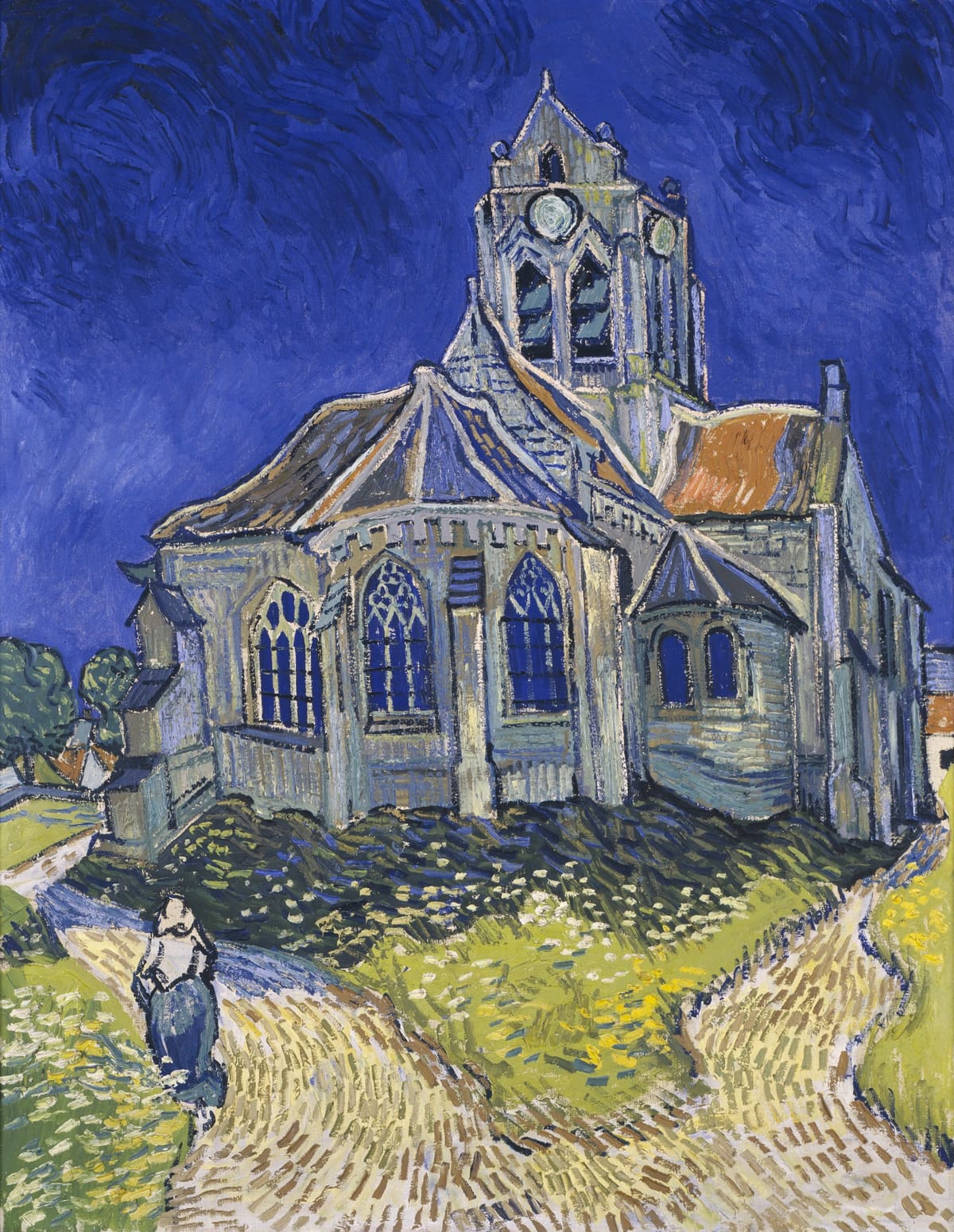
The Church at Auvers
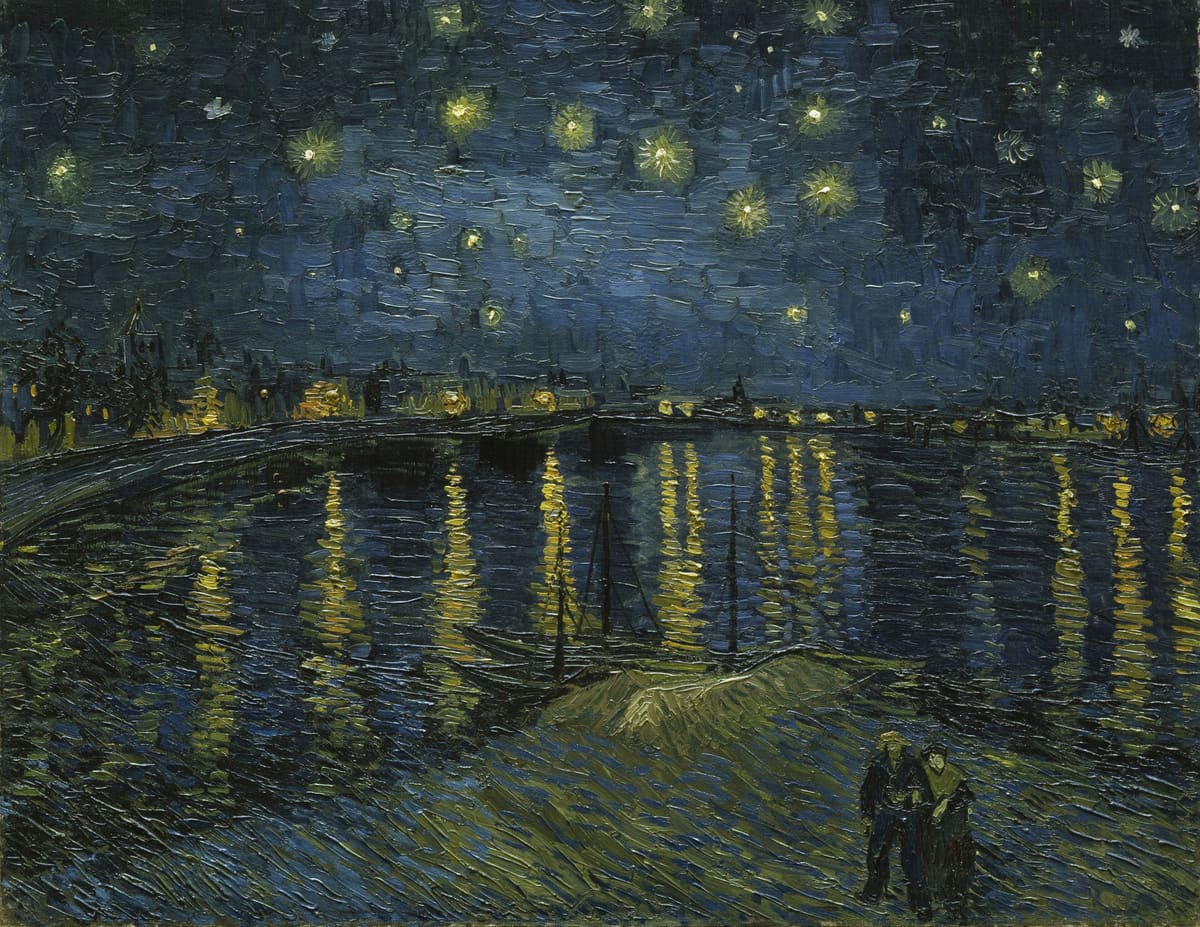
Starry Night Over the Rhone
Agostina Segatori Sitting in the Café du Tambourin
Also connected to Arles
Café Terrace at Night

Landscape with Snow

View of Arles, Flowering Orchards