Les Alyscamps
The Roman burial avenue at Arles — a real, walkable alley of stone coffins and poplars that Van Gogh and Gauguin painted side by side.
The Alyscamps
The painting shows a real, identified place that you can find today. The exact spot the artist worked from is not necessarily known.
Les Alyscamps — at a glance
- Artists
- Vincent van Gogh (1853–1890); also Paul Gauguin
- Year
- Autumn 1888
- Movement
- Post-Impressionism
- Place
- Les Alyscamps, Arles, France
- Viewpoint
- The Allée des Sarcophages — the avenue is open to visitors and little changed
- Medium
- Oil on canvas
- Dimensions
- c. 73 × 92 cm (each canvas)
- Now at
- Kröller-Müller Museum, Otterlo, and private collections
Overview
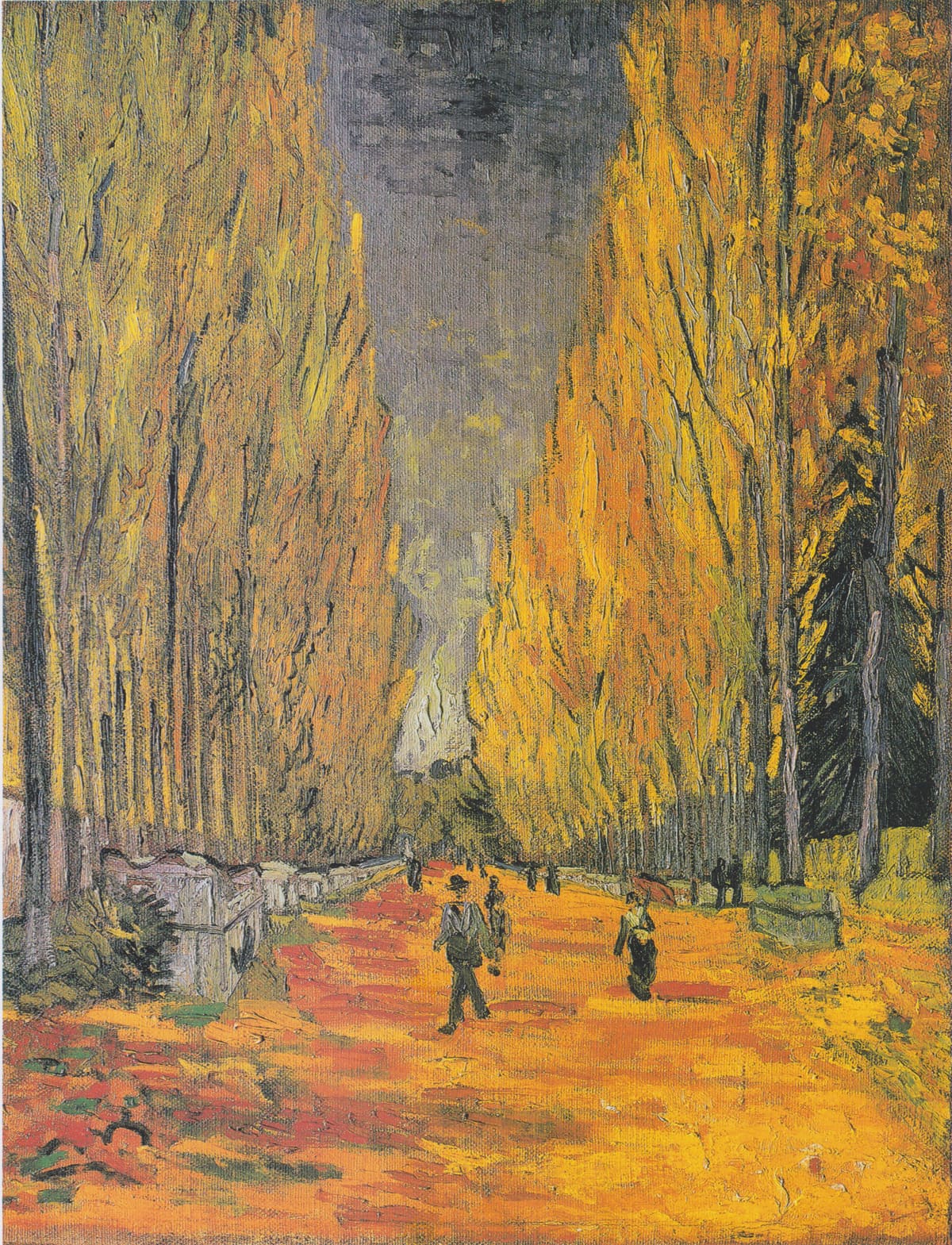
Les Alyscamps is the subject of several canvases Vincent van Gogh made in Arles in late October and early November 1888, sometimes working beside Paul Gauguin, who had just arrived to share the Yellow House. Gauguin painted the site as well. The Van Gogh versions are dispersed — two are in the Kröller-Müller Museum, others in private hands.
The subject is a real place: an ancient burial avenue on the edge of Arles.
Painting together at Arles
Gauguin reached Arles on 23 October 1888. In the first weeks the two men went out to paint together, and the Alyscamps — a short walk from the Yellow House — was one of the first motifs they shared.
Artist's own account Van Gogh wrote to Theo about the avenue of falling leaves — orange and yellow drifts along the path and over the old coffins — and about working the autumn colour. The joint campaign lasted only two months; it ended with the crisis of 23 December.
Where was Les Alyscamps painted?
The Alyscamps (from ‘Elisii Campi,’ the Elysian Fields) is a Roman and early-Christian necropolis on the south-east edge of Arles, in use for burials for well over a thousand years.
Museum interpretation The surviving stretch — the Allée des Sarcophages, an avenue of empty stone coffins lined with poplars and closed at the far end by the ruined Romanesque church of Saint-Honorat — is essentially the view the painters used, and it is open to the public as a monument. It forms part of the UNESCO-listed Roman and Romanesque monuments of Arles.
What is in the painting?
A straight avenue recedes under tall trees. The ground, and the small figures walking it, are covered in fallen orange and yellow leaves. A line of empty stone sarcophagi runs along one side. In some versions the square tower of Saint-Honorat closes the view; in others the framing is tighter, filling the canvas with the trunks and the drift of leaves.
Look closely
The stone sarcophagi
Real Roman and medieval coffins, long emptied, line one side of the path.
The church of Saint-Honorat
Its square tower closes the far end of the avenue in the wider versions.
The carpet of leaves
The ground is a thick fall of orange and yellow — not grass — running the length of the path.
The walking figures
Small couples and lone strollers move down the avenue in most of the canvases.
The colonnade of poplars
The tall trees form a receding avenue that drives the perspective hard into depth.
Details that are easy to miss. The stone boxes along the path are real Roman and medieval sarcophagi, long emptied; the tower closing some versions is the church of Saint-Honorat; small couples and single figures walk the avenue in most of the canvases; and the ground is not grass but a thick fall of coloured leaves.
Analysis
Composition & perspective
A steep one-point perspective drives the avenue and the row of trees to a distant vanishing point — sometimes with the church tower as the stop, sometimes cropped close.
Scholarship Van Gogh varies the framing across the group. In the wider canvases the poplars form a colonnade rushing back to the tower; in the tighter ones he pushes right up into the trees so that the trunks become vertical bars and the path is a slot of leaf-covered ground. Gauguin's version flattens the space more and simplifies the masses.
Colour and light
Autumn at full strength: orange and gold leaves against blue-violet shadow and the grey of old stone.
Scholarship Van Gogh works the fallen leaves as a carpet of orange and lemon, set against the cool violet-blue of the tree shadows and the weathered grey of the sarcophagi, with touches of green in the trunks. The light is low autumn sun raking down the avenue.
Handling and technique
Thick, directional strokes laid down fast on the spot — and, briefly, Gauguin's influence pushing Van Gogh toward flatter, more worked-from-memory areas.
The Van Gogh canvases are painted with a loaded brush, the strokes following the run of the path and the fall of the leaves. Working next to Gauguin in these weeks, Van Gogh experimented with more deliberate, decorative handling in places, though he soon returned to painting directly from the motif.
Meaning and interpretation
Interpretations differ. What the artist documented, what museums and scholars propose, and later or speculative theories are marked and kept separate.
An autumn motif, shared
For both painters the Alyscamps was primarily a landscape opportunity — a strong perspective, brilliant seasonal colour, and the odd poetry of an ancient graveyard turned into a public promenade.
Mortality in the setting
The row of empty coffins and the ruined church give the pictures an undertone of transience, and some writers read them beside Van Gogh's earlier churchyard studies. Van Gogh's own letters, though, emphasise the colour and the falling leaves.
History & provenance
- Oct–Nov 1888Van Gogh and Gauguin paint the Alyscamps at Arles, some canvases side by side.
- 23 Dec 1888The crisis in the Yellow House ends the joint campaign; Gauguin leaves.
- 20th c.Van Gogh's versions disperse; two enter the Kröller-Müller Museum.
- TodayKröller-Müller Museum (Otterlo) and private collections; Gauguin's version in the Musée d'Orsay.
Unlike most works on this site, the Alyscamps pictures are a small group rather than one painting: two Van Gogh canvases are in the Kröller-Müller Museum, others are privately held, and Gauguin's Alyscamps is in the Musée d'Orsay.
Sources
- Kröller-Müller Museum, Otterlo — collection entries for the two Van Gogh ‘Les Alyscamps’ canvases
- Vincent van Gogh: The Letters (Van Gogh Museum / Huygens ING), vangoghletters.org — letters to Theo van Gogh, Arles, late October–November 1888
- Ville d'Arles — Les Alyscamps, monument historique; UNESCO World Heritage listing for Arles
- Douglas Druick & Peter Zegers, ‘Van Gogh and Gauguin: The Studio of the South’ (Art Institute of Chicago, 2001)
Frequently asked
What is Les Alyscamps?
A Roman and early-Christian burial ground on the south-east edge of Arles, used for burials for over a thousand years. Its avenue of empty stone coffins, lined with poplars and ending at a ruined church, is the view the painters used.
Can you visit the avenue?
Yes. The Allée des Sarcophages is open to the public as a monument and is little changed — part of the UNESCO-listed Roman and Romanesque monuments of Arles.
Did Van Gogh and Gauguin paint it together?
Yes, in the first weeks after Gauguin arrived in Arles in October 1888. Some of the Alyscamps canvases were made side by side, before their partnership broke down in December.
Is there one painting called Les Alyscamps?
No — it is a small group. Van Gogh made several canvases of the site, and Gauguin painted it too. They are now in different collections.
What season is shown?
Autumn. The ground and the figures are covered in a thick fall of orange and yellow leaves, set against blue-violet tree shadow.
Where can the paintings be seen?
Two Van Gogh versions are in the Kröller-Müller Museum at Otterlo; others are in private collections. Gauguin's version is in the Musée d'Orsay, Paris.
Related paintings

The Yellow House
1888
The house a short walk away where Van Gogh and Gauguin were living during these weeks.

The Church at Auvers
1890
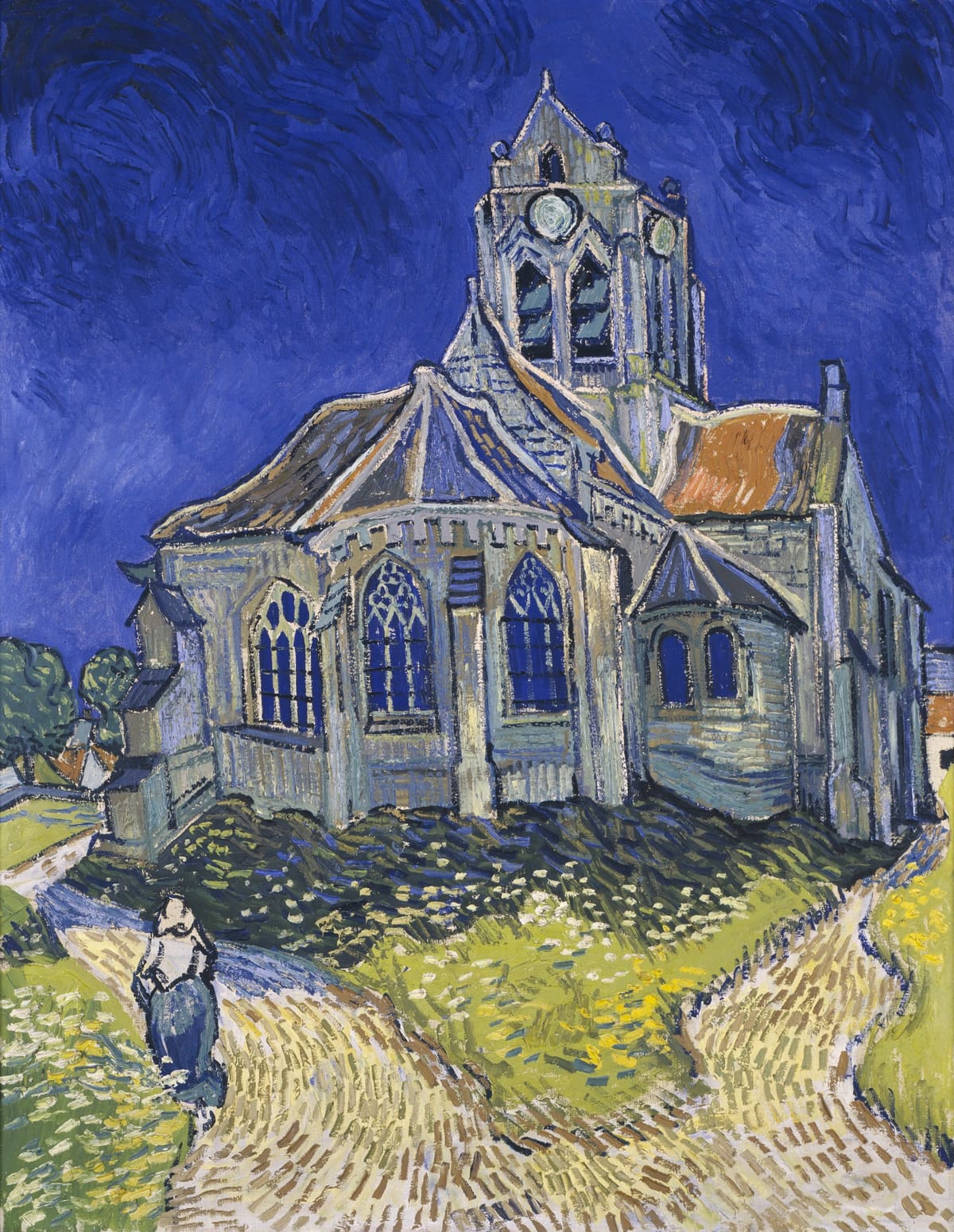
Van Gogh's later churchyard subject — the same interest in old religious buildings and mortality.

Café Terrace at Night
1888
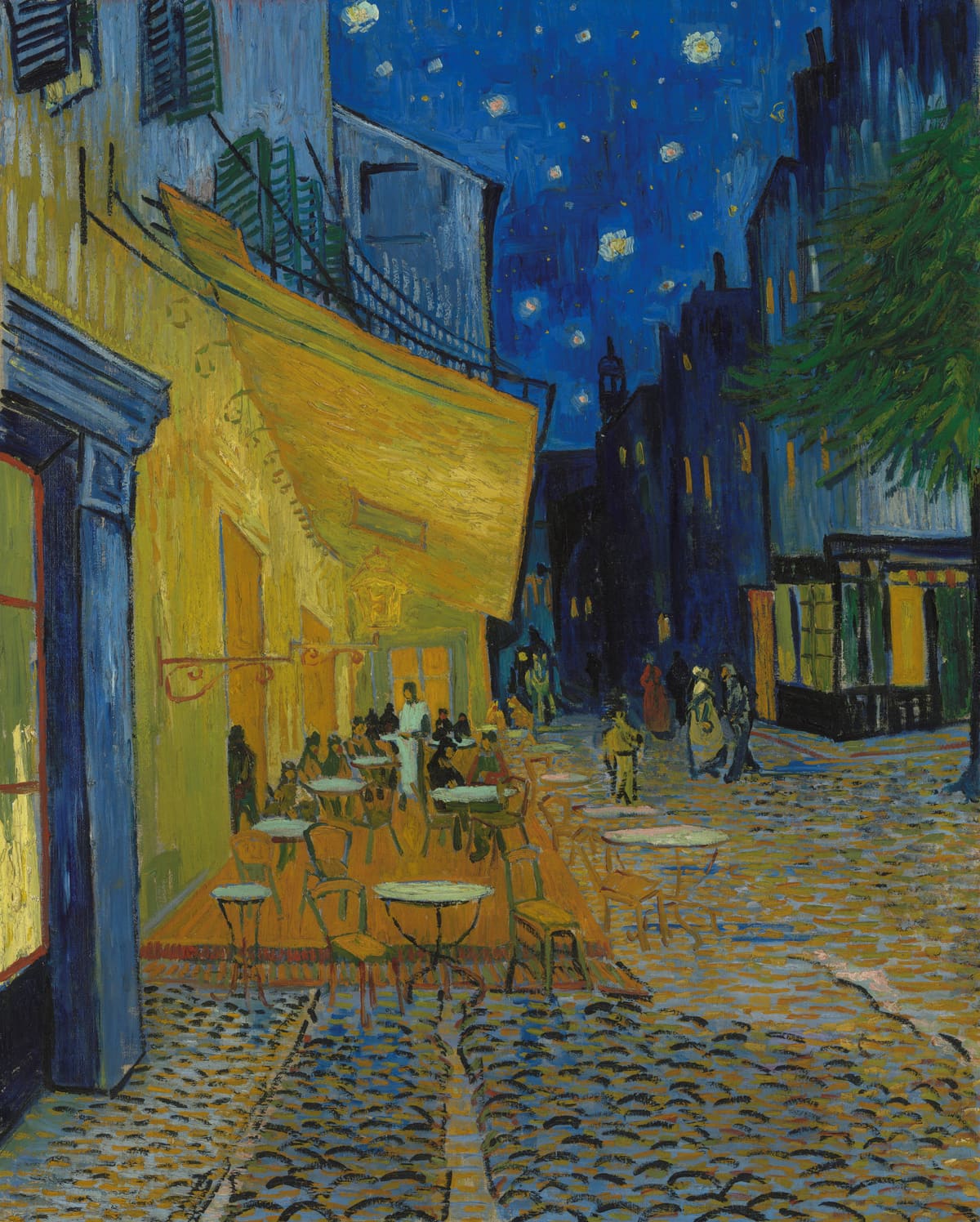
Painted in Arles a few weeks earlier, in the same burst of autumn work.
More by Vincent van Gogh
Café Terrace at Night
The Church at Auvers
Starry Night Over the Rhone