The Town Hall at Auvers
The little town hall of Auvers-sur-Oise hung with flags and lanterns for Bastille Day, seen from the inn where Van Gogh lodged.
Auvers-sur-Oise
The painting depicts a real landscape or cityscape. The precise viewpoint the artist used may be unknown, so the marker shows the general area.
The Town Hall at Auvers — at a glance
- Artist
- Vincent van Gogh (1853–1890)
- Year
- 1890
- Movement
- Post-Impressionism
- Place
- The place de la Mairie, Auvers-sur-Oise, France
- Viewpoint
- From the Auberge Ravoux across the square — inn and town hall both still stand, facing each other
- Medium
- Oil on canvas
- Dimensions
- c. 72 × 93 cm
- Now at
- Private collection
Overview
The Town Hall at Auvers is a bright, almost festive picture Vincent van Gogh painted on 14 July 1890 — Bastille Day — only weeks before his death. It shows the small village town hall (mairie) of Auvers-sur-Oise, its front hung with tricolour bunting, Chinese lanterns, greenery and flags, a Christmas-tree-like fir at the door, and a scatter of villagers in the sunny square. It is oil on canvas, about 72 by 93 cm, and it is in a private collection.
Where was The Town Hall at Auvers painted?
Scholarship Van Gogh painted this from, or just outside, the Auberge Ravoux — the café-inn on the place de la Mairie where he rented a small attic room and where he died on 29 July 1890 — looking across the square to the town hall opposite. The Auberge Ravoux (‘Maison de Van Gogh’) and the mairie both still stand, facing each other across the square, which is essentially unchanged; the view can be matched almost exactly, minus the holiday decorations.
What is in the painting?
The two-storey mairie, cream-walled with a slate roof and a clock, fills the centre, its façade festooned with bunting, lanterns and flags and a large fir set up by the door. Trees frame it on both sides; a few small figures stand or walk in the square in front. The light is bright, the colour high — the holiday feeling is unmistakable.
Look closely
The bunting and lanterns
The whole façade is festooned with tricolour bunting, Chinese lanterns, greenery and flags for the holiday.
The fir at the door
A large fir tree has been set up by the town hall entrance.
The square
A few villagers stand or walk in the sunny square in front — the same square that fronts the Auberge Ravoux.
Analysis
Composition and technique
The decorated building set square in the centre, framed by trees, the festive detail dashed in fast.
Scholarship Van Gogh centres the mairie frontally, frames it with the trees of the square, and lays in the bunting, lanterns and flags in quick, loaded touches, so the whole façade seems to flicker. It is one of his most straightforwardly cheerful subjects.
History & provenance
The painting has been in private hands since the twentieth century.
Sources
- Van Gogh Museum / catalogue raisonné — ‘The Town Hall at Auvers on 14 July 1890’
- Institut Van Gogh, Auberge Ravoux, Auvers-sur-Oise
Related paintings

The Rue Mosnier Dressed with Flags
1878
Manet's flag-hung Paris street of 1878 — the same national holiday, twelve years earlier.

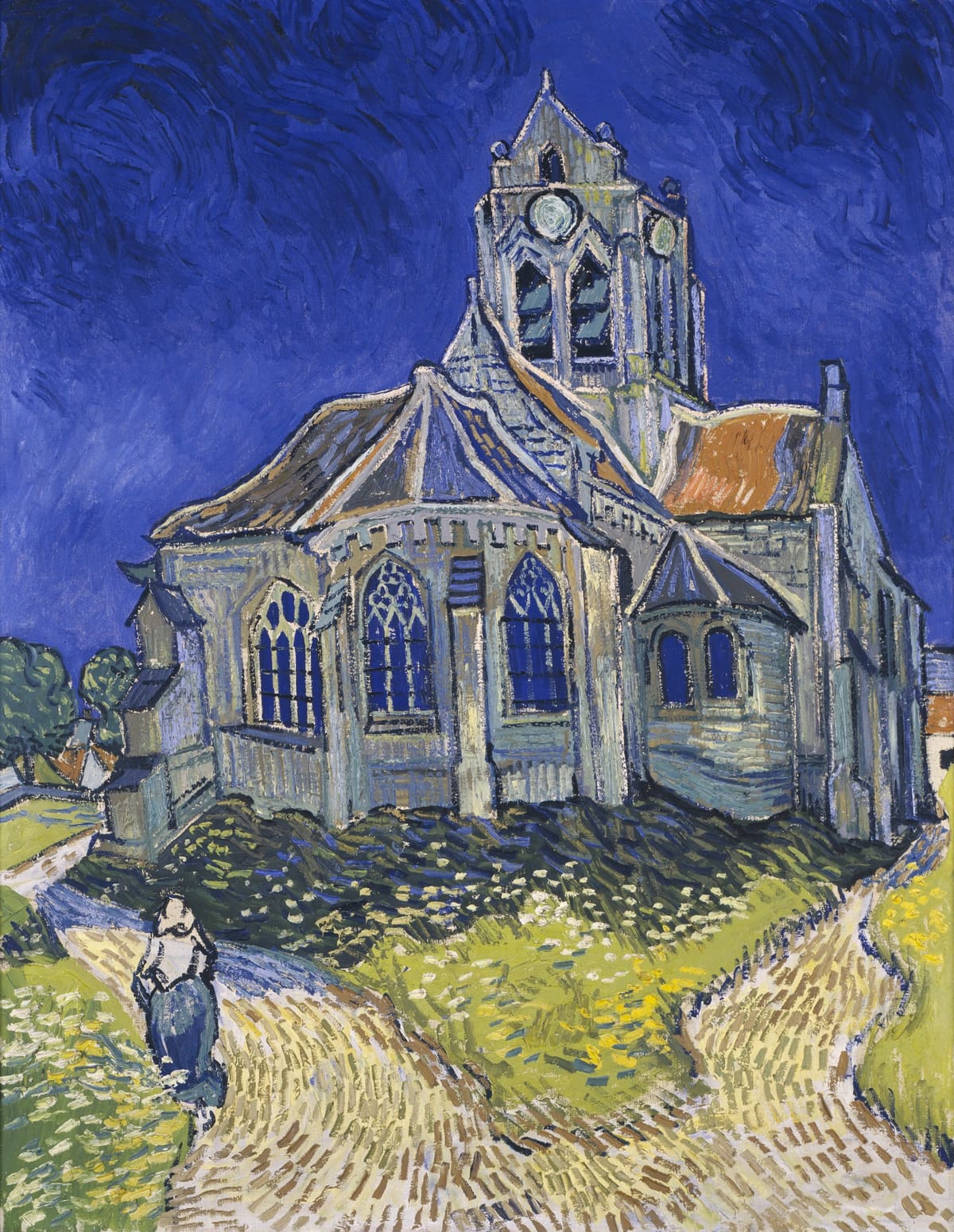
The Church at Auvers
1890
Van Gogh's church in the same village, painted the same summer.

Early Sunday Morning
1930
Hopper's small-town main street — the plain civic building as subject.
More by Vincent van Gogh
Café Terrace at Night
The Church at Auvers
Starry Night Over the Rhone
Agostina Segatori Sitting in the Café du Tambourin
Also connected to Auvers-sur-Oise
The Church at Auvers