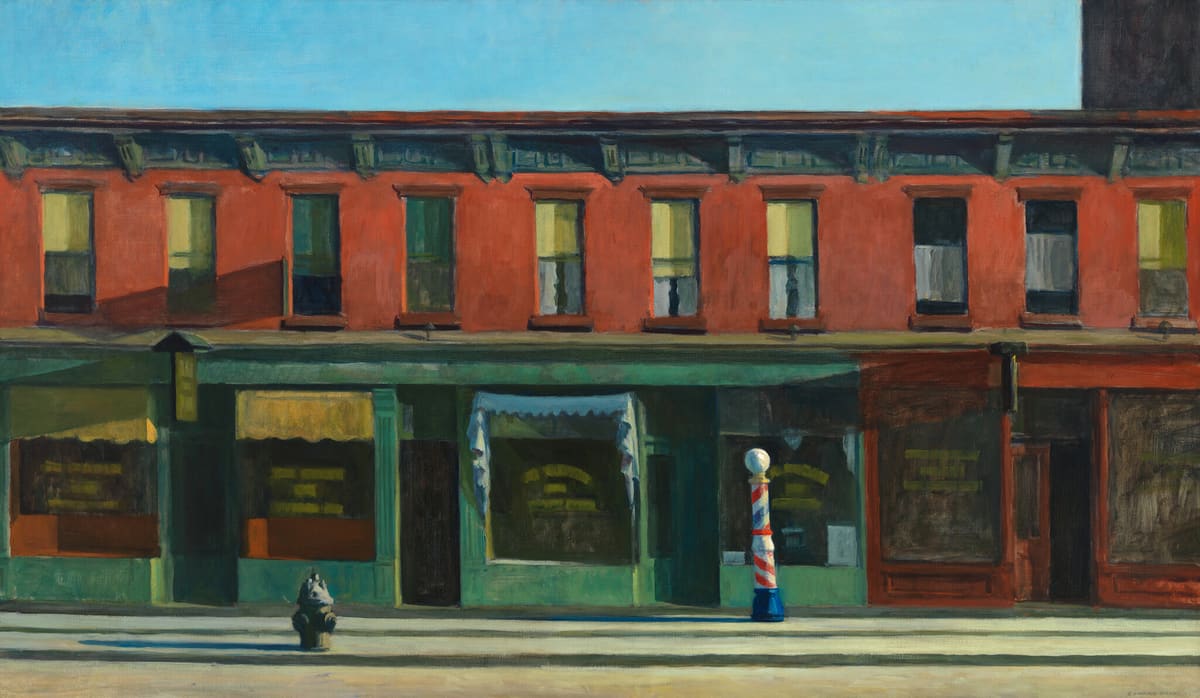
Early Sunday Morning
A stretch of Seventh Avenue in New York — simplified and rearranged until it became a type of street rather than one block.
Seventh Avenue
The painting shows a real, identified place that you can find today. The exact spot the artist worked from is not necessarily known.
Early Sunday Morning — at a glance
- Artist
- Edward Hopper (1882–1967)
- Year
- 1930
- Movement
- American Realism / American Scene
- Place
- Based on Seventh Avenue, Greenwich Village, New York — no confirmed block
- Viewpoint
- A composited row of shopfronts, seen head-on; not a fixed address
- Medium
- Oil on canvas
- Dimensions
- c. 89 × 153 cm
- Now at
- Whitney Museum of American Art, New York
Overview
Early Sunday Morning is a painting Edward Hopper made in 1930. It shows a two-storey row of shops with flats above, running the full width of the canvas in long, raking early light, with an empty sidewalk in front. It is oil on canvas, about 89 by 153 cm, and it has been in the Whitney Museum of American Art in New York since the year it was painted.
The story behind the painting
Hopper lived at 3 Washington Square North in Greenwich Village, and the picture began with the ordinary commercial buildings of Seventh Avenue nearby.
Artist's own account He flattened and simplified the row until, in his wife Jo's words, it became ‘almost a Seventh Avenue type’ rather than a portrait of one block. He also removed almost every figure. Hopper originally called it ‘Seventh Avenue Shops’; the more poetic title was suggested by someone else and he let it stand.
Where was Early Sunday Morning painted?
The source is Seventh Avenue in Greenwich Village, in Lower Manhattan, near Hopper's home.
Scholarship Because Hopper composited and pared down the buildings, there is no single confirmed address to visit — the picture is about the kind of street, not one identifiable row of it. The general character of low Village shopfronts survives, but nothing matches the painting exactly.
What is in the painting?
A long, plain brick row: shopfronts at street level, each with an awning-frame and a window, and a matching band of residential windows above. A red-and-white barber's pole and a squat fire hydrant stand on the wide, bare sidewalk.
The street is completely empty — no people, no cars. The low morning sun rakes in from the right, throwing the shadow of the buildings and the pole across the pavement. In the upper right, a dark rectangle — the shadow of a taller building just out of frame.
Look closely
The barber's pole
The red-and-white pole and the squat hydrant are the only upright ‘figures’ on the empty sidewalk.
The empty awning frames
The metal frames over the shops carry no awnings — the row is stripped to its bones.
The raking light
An almost horizontal early sun lengthens every shadow across the pavement.
The dark rectangle
Top right: the shadow of a taller building just out of frame — the one disruption to the even row.
No people, no cars
Not a single figure or vehicle anywhere — the street is completely deserted.
Details that are easy to miss. There is not a single person or vehicle anywhere in the picture; the barber's pole and the fire hydrant are the only ‘characters’; the awning frames are empty, with no awnings up; the dark rectangle at the upper right is the shadow of a taller, unseen building; and Hopper's first title was the flat ‘Seventh Avenue Shops.’
Analysis
Composition & perspective
A single long horizontal band of building fills the canvas, with almost no perspective — the street seen head-on, flattened to a frieze.
Scholarship Hopper aligns the row parallel to the picture plane, so the shopfronts and windows repeat across it in a near-regular rhythm with only slight recession. The vertical accents — the barber's pole, the hydrant, the shadows — punctuate the horizontal. The dark shape at the upper right is the one break in the order; Hopper is said to have considered painting it out.
Colour and light
Warm ochres and reds of brick and awning, thrown into strong relief by long, low, gold morning light and hard blue shadow.
Scholarship The palette is dominated by the brick's yellow-red and the tan of the awnings, with the barber's pole as a bright accent. The real subject is the light: an early, almost horizontal sun that lengthens every shadow and gives the ordinary row a stage-lit stillness.
Handling and technique
Broad, flat, deliberate paint with simplified forms — every window and cornice reduced to a plane.
Hopper worked slowly from sketches, cutting detail and straightening the row. The paint is even and matte, the drawing firm, the shapes generalised — the same spare method as his figure paintings, here with the figures taken out.
Meaning and interpretation
Interpretations differ. What the artist documented, what museums and scholars propose, and later or speculative theories are marked and kept separate.
The empty American street
The picture is read as a portrait of a kind of place — the plain commercial main street of an American town or city district — caught at an hour when it is deserted, and given a quiet monumentality.
Stillness and unease
As with much of Hopper's work, the emptiness and the raking light are often felt as faintly melancholy or expectant, as though something is about to happen or has just ended. Hopper offered no such reading himself.
History & provenance
- 1930Painted in New York; bought by the Whitney Museum of American Art the same year.
- TodayOne of the Whitney's signature works.
The Whitney Museum of American Art acquired the painting in 1930, the year it was made, and it has been a fixture of the collection ever since.
Sources
- Whitney Museum of American Art, New York — collection entry for ‘Early Sunday Morning’ (purchase, 1930; oil on canvas, c. 89 × 153 cm)
- Gail Levin, ‘Edward Hopper: An Intimate Biography’ (1995) — Jo Hopper's notes and the change of title
Frequently asked
Is Early Sunday Morning a real street?
It began with the low shopfronts of Seventh Avenue in Greenwich Village, near Hopper's home, but he flattened and generalised the row until it became a type of street rather than one identifiable block.
Can you find the exact spot?
No. Hopper composited the buildings and there is no confirmed address. The general look of low Village shopfronts survives, but nothing matches the painting.
Why are there no people?
Hopper removed almost every figure, leaving only a barber's pole and a fire hydrant. The deserted street at an early hour is the subject.
What is the dark shape in the top right?
The shadow of a taller building just outside the frame. Hopper reportedly considered painting it out, but kept it.
What was it originally called?
Hopper's own title was ‘Seventh Avenue Shops.’ The more evocative ‘Early Sunday Morning’ was suggested by someone else, and he let it stand.
Where is the painting now?
In the Whitney Museum of American Art, New York, which bought it in 1930.
Related paintings

More by Edward Hopper
East Wind Over Weehawken

Coast Guard Station, Two Lights, Maine
