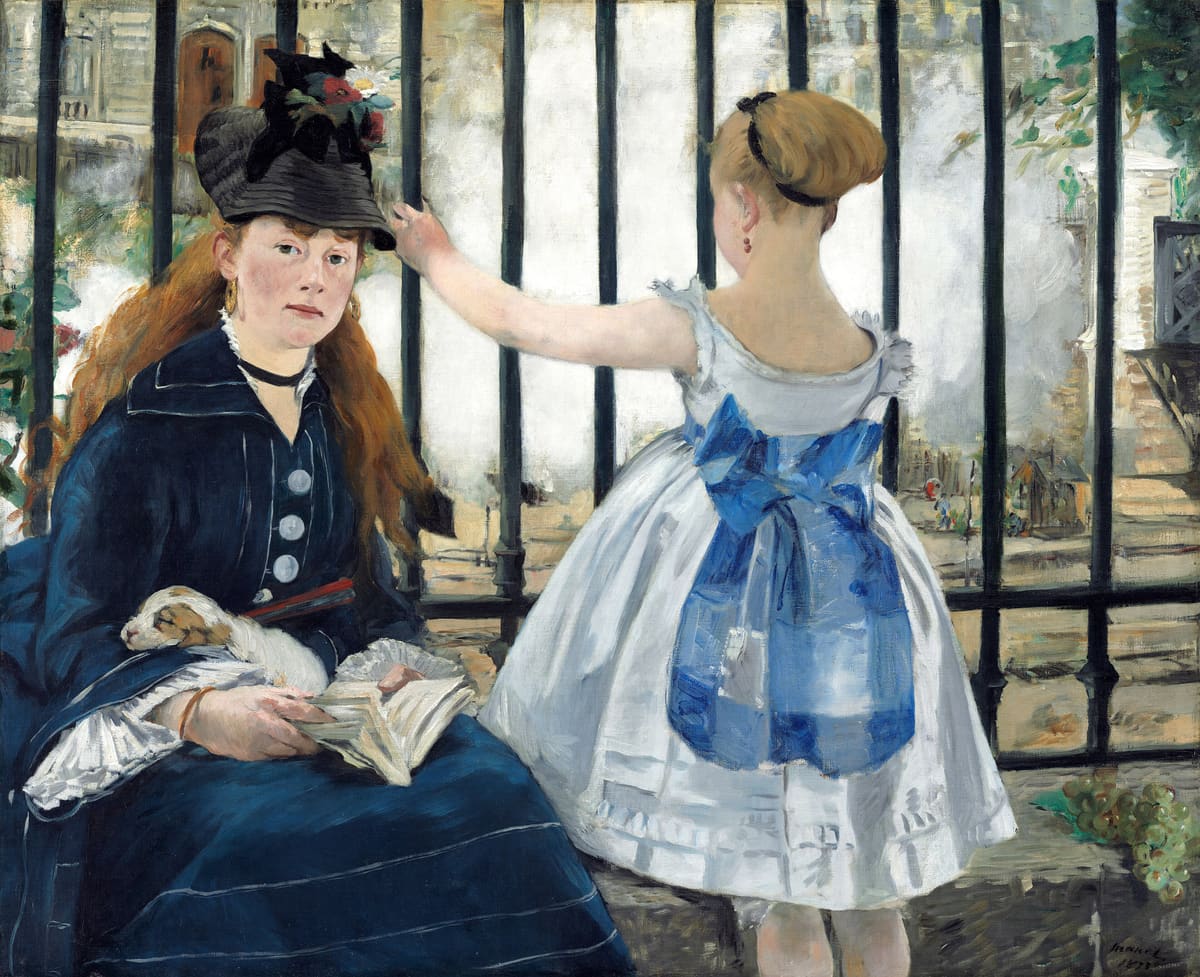
The Railway
The edge of the Gare Saint-Lazare in Paris, seen through iron railings, with a train reduced to a cloud of steam.
Gare Saint-Lazare
The painting shows a real, identified place that you can find today. The exact spot the artist worked from is not necessarily known.
The Railway — at a glance
- Artist
- Édouard Manet (1832–1883)
- Year
- 1873
- Movement
- Realism / early Impressionism
- Place
- Rue de Rome, beside the Gare Saint-Lazare, Paris 8e
- Viewpoint
- A garden overlooking the station cutting — station survives, garden gone
- Medium
- Oil on canvas
- Dimensions
- c. 93 × 112 cm
- Now at
- National Gallery of Art, Washington
Overview
The Railway is a painting Édouard Manet made in 1873 and showed at the Salon of 1874. It shows a seated woman looking out at the viewer and a small girl, seen from behind, watching a railway cutting through iron railings. It is oil on canvas, about 93 by 112 cm, and it hangs in the National Gallery of Art in Washington.
Despite the title, there is no locomotive — the railway is present only as a bank of white steam rising behind the figures.
Where was The Railway painted?
Manet painted the picture in the garden of a friend's house on the rue de Rome, which overlooked the deep open cutting carrying the tracks into the Gare Saint-Lazare — then the busiest station in Paris.
Museum interpretation The station and the Pont de l'Europe, the great wrought-iron road bridge over the tracks nearby, are still there. The specific garden and its railings have gone, but the setting is a real, identifiable corner of the city — the same railway landscape Monet would paint as a series a few years later.
What is in the painting?
A young woman in dark blue sits against the railings with an open book and a small sleeping puppy in her lap; a bunch of grapes lies beside her. She looks straight out of the canvas at the viewer, her place in the book marked with a finger.
Next to her, a girl in a white dress with a blue sash stands with her back to us, both hands on the black iron bars, watching a cloud of white steam billow up from the hidden trains below. Behind the steam, the pale façades of apartment buildings.
Look closely
The sleeping puppy
A small dog sleeps in the woman's lap, on top of her open book, next to a bunch of grapes.
The wall of steam
White steam from the hidden trains fills the upper half of the picture and lights the whole scene.
The iron bars
The black railings run edge to edge; the child grips them with both hands.
Two directions of looking
The woman stares out at the viewer; the girl stares in at the trains — neither looks at the other.
The apartment façades
Pale Haussmann buildings show faintly through and above the steam.
Details that are easy to miss. A sleeping puppy lies in the woman's lap on top of her open book; a small bunch of grapes sits on the ledge beside her; the girl's hair is tied with a blue ribbon that matches her sash; a single figure is just visible through the railings at the right; and no part of any train is shown — only the steam.
Analysis
Composition & perspective
The row of vertical iron bars runs the whole width of the picture, pinning the two figures to the front plane and shutting off the space behind.
Scholarship Manet fills the background with the flat screen of railings and steam, denying any recession. The seated woman faces out, the standing girl faces in; they share a bench-like ledge but do not interact. The composition is a near-abstract grid of black verticals against pale cloud.
Colour and light
Cool blues and whites — the woman's dress, the girl's frock, the steam — against the hard black of the bars.
Scholarship The palette is restrained and tonal: navy blue, white, grey, with warm accents in the woman's hair, the grapes and the puppy. The billowing steam is painted as a soft, luminous mass that lights the whole upper half of the canvas.
Handling and technique
Broad, confident brushwork with sharp contours and a shallow, almost photographic framing.
Manet paints with flat, decisive strokes and firm outlines, cropping the scene tightly. The model for the woman is Victorine Meurent, who had posed for his Olympia and Le Déjeuner sur l'herbe a decade earlier; the girl was the daughter of the painter whose garden it was.
Meaning and interpretation
Interpretations differ. What the artist documented, what museums and scholars propose, and later or speculative theories are marked and kept separate.
Modern life, without a story
Critics at the 1874 Salon complained that nothing was happening. Manet offers no anecdote: two figures, a barrier, a cloud of steam. The subject is the modern city itself — the railway, the iron, the anonymous apartment blocks — glimpsed rather than narrated.
Looking in and looking out
Much has been made of the contrast between the woman staring out at us and the child staring in at the trains — freedom and confinement, adulthood and childhood, the viewer caught between. These are readings of the picture's structure, not a stated programme.
History & provenance
- 1873Painted in a garden on the rue de Rome, beside the Gare Saint-Lazare.
- 1874Shown at the Paris Salon, to puzzled and hostile reviews.
- early 20th c.Enters the Havemeyer collection in New York.
- 1956Given to the National Gallery of Art, Washington.
The painting was in the great Havemeyer collection and came to the National Gallery of Art in Washington in 1956, as a gift from Horace Havemeyer in memory of his mother, Louisine Havemeyer.
Sources
- National Gallery of Art, Washington — collection entry for ‘The Railway’ (Gift of Horace Havemeyer in memory of his mother, Louisine W. Havemeyer, 1956; oil on canvas, c. 93 × 112 cm)
- Juliet Wilson-Bareau, ‘Manet, Monet, and the Gare Saint-Lazare’ (National Gallery of Art / Musée d'Orsay, 1998)
Frequently asked
Where is The Railway set?
In a garden on the rue de Rome in Paris, overlooking the open cutting that carries the tracks into the Gare Saint-Lazare, the busiest station in the city.
Can you visit the spot?
The station and the nearby Pont de l'Europe still exist, but the specific garden and its railings are gone. The setting is a real corner of Paris rather than a preserved viewpoint.
Why is there no train?
Manet shows the railway only as a great cloud of white steam rising from the hidden cutting. The absence of the locomotive was part of what baffled critics in 1874.
Who are the two figures?
The seated woman is Victorine Meurent, Manet's frequent model, who had posed for Olympia. The standing girl was the daughter of the painter whose garden Manet used.
Are they mother and daughter?
The painting does not say. They share a ledge but do not interact, and their relationship is deliberately left open.
Where is the painting now?
In the National Gallery of Art, Washington, since 1956.
Related paintings

Paris Street; Rainy Day
1877
Caillebotte in the same quarter four years later — the streets of the new Europe district around the station.

Rain, Steam and Speed – The Great Western Railway
1843
Turner's railway picture of 1844 — the locomotive itself, thirty years earlier, in England.

A Bar at the Folies-Bergère
1882
Manet's last major work — again a still woman set against the blur of modern Paris.
More by Édouard Manet
A Bar at the Folies-Bergère
Music in the Tuileries

The Races at Longchamp
Also connected to Gare Saint-Lazare
