Music in the Tuileries
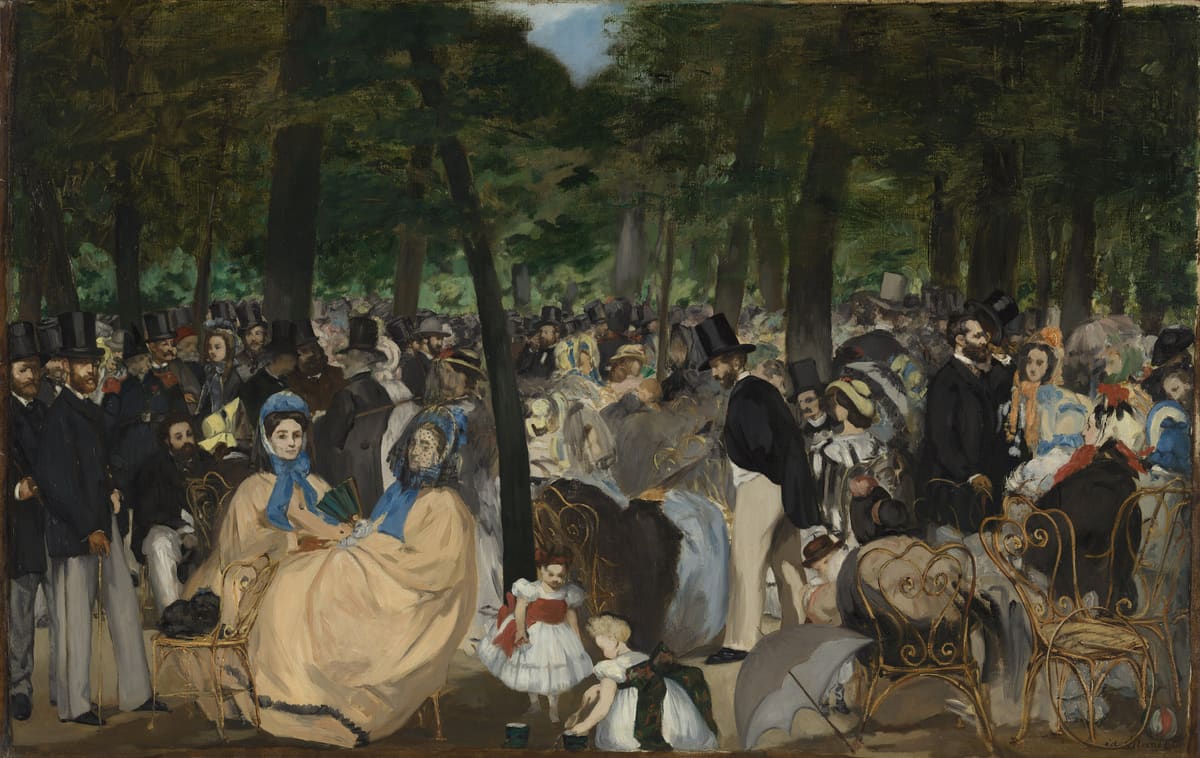
A Sunday concert crowd under the chestnut trees of the Tuileries Garden — an unchanged Paris park.
Tuileries Garden
The painting shows a real, identified place that you can find today. The exact spot the artist worked from is not necessarily known.
Music in the Tuileries — at a glance
- Artist
- Édouard Manet (1832–1883)
- Year
- 1862
- Movement
- Realism / precursor of Impressionism
- Place
- Jardin des Tuileries, Paris 1er
- Viewpoint
- Among the concert crowd under the trees — a general setting; the garden is unchanged
- Medium
- Oil on canvas
- Dimensions
- c. 76 × 118 cm
- Now at
- National Gallery, London (shared with the Hugh Lane Gallery, Dublin)
Overview
Music in the Tuileries is one of Édouard Manet's first pictures of modern city life, painted in 1862. It shows a well-dressed crowd standing and sitting among trees at an open-air concert in central Paris. It is oil on canvas, about 76 by 118 cm, and it is shared, on a rotating loan, between the National Gallery in London and the Hugh Lane Gallery in Dublin.
It has no central subject and no story — just the crowd — which is exactly why it mattered.
A painting of modern life
The critic and poet Charles Baudelaire had called for an art of contemporary Paris — its fashions, its streets, its passing pleasures. Manet, who was close to Baudelaire, answered with this scene, worked up from sketches made in the garden.
He filled the crowd with people he knew: himself at the far left edge, his brother Eugène, Baudelaire in profile, the writer Théophile Gautier, the composer Jacques Offenbach seated at the right, the painter Henri Fantin-Latour, and several society women. It is part group portrait of the Parisian avant-garde, part snapshot of a Sunday afternoon.
Where was Music in the Tuileries painted?
The Jardin des Tuileries runs between the Louvre and the Place de la Concorde in the centre of Paris. In the 1860s, band concerts were held there on Sunday afternoons and drew a fashionable crowd.
Museum interpretation The garden — its gravel walks, its clipped and pollarded trees, its rows of chairs — is essentially unchanged and is a public park open every day. The specific stretch under the chestnuts is a general setting rather than a single fixed viewpoint.
What is in the painting?
A dense press of Parisians in top hats, bonnets and crinolines stands and sits among tall trees. In the foreground, two seated women in bonnets; children play in the pale dirt with a toy and a hoop. Towards the back the faces dissolve into quick dabs of paint, and blue sky shows between the leaves.
The band is nowhere to be seen; the picture is entirely about the audience.
Look closely
Manet at the edge
The artist put himself at the far left of the canvas, half cut off by the frame.
Baudelaire in profile
The poet who called for a painting of modern life stands near Manet, seen from the side.
Offenbach seated
The composer sits at the right in gold-rimmed spectacles.
Children in the dirt
In the foreground, children play with a hoop and a toy in the pale garden dust.
The dissolving back rows
Towards the rear the faces become pure dabs of paint, with blue sky between the leaves.
Details that are easy to miss. Manet stands at the far left edge, half in and half out of the picture; Baudelaire is in profile near him; Offenbach sits at the right in gold-rimmed glasses; a child in the foreground plays in the dirt with a hoop; and the back of the crowd is nothing but flecks of paint — no drawn faces at all.
Analysis
Composition & perspective
There is no focal point: the crowd fills the canvas edge to edge, sharp at the front and melting to blur at the back.
Scholarship Manet spreads the figures across the whole width with no hierarchy — no hero, no anecdote. The tree trunks make a loose vertical rhythm; the crowd recedes not by perspective lines but by becoming less and less distinct. The two foreground women and the playing children are the only fully resolved passages.
Colour and light
A scatter of bright accents — a yellow chair, blue dresses, a child's red — across a ground of black coats, green leaves and pale dust.
Scholarship The men's black frock coats and top hats dominate; against them Manet flicks in the yellows, blues and whites of the women's clothes and the chairs, and the fresh green of the foliage with sky-blue between. The dappled light is suggested rather than described.
Handling and technique
Loose, rapid, sketch-like paint — deliberately ‘unfinished’ by the standards of 1862.
Manet worked wet and fast, leaving edges open and faces as a few strokes. Contemporary viewers found it slapdash and incoherent; it now reads as one of the first pictures to treat a modern crowd with an Impressionist touch, more than a decade before the movement had a name.
Meaning and interpretation
Interpretations differ. What the artist documented, what museums and scholars propose, and later or speculative theories are marked and kept separate.
The audience as subject
By painting the concert crowd and not the concert, Manet made the fashionable public of Second-Empire Paris — and his own circle within it — the worthy subject of a large canvas, following Baudelaire's call for an art of contemporary life.
A group portrait in disguise
It also works as a record of a milieu: the writers, composers and painters who would shape the next twenty years of French culture, gathered in one park on one afternoon.
History & provenance
- 1862Painted from sketches made in the Tuileries Garden.
- 1863Shown at the Galerie Martinet, Paris, to hostile reviews.
- early 20th c.Bought by the Dublin-born dealer and collector Sir Hugh Lane.
- 1917Enters the National Gallery, London, through the Lane bequest; later shared with Dublin.
The painting came to the National Gallery in London through the bequest of Sir Hugh Lane, who drowned on the Lusitania in 1915. Under a long-running agreement it rotates between London and the Hugh Lane Gallery in Dublin.
Sources
- The National Gallery, London — collection entry for ‘Music in the Tuileries Gardens’ (Lane Bequest, 1917; oil on canvas, c. 76 × 118 cm)
- Charles Baudelaire, ‘The Painter of Modern Life’ (1863)
- Nancy Locke, ‘Manet and the Family Romance’ (2001) — on the identifications in the crowd
Frequently asked
Where is the garden in Music in the Tuileries?
The Jardin des Tuileries in central Paris, between the Louvre and the Place de la Concorde, where Sunday afternoon band concerts were held in the 1860s.
Can you visit it?
Yes. The Tuileries is a public park, open daily, and its gravel walks, clipped trees and rows of chairs are essentially unchanged.
Who is in the crowd?
Many of Manet's circle: Manet himself at the far left, his brother Eugène, the poet Baudelaire, the writer Théophile Gautier, the composer Offenbach and the painter Fantin-Latour, among others.
Why did it shock people?
It has no central subject and no story, and the loose, sketch-like paint — with the back of the crowd left as mere dabs — looked unfinished and chaotic to viewers in 1862–63.
Where is the band?
Not shown. Manet painted only the audience — the fashionable Sunday crowd — which is the point of the picture.
Where is the painting now?
It belongs to the National Gallery, London, and rotates on loan with the Hugh Lane Gallery in Dublin.
Related paintings

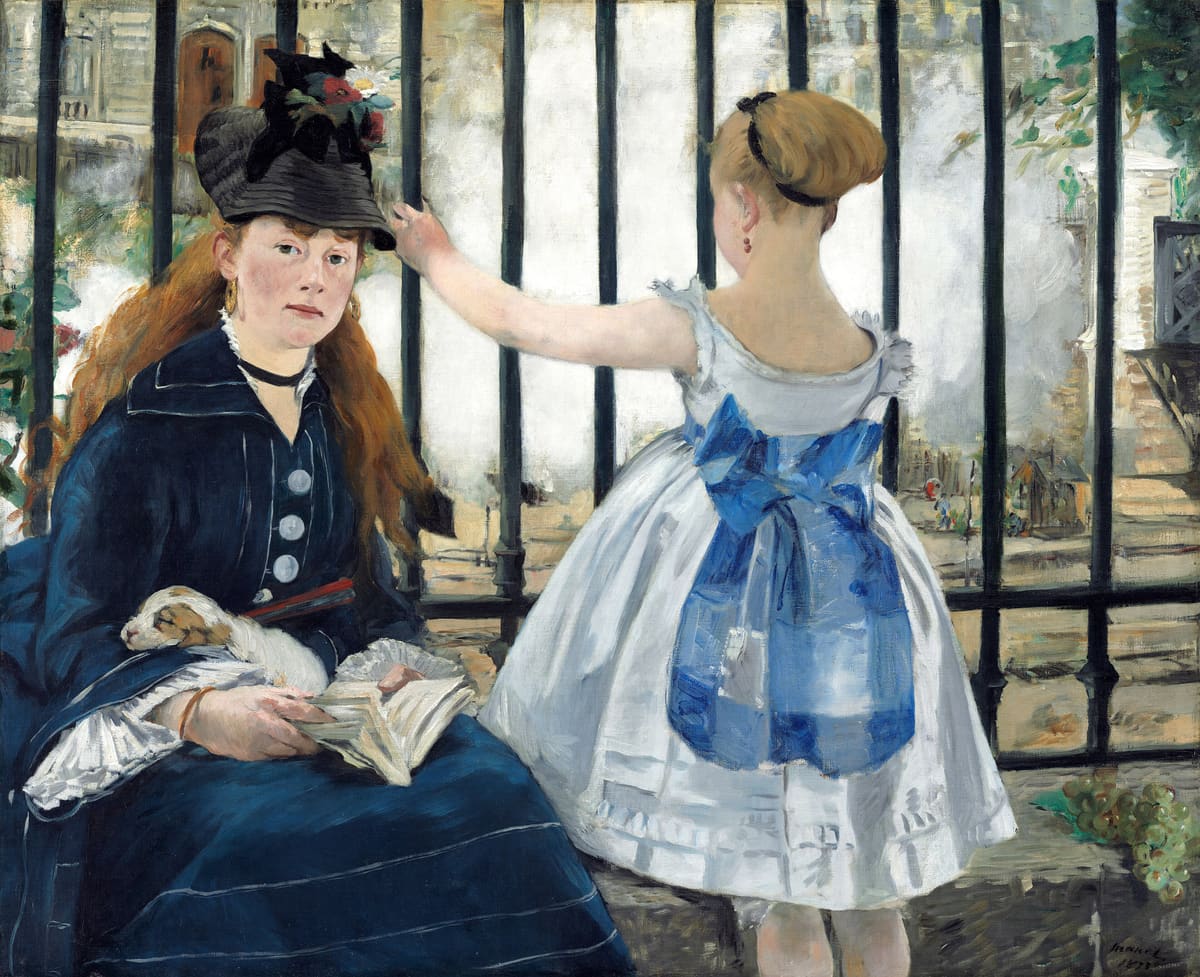
The Railway
1873
Manet a decade on, again setting figures against a modern-Paris backdrop with no anecdote.

Bal du moulin de la Galette
1876
Renoir's crowd of 1876 — the Impressionist follow-through on Manet's modern-life subject.

A Bar at the Folies-Bergère
1882
Manet's last great crowd, this time a music hall reflected in a mirror.
More by Édouard Manet
A Bar at the Folies-Bergère
The Railway