Paris Street; Rainy Day
A wedge-shaped junction in the new Haussmann Paris near the Gare Saint-Lazare — still there, minus the cobbles.
rue de Moscou
This is a documented exact viewpoint — you can stand roughly where the artist stood and look at the same scene.
Paris Street; Rainy Day — at a glance
- Artist
- Gustave Caillebotte (1848–1894)
- Year
- 1877
- Movement
- Impressionism (Realist wing)
- Place
- Place de Dublin (Carrefour de Moscou), Paris 8e
- Viewpoint
- The junction of the rue de Turin and rue de Moscou — buildings still standing
- Medium
- Oil on canvas
- Dimensions
- c. 212 × 276 cm
- Now at
- Art Institute of Chicago
Overview
Paris Street; Rainy Day is a very large canvas — over two metres by two and a half — that Gustave Caillebotte showed at the third Impressionist exhibition in 1877. It gives a wide-screen view of an ordinary street corner in the new, rebuilt Paris on a wet grey day. It is oil on canvas and has belonged to the Art Institute of Chicago since 1964.
Caillebotte had trained in law and briefly in engineering and was a wealthy man who painted, collected and financed the Impressionist group. This is his best-known work.
Where was Paris Street; Rainy Day painted?
The setting is the junction where the rue de Turin, the rue de Moscou and the rue Clapeyron meet, in the Europe quarter of the 8th arrondissement, a few hundred metres north of the Gare Saint-Lazare. In Caillebotte's day it was the Carrefour de Moscou; today it is the Place de Dublin.
Museum interpretation The whole quarter was cut through in the 1860s under Baron Haussmann, which is why the apartment blocks meet at such sharp angles. Those acute-angled buildings are still standing and the junction is easily found, though the cobbles, the gas lamps and the wide open feel have gone.
What is in the painting?
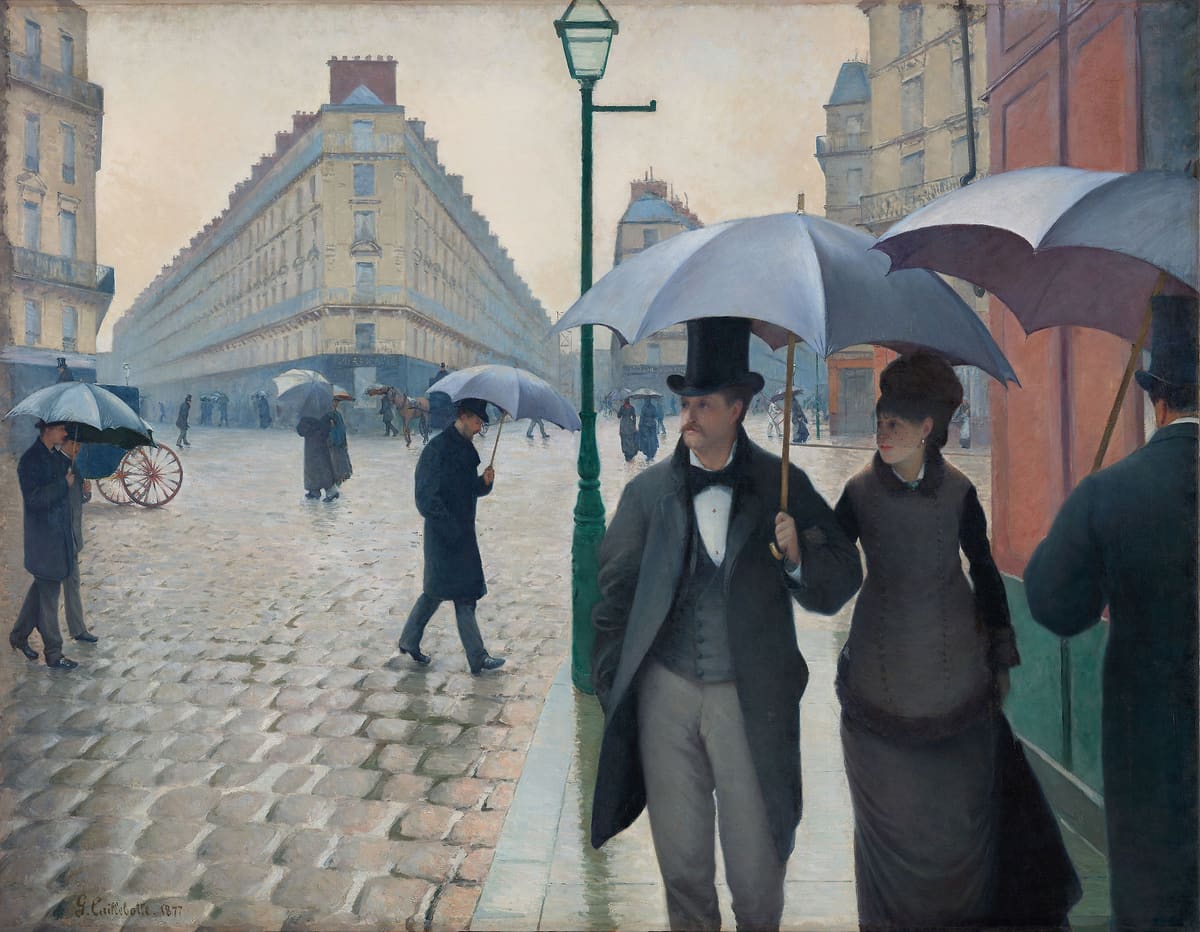
Well-dressed Parisians cross a broad cobbled junction under umbrellas in flat, shadowless light. A green cast-iron lamp-post stands almost dead centre, splitting the canvas. A couple in the foreground — the man in a top hat, the woman on his arm — walks towards the viewer; a man at the far right is sliced off by the frame.
Wedge-shaped Haussmann apartment blocks, five storeys of pale stone with iron balconies, recede down every street. The pavements gleam; the sky is a even grey.
Look closely
The central lamp-post
A green cast-iron gas lamp stands almost exactly on the centre line, dividing the picture in two.
The cropped man
At the far right, a figure is sliced clean through by the edge of the canvas — a photographic device.
The foreground couple
A top-hatted man and a woman under one umbrella walk straight towards the viewer, close and large.
Individual cobblestones
The wet paving is rendered stone by stone, converging on the vanishing point.
The painter's ladder
A ladder leans against a building on the left — the new quarter still being finished.
Details that are easy to miss. The man at the far right edge is cut in half by the frame; the foreground couple are about to collide with him; a house-painter's ladder leans against a building at the left; the cobblestones are each individually rendered; and the lamp-post's base sits almost exactly on the centre line of the canvas.
Analysis
Composition & perspective
A near-central lamp-post divides the picture in two, and a precise one-point perspective runs the streets back to a single vanishing point.
Scholarship Caillebotte built the scene with an engineer's rigour: the lamp-post falls close to the exact centre, the cobbles are laid out in a converging grid, and the buildings are foreshortened along strict orthogonals. The right half is dominated by the huge, close foreground couple; the left half opens into deep street space. The man cropped at the right edge and the tilted-forward viewpoint give it a photographic, snapshot quality.
Colour and light
A restrained palette of wet greys, blacks and stone — the diffuse light of an overcast city day, with almost no cast shadow.
The colour is cool and muted: grey sky, grey-blue cobbles slicked with rain, the near-black of the men's coats, the pale cream of the buildings. Highlights are soft glints on wet stone and umbrella silk rather than sunlit accents.
Handling and technique
Smooth, tightly controlled paint — closer to academic finish than to Impressionist brushwork, especially in the foreground figures.
The near figures and the architecture are painted with crisp edges and blended surfaces; the handling loosens towards the background. Caillebotte made careful perspective studies and at least one oil sketch before the final canvas.
Meaning and interpretation
Interpretations differ. What the artist documented, what museums and scholars propose, and later or speculative theories are marked and kept separate.
A portrait of the new Paris
The museum reads the picture as a record of the modern, rebuilt city — its wide junctions, its uniform blocks, its prosperous, anonymous crowds — painted at monumental scale.
Modern life as mild alienation
Many writers note that the figures do not meet each other's eyes, keep their distance and seem set adrift in the great grey space — a cool, faintly uneasy view of city life. This is an interpretation of the mood rather than a stated programme.
History & provenance
- 1877Painted and shown at the third Impressionist exhibition in Paris.
- 1894Kept by the Caillebotte family after the artist's death.
- 1964Acquired by the Art Institute of Chicago.
- TodayOne of the most-visited works in the Art Institute's Impressionist galleries.
The painting stayed with Caillebotte's family for decades and was bought by the Art Institute of Chicago in 1964. It has been a centrepiece of the museum's Impressionist rooms ever since.
Featured in Famous Painting Locations: 13 Real Places You Can Visit
Research Included in the Painting Location Precision Study
Sources
- Art Institute of Chicago — collection entry for ‘Paris Street; Rainy Day’ (Charles H. and Mary F. S. Worcester Collection, 1964.336; oil on canvas, c. 212 × 276 cm)
- Kirk Varnedoe, ‘Gustave Caillebotte’ (Yale University Press, 1987)
- Art Institute of Chicago — catalogue essays on Caillebotte's perspective studies for the painting
Frequently asked
Where is the street corner in Paris Street; Rainy Day?
The junction of the rue de Turin, rue de Moscou and rue Clapeyron in the Europe quarter of the 8th arrondissement, just north of the Gare Saint-Lazare — now called the Place de Dublin.
Can you still find the spot?
Yes. The sharp-angled Haussmann apartment blocks Caillebotte painted are still standing and the junction is easy to identify, though the cobbles and gas lamps are long gone.
Why do the buildings meet at such sharp angles?
The quarter was driven through in the 1860s as part of Baron Haussmann's rebuilding of Paris, which produced acute-angled blocks where the new avenues crossed.
How big is the painting?
About 2.1 by 2.8 metres — the scale of a Salon history painting, applied to a mundane street corner.
Is it an Impressionist painting?
Caillebotte showed it with the Impressionists in 1877 and supported the group, but the tight drawing, smooth finish and rigorous perspective are closer to academic practice than to the loose brushwork of Monet or Renoir.
What is the lamp-post doing in the middle?
It splits the canvas almost exactly in half, separating the deep street view on the left from the large foreground couple on the right — a deliberate, almost provocative piece of construction.
Where is the painting now?
In the Art Institute of Chicago, which acquired it in 1964.
Related paintings


Current display status
Currently on viewMore by Gustave Caillebotte

Le Pont de l'Europe
