A Bar at the Folies-Bergère
The bar of a real Paris music hall — and a mirror reflection whose geometry has been argued over for 140 years.
Folies Bergère
The painting shows a real, identified place that you can find today. The exact spot the artist worked from is not necessarily known.
A Bar at the Folies-Bergère — at a glance
- Artist
- Édouard Manet (1832–1883)
- Year
- 1882
- Movement
- Impressionism / Realism
- Place
- Folies Bergère, rue Richer, Paris 9e
- Viewpoint
- Standing at the bar — but the mirror behind is rearranged, not a true view of the hall
- Medium
- Oil on canvas
- Dimensions
- c. 96 × 130 cm
- Now at
- The Courtauld Gallery, London
Overview
A Bar at the Folies-Bergère was Édouard Manet's last major painting, shown at the Paris Salon in 1882, the year before his death. It shows a barmaid behind a marble counter of bottles, with the crowded balconies of a music hall spread out behind her — a scene almost entirely made of a mirror reflection. It is oil on canvas, about 96 by 130 cm, and it hangs in the Courtauld Gallery, London.
For all its bright surface it is a puzzle picture: the reflection in the mirror does not match what is in front of it.
How it was made
Manet was already seriously ill and could not work standing for long. He had a real barmaid from the Folies, named Suzon, pose in his studio, with a table of bottles set up in front of her, and worked the great mirror and the hall behind her from studies and memory.
The Folies Bergère was one of the most fashionable night spots in Paris, a place of variety acts, promenading crowds and casual prostitution. Manet's subject is the barmaid at the still centre of that spectacle.
Where was A Bar at the Folies-Bergère painted?
The Folies Bergère opened in 1869 on the rue Richer, in the 9th arrondissement of Paris, and is still an operating theatre. The bars set into the balconies, where drinks were sold during the acts, were a real feature of the hall.
Museum interpretation The picture is not a topographic view of the interior — the hall behind the barmaid is a reflection, and the space is compressed and rearranged — but the setting is a specific, still-existing Paris venue.
What is in the painting?
A young woman stands square to the viewer behind a marble bar, her hands flat on its edge. In front of her: bottles of champagne and English beer, a compote of oranges, roses in a glass. Her face is still and unreadable.
Almost everything else is in the mirror behind her: the chandeliered balconies, a haze of gaslight, a packed crowd, and — at the upper left — the green-slippered legs of a trapeze artist swinging above it all. At the right, the barmaid's own reflected back leans towards a top-hatted man who is speaking to her.
Look closely
The trapeze legs
Green-slippered legs swing at the upper left — an acrobat above the crowd, marking this as a variety hall.
The Bass ale bottle
One bottle carries the red triangle of Bass — one of the first registered commercial trademarks.
The bowl of oranges
A compote of oranges on the bar — a motif Manet elsewhere attaches to women for sale.
The reflected conversation
At the right, the barmaid's mirrored back leans toward a top-hatted man who has no counterpart in front of the bar.
The still, unreadable face
The barmaid looks straight out, expression closed, at the centre of all the movement and light.
Details that are easy to miss. The green legs and slippers of a trapeze artist swing at the upper left, above the crowd; one beer bottle carries the red triangle of Bass ale, an early registered trademark; the bowl of oranges is a motif Manet used elsewhere for women of easy virtue; the barmaid wears a locket and a spray of flowers at her bodice; and the man in the top hat exists only in the mirror.
Analysis
Composition & perspective
The reflection is wrong on purpose: the barmaid's mirrored back is shifted far to the right, and she seems to be serving a customer we cannot see.
Scholarship If the mirror were behind her and parallel to the bar, her reflection should sit directly behind her and show the crowd she is facing. Instead her reflected back and the man she is serving are pushed to the right edge, as though the mirror were angled or the viewer standing where that customer stands. Manet almost certainly knew the geometry did not close; the dislocation puts the viewer into the transaction and makes the picture about looking and being looked at.
Colour and light
A cool, silvery front plane of marble, glass and skin against a warm blur of gaslight and crowd behind.
Scholarship The bottles, the marble, the barmaid's bodice and skin are painted crisply and coolly in the foreground; everything in the mirror dissolves into loose, warm dabs — gold, pink, brown — so that the reflected hall shimmers and the barmaid stands out sharp against it. The white electric-and-gas glare of the Folies is rendered as light rather than described.
Handling and technique
The still-life foreground is worked with great care; the reflected crowd is brushed in fast and thin.
Manet contrasts two ways of painting in one canvas: the precise, almost Dutch still life of bottles and fruit on the bar, and the rapid, sketch-like handling of the mirrored hall. X-rays show he moved the barmaid's reflection during work, adjusting the impossible geometry rather than fixing it.
Meaning and interpretation
Interpretations differ. What the artist documented, what museums and scholars propose, and later or speculative theories are marked and kept separate.
The barmaid as commodity
A common reading is that the barmaid, priced goods laid out before her and a male customer at her reflected shoulder, is herself part of what is on sale at the Folies — Manet's cool comment on commerce, spectacle and the position of working women in the city.
A picture about looking
Others focus on the mirror trick itself: by placing the viewer where the unseen customer must stand, Manet makes the subject the act of looking at a woman across a bar, and our complicity in it.
Manet's own account
Manet left no written explanation of the picture. Its meanings are all later readings, though the deliberate mirror dislocation is generally accepted as intentional.
History & provenance
- 1882Shown at the Paris Salon.
- 1883Manet dies, aged 51.
- late 19th c.Bought by the composer Emmanuel Chabrier, a friend of Manet.
- 1926Acquired by the industrialist and collector Samuel Courtauld.
- 1934Enters the Courtauld collection in London, where it remains.
The painting passed through several hands, including the composer Chabrier, before Samuel Courtauld bought it in 1926. It is a centrepiece of the Courtauld Gallery in London.
Sources
- The Courtauld Gallery, London — collection entry for ‘A Bar at the Folies-Bergère’ (Samuel Courtauld Trust; oil on canvas, c. 96 × 130 cm)
- T. J. Clark, ‘The Painting of Modern Life: Paris in the Art of Manet and His Followers’ (1985)
- The Courtauld — technical study and X-radiography of the shifting mirror reflection
Frequently asked
Is the Folies Bergère a real place?
Yes. It opened in 1869 on the rue Richer in Paris and is still an operating theatre. The balcony bars where drinks were sold, like the one in the painting, were a real feature of the hall.
Why doesn't the mirror reflection line up?
The barmaid's reflected back and the customer she is serving are shifted far to the right, where they could not be if the mirror were simply behind her. Manet almost certainly did this on purpose, to place the viewer in the customer's position.
Who is the woman?
A real barmaid from the Folies Bergère, named Suzon, who posed for Manet in his studio in front of a table of bottles.
Who is the man in the top hat?
He appears only in the mirror, at the upper right, leaning in to speak to the barmaid. In front of the bar, where he should be standing, there is no one — the viewer takes his place.
What are the green shapes at the top left?
The legs and slippers of a trapeze artist, swinging above the crowd — a reminder that this is a variety hall.
What does the painting mean?
Readings centre on the barmaid as part of what the Folies sells, and on the mirror device making the viewer a looking, buying customer. Manet left no explanation.
Where is it now?
In the Courtauld Gallery, London, since 1934.
Related paintings

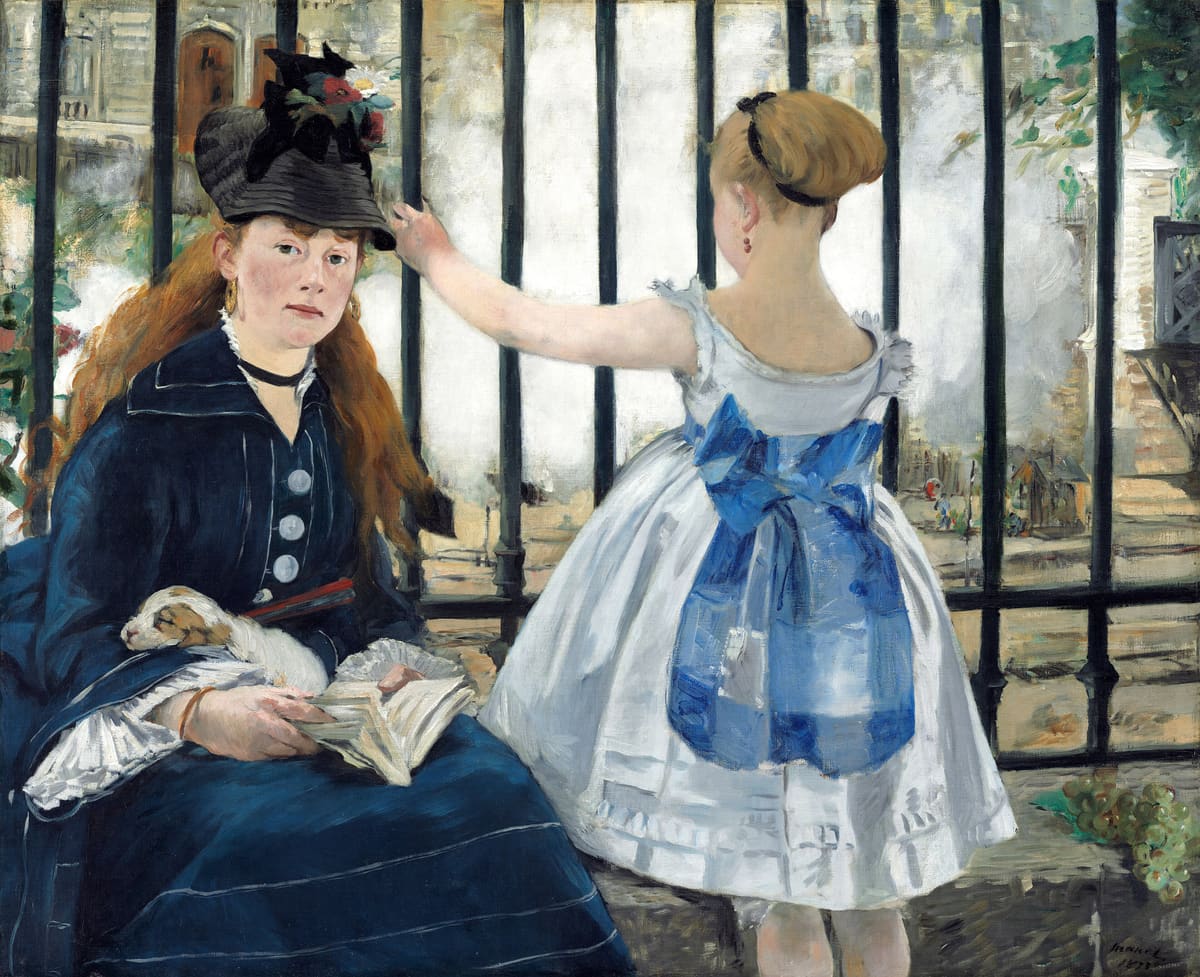
The Railway
1873
Manet nine years earlier, again putting a still female figure against the noise of modern Paris.

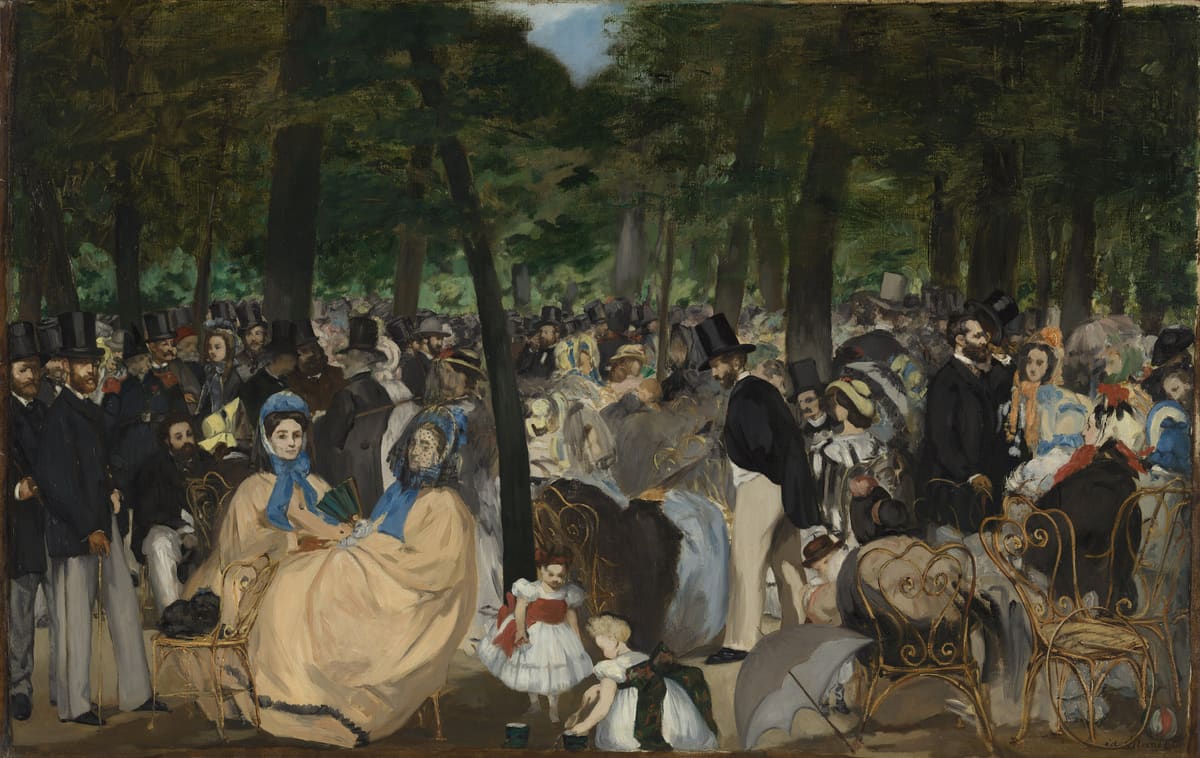
Music in the Tuileries
1862
Manet's first crowd of modern Parisians at leisure, twenty years before.

Bal du moulin de la Galette
1876
Renoir's Montmartre dance — the sunlit, sociable side of the same nightlife world.
More by Édouard Manet
The Railway
Music in the Tuileries