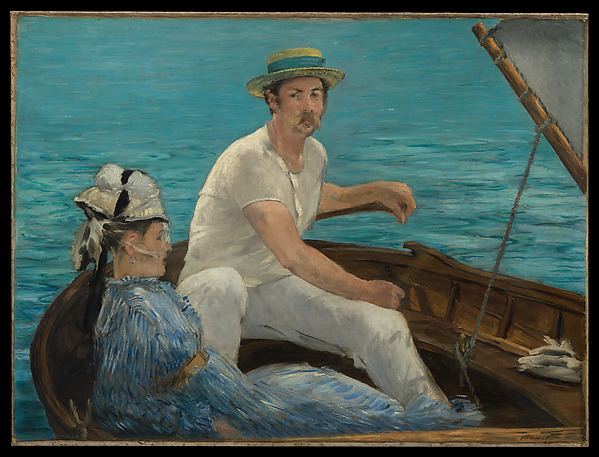
Boating
A man and a woman in a sailing dinghy on the Seine at Argenteuil — painted the summer Manet worked alongside Monet on the river.
Seine
The painting depicts a real landscape or cityscape. The precise viewpoint the artist used may be unknown, so the marker shows the general area.
Boating — at a glance
- Artist
- Édouard Manet (1832–1883)
- Year
- 1874
- Movement
- Impressionism / Realism
- Place
- The Seine at Argenteuil, north-west of Paris
- Viewpoint
- A sailing boat on the river — the reach survives; banks now built up
- Medium
- Oil on canvas
- Dimensions
- c. 97 × 130 cm
- Now at
- Metropolitan Museum of Art, New York
Overview
Boating is one of the pictures Édouard Manet painted in the summer of 1874, when he stayed at Gennevilliers and worked on the Seine alongside Claude Monet, who was living across the river at Argenteuil. It shows, close up and cropped, a man in a boater and blue-striped jersey handling the sheet of a small sailing boat, a woman in a white dress and veiled hat seated beside him, and a slab of bright blue-green river filling almost the whole background. It is oil on canvas, about 97 by 130 cm, and it hangs in the Metropolitan Museum of Art, New York.
Where was Boating painted?
Museum interpretation Argenteuil, about 10 km north-west of central Paris, was a boating and sailing centre on a wide, calm reach of the Seine, reached in minutes by train and hugely popular for Sunday outings in the 1870s. Manet and Monet painted its river, sailboats and bridges repeatedly that summer. The reach of the Seine and the sailing tradition survive; the riverbanks are now built up. The painting shows figures in a boat on the water rather than a fixed point on the shore.
What is in the painting?
The boat is cut by the frame on all sides, so the viewer seems to be aboard. The man, seen almost full-length, leans back with the mainsheet in his hand and looks off to the right; the woman sits lower in the stern, hands in her lap, gazing away to the left. The varnished hull, the pale sail and a length of gunwale frame them; everything else is flat, saturated Seine water with a few ripples.
Look closely
The cropped boat
Cut by the frame top, bottom and sides — the viewer is aboard with the couple.
The mainsheet
The man holds the rope controlling the sail, leaning back against its pull.
The two gazes
He looks off to the right, she to the left; neither meets the other's eye.
The flat blue Seine
Saturated blue-green water fills nearly the whole background, with no horizon.
Analysis
Composition and technique
Radical cropping and a near-abstract field of blue water — a modern-life subject treated like a snapshot.
Scholarship Manet cuts the boat hard on every side and tilts the horizon up out of the picture, so the couple sit against pure river. The flat expanse of blue-green, the high viewpoint and the disconnected gazes are borrowed from photography and Japanese prints, and were startling at the 1879 Salon.
Colour and light
A dominant slab of blue-green water, against white dress and sail, dark jacket and varnished wood.
Manet keys the whole picture to the strong blue of the sunlit Seine, letting the white of the woman's dress and the sail, and the man's dark blue jacket, stand out sharply against it. The handling is broad and flat, with little modelling.
History & provenance
The painting was shown at the Salon of 1879, entered the Havemeyer collection, and came with it to the Metropolitan Museum of Art, New York.
Sources
- The Metropolitan Museum of Art, New York — collection entry for Édouard Manet, ‘Boating’ (1874; oil on canvas, c. 97 × 130 cm; Havemeyer Collection)
- Juliet Wilson-Bareau, ‘Manet and Argenteuil’ literature
Related paintings

Claude Monet painting in his studio boat
1874
Manet's other 1874 Argenteuil picture — Monet at work on the same river.

The Grand Canal
1908
Monet on the water in Venice — the same instinct to paint from a boat, decades later.

Summer's Day
1879
Morisot's boat on the Bois de Boulogne lake — the same aboard-the-boat viewpoint and cropping.
More by Édouard Manet

A Bar at the Folies-Bergère
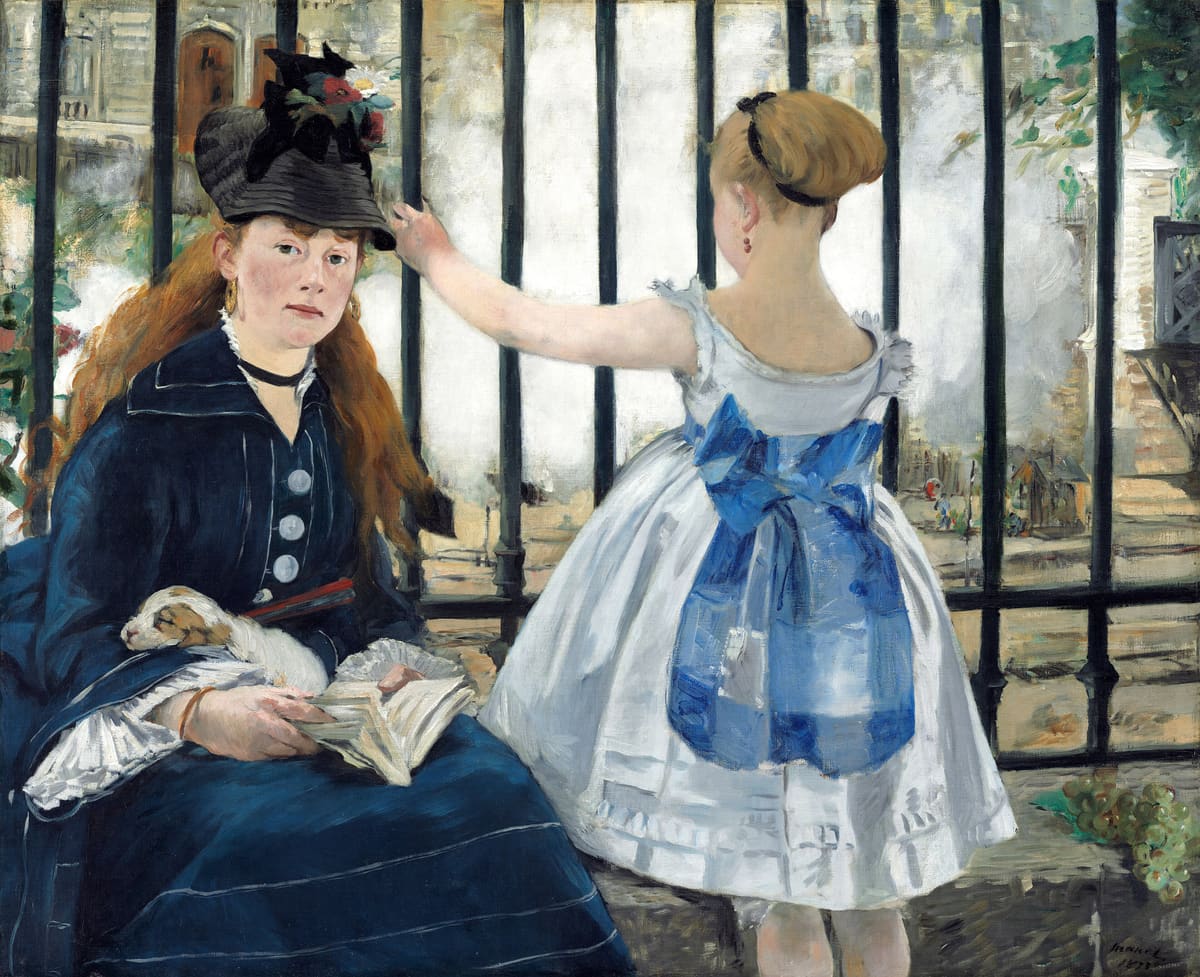
The Railway
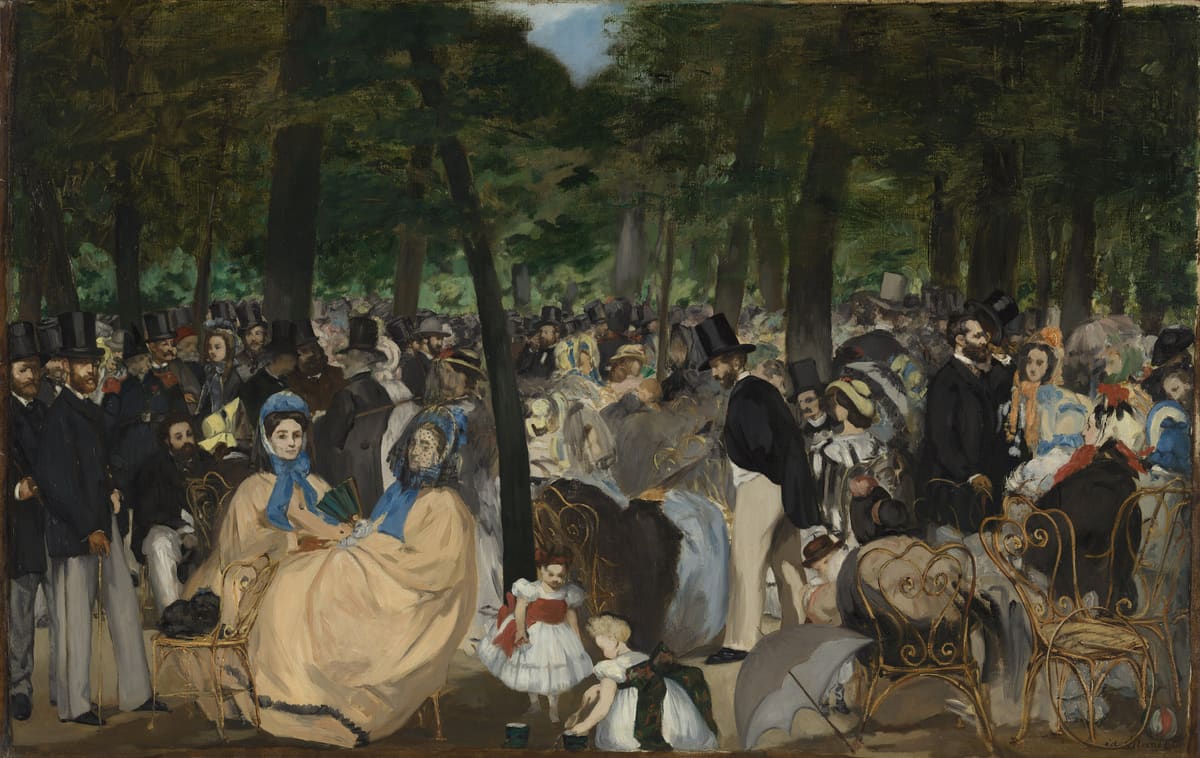
Music in the Tuileries

The Races at Longchamp
Also connected to Seine

