
Chichester Canal
A still, golden evening on the Chichester Canal in Sussex — the cathedral spire far off, a becalmed boat, the water like glass.
Chichester
The painting shows a real, identified place that you can find today. The exact spot the artist worked from is not necessarily known.
Chichester Canal — at a glance
- Artist
- J. M. W. Turner (1775–1851)
- Year
- c. 1828
- Movement
- English Romanticism
- Place
- The Chichester Canal, West Sussex, England
- Viewpoint
- Along the canal toward the cathedral spire — a stretch of canal survives (restored for leisure); the spire still dominates
- Medium
- Oil on canvas
- Dimensions
- c. 65 × 134 cm
- Now at
- Tate Britain, London
Overview
Chichester Canal is one of a group of landscapes J. M. W. Turner painted around 1828 for George Wyndham, 3rd Earl of Egremont, his patron at Petworth House in Sussex — Egremont had invested in the canal. It shows the waterway at dusk: a broad, mirror-still channel running to a low horizon, a sailing vessel with its masts reflected, cattle and figures on the bank, trees, and the distant spire of Chichester Cathedral, all bathed in a hazy gold light. It is oil on canvas, about 65 by 134 cm, and it hangs in Tate Britain, London.
Where was Chichester Canal painted?
Scholarship The Chichester Canal (part of the Portsmouth and Arundel Canal) opened in 1822 to link the city of Chichester to the sea at Chichester Harbour. It was never a commercial success. A stretch of it survives, restored and used for leisure boating, running south from the city basin; Chichester Cathedral's spire (rebuilt after a collapse in 1861) still dominates the skyline, so the general view along the canal towards the spire can be found today. Turner heightened the light and the calm.
What is in the painting?
The canal runs straight back down the centre, its surface unbroken and reflecting a sky of pale gold and rose. A single-masted vessel lies becalmed near the centre, doubled exactly in the water; cattle stand on the left bank, a figure or two nearby; low trees line the sides. Far off, small against the light, the cathedral spire. Everything is softened by evening haze.
Look closely
The becalmed boat
A single-masted vessel lies motionless near the centre, its masts doubled exactly in the still water.
The cathedral spire
Chichester Cathedral's spire stands small and far off against the evening light.
The mirror water
The canal surface is unbroken, reflecting a sky of pale gold and rose.
The bankside cattle
Cattle and a figure or two stand on the left bank among low trees.
Analysis
Composition and technique
A central mirror-still waterway leading to a low horizon and a distant spire, drenched in hazy gold light.
Scholarship Turner runs the canal dead down the middle to a small distant point, doubles the boat and sky in the still water, and dissolves the edges of everything in warm evening haze — a quiet, almost abstract study of calm and light rather than a topographical record.
History & provenance
The painting was part of the Turner Bequest to the nation and is held by Tate, shown at Tate Britain, London (some of the Petworth group remain at Petworth House).
Sources
- Tate — collection entry for J. M. W. Turner, ‘Chichester Canal’ (c. 1828; oil on canvas, c. 65 × 134 cm; Turner Bequest)
- Chichester Ship Canal Trust — the restored canal
Related paintings

Norham Castle, Sunrise
1845
Turner's late dissolved castle and river — the same drowning of form in light.

The Canal du Loing at Moret
1892
Sisley's tree-lined French canal — the still-water-and-towpath subject, sixty years on.

Salisbury Cathedral from the Meadows
1831
Constable's Sussex-borders cathedral of 1831 — the spire across water, in storm rather than calm.
More by J. M. W. Turner
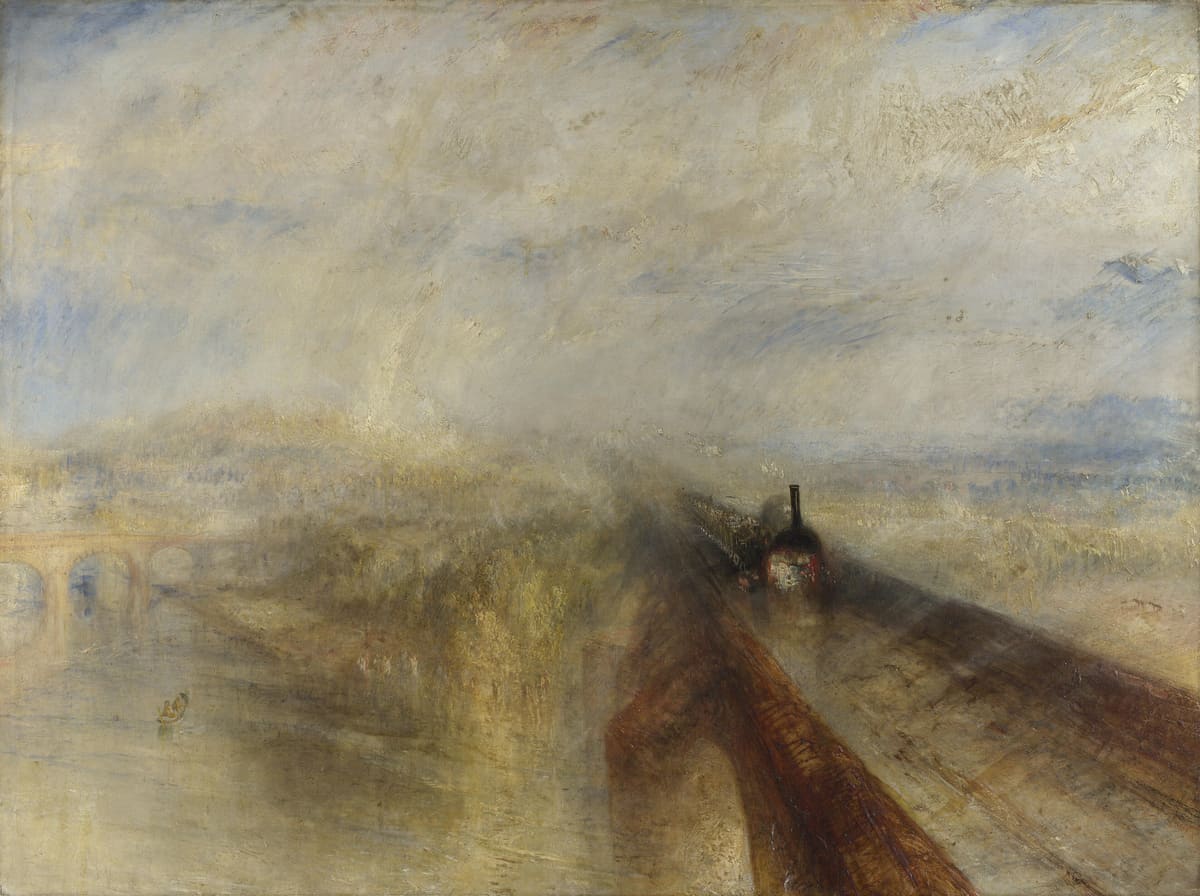
Rain, Steam and Speed – The Great Western Railway

Dido building Carthage

Dolbadarn Castle