The Hay Wain
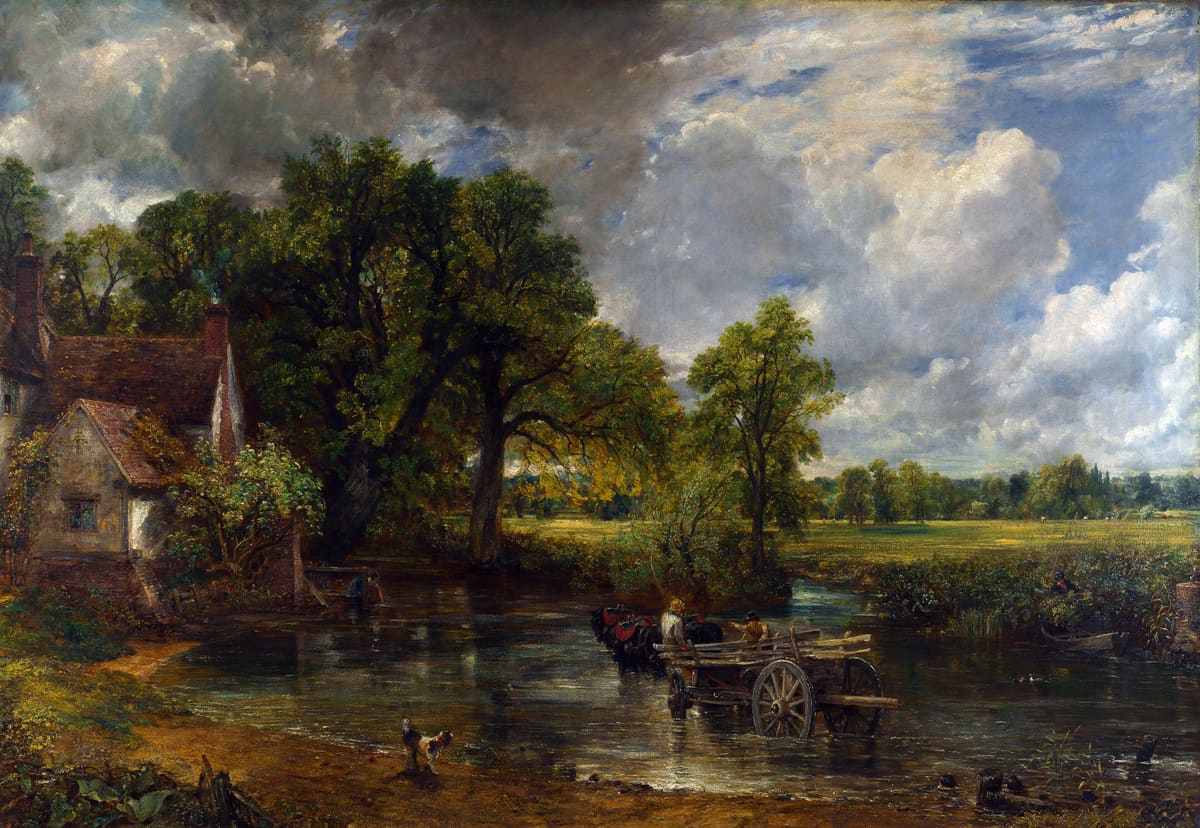
A farm cart in the millpond by Willy Lott's cottage at Flatford — a real Suffolk spot the National Trust still keeps.
Willy Lott's Cottage
The painting shows a real, identified place that you can find today. The exact spot the artist worked from is not necessarily known.
The Hay Wain — at a glance
- Artist
- John Constable (1776–1837)
- Year
- 1821
- Movement
- English Romantic landscape
- Place
- Flatford, River Stour, Suffolk, England
- Viewpoint
- The millpond by Willy Lott's House — National Trust land, view preserved
- Medium
- Oil on canvas
- Dimensions
- c. 130 × 185 cm (a ‘six-footer’)
- Now at
- The National Gallery, London
Overview
The Hay Wain is a six-foot canvas John Constable painted in his London studio in 1821 from sketches made around his father's mills on the Suffolk–Essex border. It shows a hay cart being driven across a shallow millpond on a bright, cloud-scudding day. It is oil on canvas and hangs in the National Gallery, London.
It made little impression in England but caused a stir at the 1824 Paris Salon, where it won a gold medal and struck French painters, Delacroix among them.
The story behind the painting
Constable grew up at East Bergholt; his father ran Flatford Mill and Dedham Mill on the Stour. He painted this stretch of river over and over. The Hay Wain was the third of his large ‘six-footers’ of the Stour, worked up in London from small oil studies and a full-size preparatory sketch.
Shown at the Royal Academy in 1821 as ‘Landscape: Noon,’ it was passed over. Three years later the dealer John Arrowsmith took it to Paris, where it won a Salon gold medal and impressed the younger French landscape painters; Delacroix is said to have reworked passages of one of his own canvases after seeing it.
Where was The Hay Wain painted?
The cottage on the left is Willy Lott's House at Flatford, a few steps from Flatford Mill, on the River Stour where it divides Suffolk from Essex. Willy Lott, a tenant farmer, is said to have lived in the house for more than eighty years.
Museum interpretation The house, the mill stream, Bridge Cottage and the surrounding meadows are now looked after by the National Trust, and the view across the water to the cottage is little changed. The millpond has silted since Constable's day and the far meadow, where the haymakers work, has grown up with trees.
What is in the painting?
An empty hay wain — a wooden farm wagon — is being driven by two men across a shallow, stony ford in the millpond. A dog stands on the near bank watching. Willy Lott's cottage sits among trees on the left, smoke rising from a chimney.
Beyond the water, a broad sunlit meadow opens out where tiny figures make hay; a hay wagon is already loaded in the distance. Above it all, a wide sky of moving cloud takes up the top half of the canvas.
Look closely
Willy Lott's House
The tenant farmer is said to have lived in this cottage for over eighty years; it still stands.
The empty wain
The cart is heading out across the ford to be loaded — the hay-making is happening in the far meadow.
The watching dog
A dog on the near bank turns to follow the cart across the water.
‘Constable's snow’
Small flecks of pure white all over the leaves and water, standing for glints of light.
The far meadow
Tiny figures make hay in the sunlit distance, with a loaded wagon already standing among them.
Details that are easy to miss. The wain is empty — it is heading out to be loaded, not coming back full; the dog on the bank looks across at the cart; a small boat is half-hidden in the reeds at the near right; a figure fishes from the far bank; and the haymakers in the sunlit meadow are only a few flecks of paint.
Analysis
Composition & perspective
The cottage anchors the left, the sunlit meadow opens the centre, and half the picture is given to a working sky.
Scholarship Constable balances the dark, tree-shaded cottage and near bank against the bright, deep meadow beyond the water. The cart and the dog carry the eye from the left across the pond and out into the light. The horizon is kept low so that the sky — which Constable called the chief ‘organ of sentiment’ in a landscape — dominates.
Colour and light
Fresh greens, warm browns and a cool cloudy light, flecked all over with small dabs of pure white.
Scholarship Constable renders a moist, changeable English noon: the greens are varied and unblended, the water and wet leaves catch the light in tiny touches of white — the flecks critics of the day called ‘Constable's snow.’ The sky is grey, white and blue in motion, and its light is scattered rather than focused.
Handling and technique
A studio painting worked from open-air oil sketches and a same-size trial canvas, with a broken, loaded touch.
Constable made rapid oil sketches outdoors and then a full-scale sketch (now in the Victoria and Albert Museum) before the exhibited canvas. The finished paint is thick and broken, with a palette knife used in places and highlights dragged over darker layers.
Meaning and interpretation
Interpretations differ. What the artist documented, what museums and scholars propose, and later or speculative theories are marked and kept separate.
Constable's aim
Constable set out to paint the ordinary working countryside he had grown up in — ‘the sound of water escaping from mill-dams... old rotten planks, slimy posts, and brickwork’ — truthfully and at a scale usually kept for grander subjects.
An image of a settled England
The picture is often read as a vision of a stable, timeless rural England — a reading sharpened by nostalgia in the century and a half since, and by the fact that it was painted in a decade of real agricultural hardship. That is later interpretation, not Constable's stated subject.
History & provenance
- 1821Painted in London; shown at the Royal Academy as ‘Landscape: Noon’, with little notice.
- 1824Shown at the Paris Salon; wins a gold medal and impresses French painters.
- 1824Bought by the dealer John Arrowsmith and taken to France; later returns to England.
- 1886Given to the National Gallery, London, by Henry Vaughan.
- TodayOne of the best-known paintings in the National Gallery.
After changing hands several times the painting was presented to the National Gallery in 1886 by the collector Henry Vaughan. Regularly voted one of Britain's favourite paintings, it has been attacked by protesters more than once and always restored.
Sources
- The National Gallery, London — collection entry for ‘The Hay Wain’ (NG1207; oil on canvas, c. 130 × 185 cm; presented by Henry Vaughan, 1886)
- National Trust — Flatford: Bridge Cottage and Willy Lott's House
- Victoria and Albert Museum — Constable's full-size oil sketch for The Hay Wain
- John Constable, letters to John Fisher, 1821 (on the Stour scenery)
Frequently asked
Where is the cottage in The Hay Wain?
It is Willy Lott's House at Flatford, on the River Stour on the Suffolk–Essex border, a few steps from Flatford Mill, which Constable's family ran.
Can you visit the spot?
Yes. The house, the mill stream, Bridge Cottage and the meadows are cared for by the National Trust, and the view across the water to the cottage is little changed — though the pond has silted and the far meadow is now wooded.
Did Constable paint it outdoors?
No. He made oil sketches and a full-size trial canvas outdoors and near the spot, but the finished six-foot painting was worked up in his London studio in 1821.
What is the cart doing in the water?
The empty hay wain is being driven across a shallow stony ford in the millpond, on its way out to the meadow to be loaded with hay.
Why was it more admired in France than in England?
At the 1824 Paris Salon its fresh colour and broken, sketch-like handling struck the younger French painters and won a gold medal, while English critics of 1821 had found it unfinished.
What are the white flecks all over it?
Small dabs of pure white that Constable used to suggest light glancing off wet leaves and water — mocked by contemporaries as ‘Constable's snow.’
Where is the painting now?
In the National Gallery, London, which has held it since 1886.
Related paintings

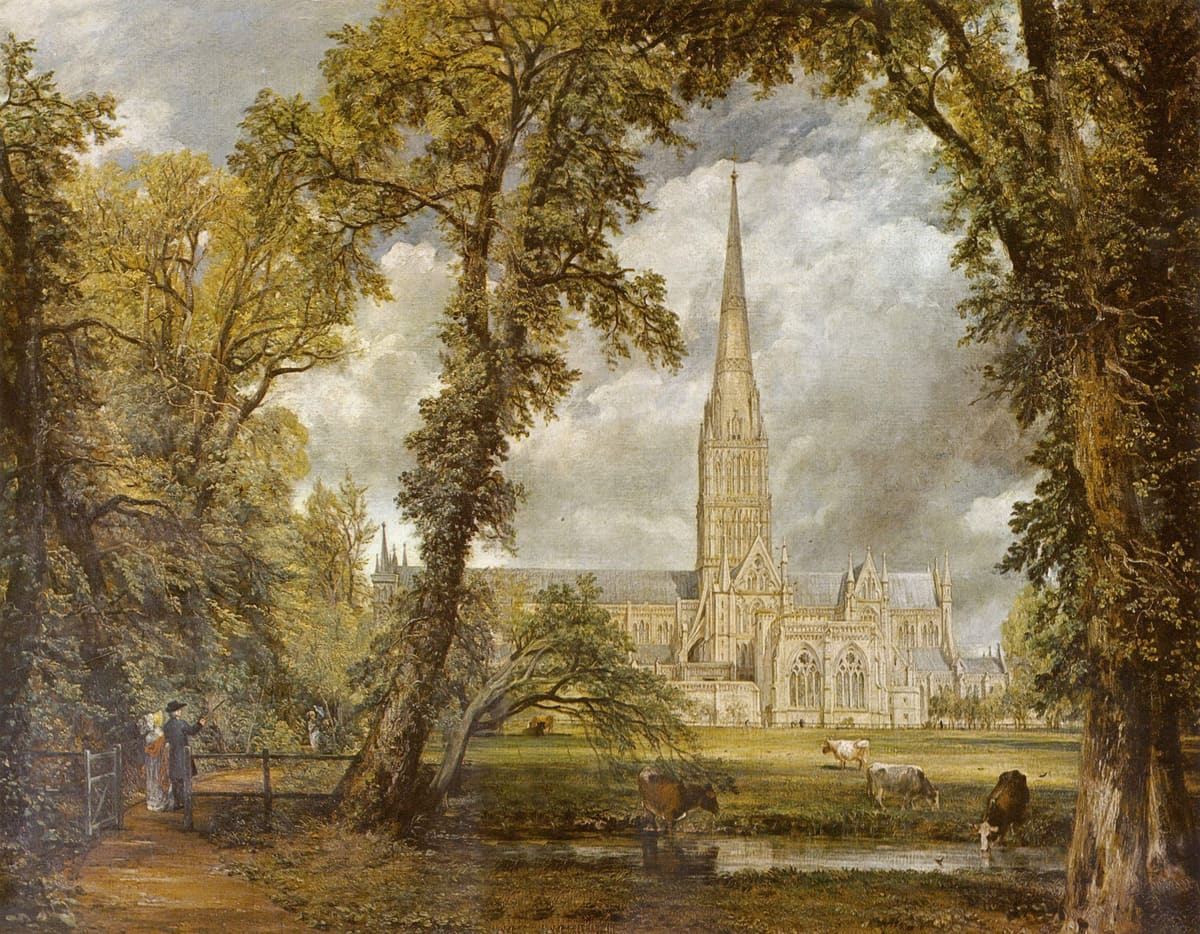
Salisbury Cathedral from the Bishop's Grounds
1823
Constable's other great subject — the cathedral framed by trees, painted for his friend the Bishop.

Rain, Steam and Speed – The Great Western Railway
1843
Turner's railway bridge over the Thames — the other pole of English landscape, twenty years on.
More by John Constable
Salisbury Cathedral from the Bishop's Grounds


Salisbury Cathedral from the Meadows
