
Dolbadarn Castle
The lone round tower of Dolbadarn Castle on a crag above Llyn Padarn, in the mountains of Snowdonia — the tower still stands.
Dolbadarn Castle
The painting shows a real, identified place that you can find today. The exact spot the artist worked from is not necessarily known.
Dolbadarn Castle — at a glance
- Artist
- J. M. W. Turner (1775–1851)
- Year
- 1799–1800
- Movement
- English Romanticism
- Place
- Dolbadarn Castle, Llanberis, Snowdonia (Eryri), Wales
- Viewpoint
- The castle crag above Llyn Padarn — the tower survives (Cadw); heights exaggerated by the artist
- Medium
- Oil on canvas
- Dimensions
- c. 120 × 90 cm
- Now at
- Royal Academy of Arts, London
Overview
Dolbadarn Castle is the painting the young J. M. W. Turner presented to the Royal Academy on his election in 1802 as his ‘diploma work’. Based on a tour of North Wales in 1798–99, it shows the single tall round tower of the ruined castle silhouetted against the sky on its rocky knoll, dark mountains crowding around, tiny figures on the path below, and a wild, storm-lit light. It is oil on canvas, about 120 by 90 cm, and it hangs in the Royal Academy of Arts, London.
Where was Dolbadarn Castle painted?
Scholarship Dolbadarn Castle was built by the Welsh princes of Gwynedd in the thirteenth century to guard the Llanberis Pass. Its great round keep stands on a crag between the lakes Llyn Padarn and Llyn Peris, near the village of Llanberis in Snowdonia (Eryri), at the foot of Snowdon. The tower still stands, cared for by Cadw, and is freely accessible by a short walk; Turner exaggerated the height of the tower and the surrounding peaks for drama, but the setting is unmistakable.
What is in the painting?
The tower rises at the centre, made taller and more gaunt than it really is, black against a pale, broken sky. Steep dark crags and mountainsides close in on both sides and behind. At the foot of the rock, a track with small figures — travellers, perhaps a guard leading a prisoner — gives the scale. The light is low and stormy, catching the tower's top and a slope of scree.
Look closely
The heightened tower
The real keep is stocky; Turner draws it tall and gaunt against the sky.
The crowding crags
Dark mountainsides press in on all sides, making a claustrophobic wall of rock.
The figures on the path
Tiny travellers at the foot of the rock — sometimes read as a guard and a prisoner.
The storm light
A low, broken light catches the tower's top and a slope of scree.
Analysis
Composition and technique
A single vertical tower dwarfed by exaggerated mountains, lit by a low, dramatic storm light.
Scholarship Turner builds a claustrophobic wall of dark rock around the pale tower, heightens everything vertically, and uses a shaft of stormy light to pick out the keep against the sky. It is an early statement of the sublime landscape — nature and ruin overwhelming the human.
Meaning and interpretation
Interpretations differ. What the artist documented, what museums and scholars propose, and later or speculative theories are marked and kept separate.
Welsh liberty lost
Turner attached lines of his own verse about the imprisonment there of the Welsh prince Owain Goch by his brother, and about ‘the fate of Cambria's Prince’. The lonely tower among crushing mountains stands for lost Welsh independence — a Romantic, patriotic-elegiac reading of a real ruin.
History & provenance
As a Royal Academy diploma work the painting has remained in the Academy's own collection since 1802.
Sources
- Royal Academy of Arts, London — collection entry for J. M. W. Turner, ‘Dolbadarn Castle, North Wales’ (1799–1800; diploma work)
- Cadw (Welsh Government) — Dolbadarn Castle, Llanberis
Related paintings

More by J. M. W. Turner
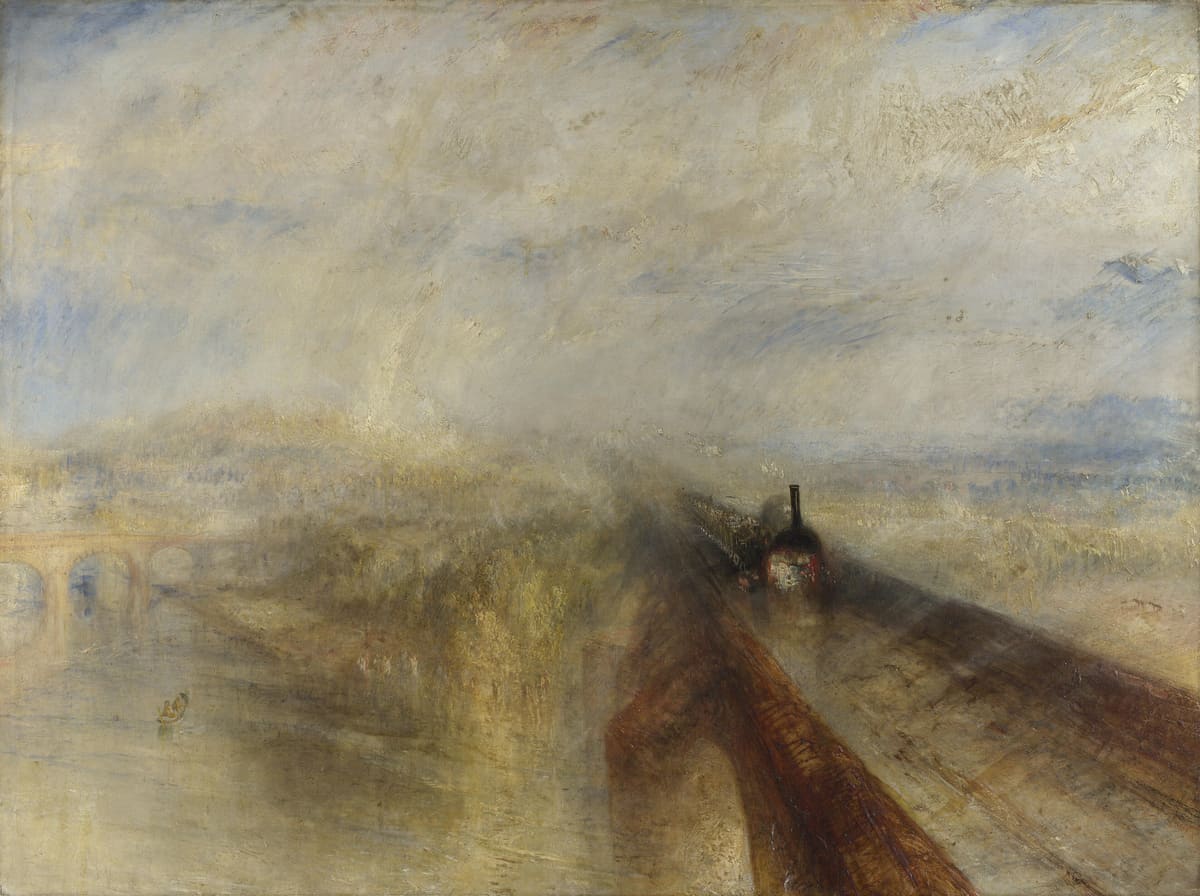
Rain, Steam and Speed – The Great Western Railway

Dido building Carthage

