
Norham Castle, Sunrise
The ruined border castle of Norham on the River Tweed, dissolved almost to nothing in the light of a late Turner sunrise.
Norham Castle
The painting shows a real, identified place that you can find today. The exact spot the artist worked from is not necessarily known.
Norham Castle, Sunrise — at a glance
- Artist
- J. M. W. Turner (1775–1851)
- Year
- c. 1845
- Movement
- English Romanticism
- Place
- Norham Castle, on the River Tweed, Northumberland, England
- Viewpoint
- The castle mound above the Tweed — the ruin survives (English Heritage); dissolved to a haze here
- Medium
- Oil on canvas
- Dimensions
- c. 91 × 122 cm
- Now at
- Tate Britain, London
Overview
Norham Castle, Sunrise is one of the paintings left in J. M. W. Turner's studio at his death and now among the most admired of his late works. It shows the ruined keep of Norham Castle as a pale blue ghost on its mound above the River Tweed, with a cow standing in the shallows, the whole scene bleached and dissolved in a flood of yellow and rose sunrise light. It is oil on canvas, about 91 by 122 cm, and it hangs in Tate Britain, London.
Where was Norham Castle, Sunrise painted?
Scholarship Norham Castle is a large twelfth-century fortress on the south (English) bank of the River Tweed, which forms the border with Scotland, near the village of Norham in Northumberland. Turner first drew it on a tour in 1797 and returned to the subject in watercolour, print and oil for the next fifty years — he is said to have raised his hat to the castle in later life in thanks for the success its images brought him. The ruin still stands, cared for by English Heritage, on its mound above the river; the profile is recognisable, though Turner's late oil reduces it almost to a coloured haze.
What is in the painting?
The keep is a soft, near-transparent blue wedge just left of centre, its outline barely fixed. Below, the pale river and a low bank; a single cow stands in the water at the right, its reflection the firmest dark note in the picture. Everything else is broad washes of pale yellow, cream, rose and blue — sky, water and land almost merged in the low sun.
Look closely
The ghost castle
The keep is a pale blue wedge with barely a fixed outline, just left of centre.
The single cow
A cow stands in the shallows at the right; its dark reflection is the firmest note in the picture.
The merged sky and water
Pale yellow, cream, rose and blue washes run together — land, river and air almost one.
The thin luminous paint
Turner works transparent colour over a white ground so the picture seems lit from within.
Analysis
Composition and technique
A near-abstract field of pale colour, with the castle and a single cow as the only footholds for the eye.
Scholarship Turner works thin, luminous colour over a white ground and lets form dissolve into light: the castle is defined by the faintest change of tone, the cow by a small dark reflection. It is landscape reduced to the experience of looking into a sunrise, and is often cited as a forerunner of abstraction.
Meaning and interpretation
Interpretations differ. What the artist documented, what museums and scholars propose, and later or speculative theories are marked and kept separate.
A lifelong motif, finally dissolved
Norham was a subject Turner returned to for half his career; the late oil is read as the culmination of that long attachment — the solid border fortress of his youth turned, in old age, almost entirely into light.
History & provenance
The painting was part of the Turner Bequest to the nation and is held by Tate, shown at Tate Britain, London.
Sources
- Tate — collection entry for J. M. W. Turner, ‘Norham Castle, Sunrise’ (c. 1845; oil on canvas, c. 91 × 122 cm; Turner Bequest)
- English Heritage — Norham Castle, Northumberland
Related paintings

Dolbadarn Castle
1800
Turner's early Welsh castle keep of 1800 — the same motif, solid and dramatic, before the dissolving late style.

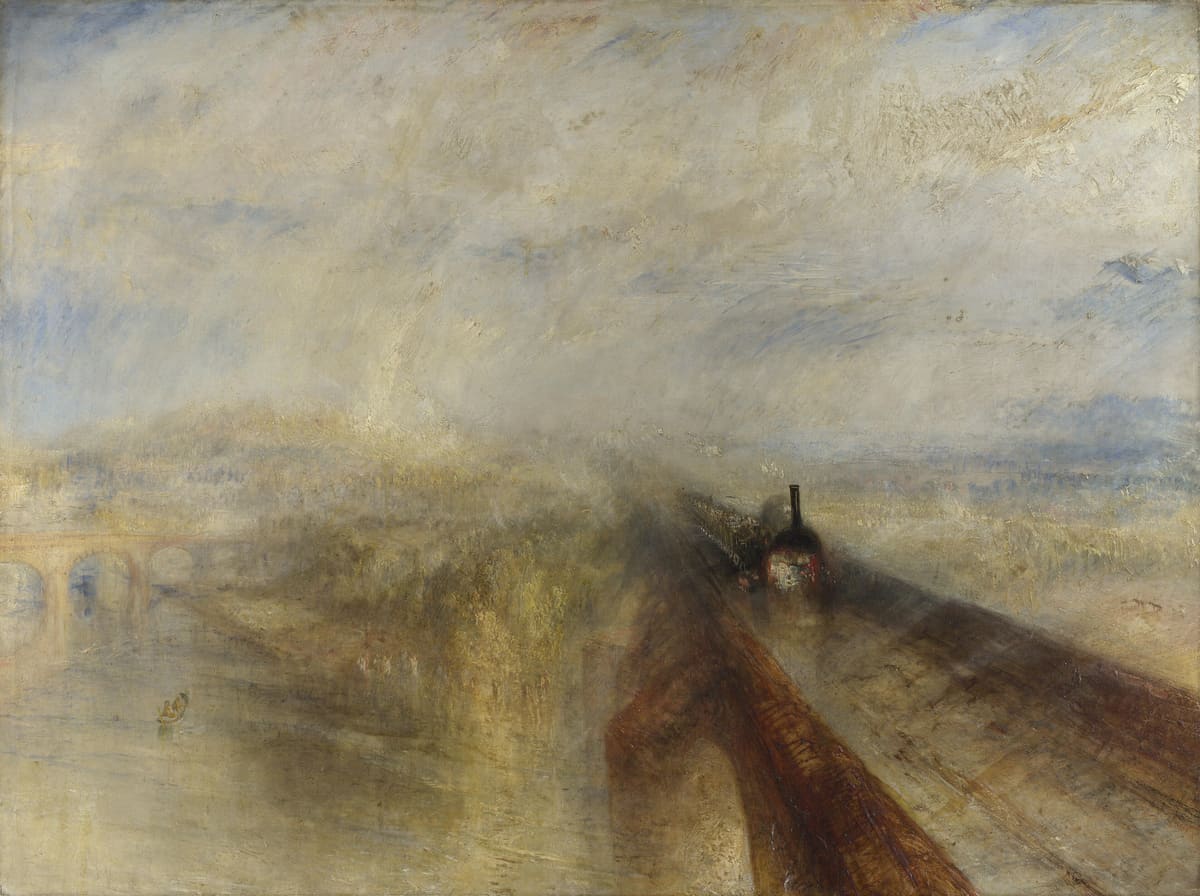
Rain, Steam and Speed – The Great Western Railway
1843
Turner's late railway picture — the same near-abstract handling of light and weather.

Impression, Sunrise
1872
Monet's 1872 harbour sunrise — the next generation's version of dissolving a scene into low light.
More by J. M. W. Turner
Rain, Steam and Speed – The Great Western Railway

Dido building Carthage
Dolbadarn Castle
