Famous work · not an exact-location map point
Nighthawks
An all-night diner assembled from imagination and memory — no real corner has ever been confirmed.
No single real-world viewpoint
This famous work does not have a single exact real-world viewpoint. The connection below explains its actual relationship to the real world.
Nighthawks — at a glance
- Artist
- Edward Hopper (1882–1967)
- Year
- 1942
- Movement
- American Realism / American Scene
- Place
- New York City — no confirmed site
- Viewpoint
- An invented corner; ‘suggested by’ Greenwich Avenue but not a real diner
- Medium
- Oil on canvas
- Dimensions
- c. 84 × 152 cm
- Now at
- Art Institute of Chicago
Overview
Nighthawks is an oil painting Edward Hopper made in New York in the winter of 1941–42, finishing it in January 1942. It shows a counterman and three customers in a plate-glass corner diner, brightly lit, on a deserted street at night. It is oil on canvas, about 84 by 152 cm, and the Art Institute of Chicago bought it within months of its completion.
It is one of the most reproduced American paintings, and its subject is not a real place but a mood: the loneliness of a city after dark.
“Unconsciously, probably, I was painting the loneliness of a large city.”
The story behind the painting
Hopper began the picture in December 1941, in the weeks after the attack on Pearl Harbor, and finished it that January. His wife Jo, who kept the studio ledger and named it, recorded it as a night scene of a cheap restaurant with a big window, three customers and a barman; she posed for the woman, and Hopper for both men.
Artist's own account Hopper said the picture was ‘suggested by a restaurant on New York's Greenwich Avenue where two streets meet,’ but that he had simplified the scene and made the diner much bigger. Looking back, he added that ‘unconsciously, probably, I was painting the loneliness of a large city.’
Where was Nighthawks painted?
No real diner has ever been reliably identified. Greenwich Avenue, in the Village near Hopper's own home on Washington Square, is the street he named, and its triangular corners fit the wedge shape of the building.
Scholarship But Hopper combined and enlarged what he saw — the seamless curved window with no visible door is a compositional invention — and nothing on Greenwich Avenue matches the picture. There is no site to visit; the ‘place’ is a type of street corner, not one address.
How we know
- Hopper said it was 'suggested by a restaurant on Greenwich Avenue'; scholarship (J. Moss, NYT; Village Preservation) concludes it is an amalgamation of several diners, all demolished, and the often-cited Mulry Square site is debunked. Real neighbourhood, no 1:1 place. (E - disputed - was also considered.)
What is in the painting?
Behind a long cherry-wood counter, a fair-haired counterman in white stoops at a task. A man in a grey hat and dark suit sits at the counter with a cigarette; beside him a woman in a red dress holds a sandwich and looks at something in her hand. A fourth figure, in dark clothes, sits with his back to us at the left.
The diner's light spills onto the empty pavement and the dark shopfronts opposite. A sign along the top reads ‘Phillies’ over a picture of a cigar. There is no door in view, no litter, no traffic — just the lit box and the four people, none of whom speaks to another.
Look closely
No door
The curved window runs the width of the picture with no visible entrance — the diner cannot be entered or left.
The ‘Phillies’ sign
A cigar advertisement runs along the top of the building, over a picture of a cigar.
The green tile strip
Jo Hopper's notes single out a ‘brilliant streak of jade green tiles’ at the base of the window.
The coffee urns
Two large metal urns gleam behind the counter at the right.
The fourth figure
A man in dark clothes sits with his back to us at the left, cut off from the other three.
The empty street
Not a car, a person or a scrap of litter outside — only the light from the diner on the pavement.
Details that are easy to miss. There is no door into the diner anywhere in the picture; the woman's and the man's hands almost touch on the counter but do not; two coffee urns gleam at the back; the ‘Phillies’ cigar advertisement runs along the top of the building; and the street outside is completely empty — no cars, no pedestrians, no rubbish.
Analysis
Composition & perspective
The diner is a bright wedge driven across a dark canvas, its long window sealing the people inside from the street and from us.
Scholarship The great curved sheet of glass runs almost the full width of the picture, cutting the lit interior off from the shadowed exterior. There is no visible entrance. The counter and the diner's prow push forward like the bow of a ship; the four figures are spaced along it without touching or facing one another.
Colour and light
A hard fluorescent-white interior — a new kind of electric light in 1942 — against deep browns and blacks outside.
Museum interpretation The diner glows an even, shadowless white; Jo Hopper's notes single out the ‘brilliant streak of jade green tiles’ at the base of the window and the yellow-ochre door to the kitchen. Outside, the brick houses opposite are a darkish red and the pavement a pale greenish grey. The light is the subject as much as the people.
Handling and technique
Flat, smooth, dry paint with crisp edges — every form simplified to a plane of colour.
Hopper worked slowly from drawings and, in Jo's phrase, from a scene that was ‘probably a very sad picture.’ The paint is thin and even, the drawing hard, the shapes reduced. He made preparatory sketches for the diner and the figures before the final canvas.
Meaning and interpretation
Interpretations differ. What the artist documented, what museums and scholars propose, and later or speculative theories are marked and kept separate.
Hopper's own words
Hopper resisted fixed readings, but said he had ‘unconsciously, probably’ been painting the loneliness of a large city, and denied any deliberate message beyond that.
Isolation in the modern city
The standard reading takes it as an image of urban alienation: people together in a lit room but sealed off from the street and from each other, at an hour when the city is empty.
A refuge of light
The Art Institute has also presented it the other way round — as a warm, safe island of light in the dark, especially resonant painted in the anxious weeks after Pearl Harbor. Both readings are interpretation; the picture supports either.
History & provenance
- Dec 1941 – Jan 1942Painted in New York in the weeks after Pearl Harbor.
- 1942Bought by the Art Institute of Chicago for $3,000.
- TodayOne of the Art Institute's signature works.
The Art Institute of Chicago acquired the painting the year it was made, for the Friends of American Art Collection, and has held it since.
Sources
- Art Institute of Chicago — collection entry and curatorial notes for ‘Nighthawks’ (Friends of American Art Collection, 1942.51)
- Gail Levin, ‘Edward Hopper: An Intimate Biography’ (1995) — Jo Hopper's studio ledger and Hopper's remarks
- Art Institute of Chicago — ‘Nighthawks as a Symbol of Hope’ (curatorial essay)
Frequently asked
Is the diner in Nighthawks a real place?
No real diner has ever been reliably identified. Hopper said it was ‘suggested by a restaurant on Greenwich Avenue where two streets meet,’ but he simplified and enlarged what he saw, and nothing on that street matches the picture.
Can you visit the location?
There is nothing to visit. The seamless curved window with no door is an invention, and no corner in Greenwich Village corresponds to the scene.
When was it painted?
Between December 1941 and January 1942 — in the weeks after the attack on Pearl Harbor.
Who are the four people?
They are not portraits. Hopper's wife Jo posed for the woman and Hopper posed for both men; the counterman completes the group.
What does Nighthawks mean?
Hopper said he had ‘unconsciously, probably’ been painting the loneliness of a large city. It is usually read as urban isolation, though the Art Institute has also presented it as a warm refuge of light in the dark.
Why is there no door?
The unbroken sheet of glass with no visible entrance is Hopper's invention. It seals the diner off from the street and from the viewer, and is central to the picture's effect.
Where is the painting now?
In the Art Institute of Chicago, which bought it in 1942.
Related paintings

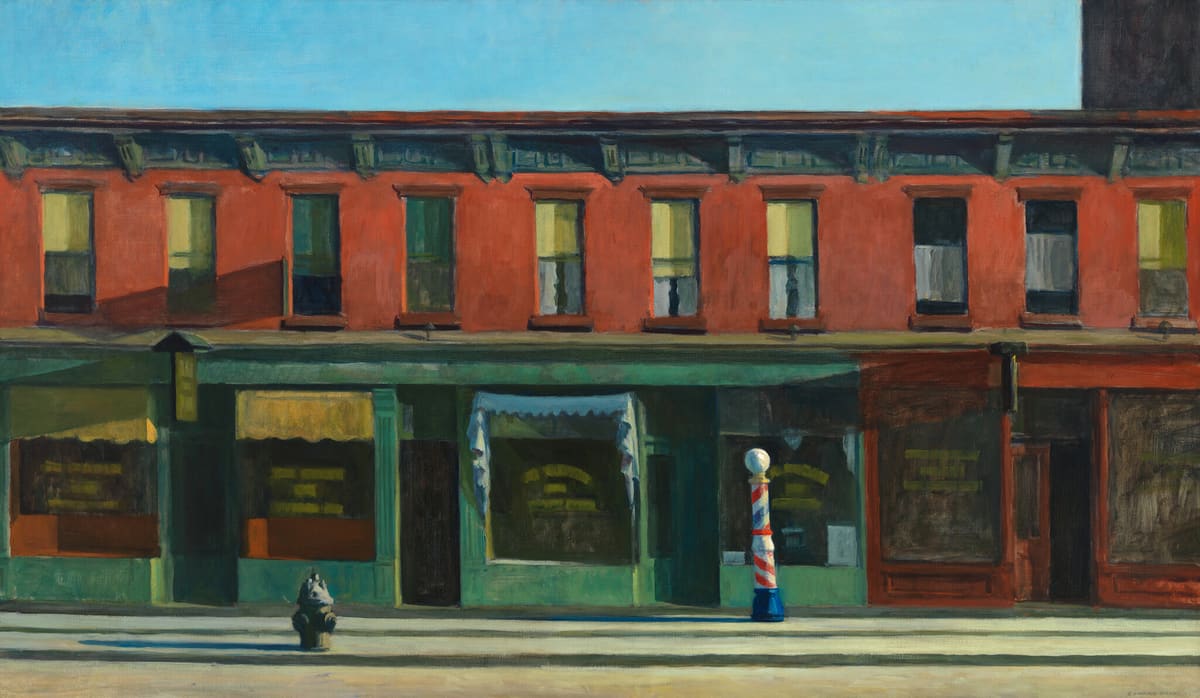
Early Sunday Morning
1930
Hopper's other great New York street, painted twelve years earlier — the same city, empty, in raking light.

The Night Café
1888
Van Gogh's all-night café in Arles, 1888 — an earlier picture of a lit refuge for the sleepless.

Café Terrace at Night
1888
Van Gogh's lamplit café terrace — the warm, sociable version of the same nocturnal subject.
Current display status
Currently not on viewMore by Edward Hopper
East Wind Over Weehawken
Early Sunday Morning

Coast Guard Station, Two Lights, Maine
