
Manhattan Bridge Loop
The bleak approach to the Manhattan Bridge on the Lower East Side — a long, low, empty stretch of the New York the bridge cut through.
Manhattan Bridge
The painting shows a real, identified place that you can find today. The exact spot the artist worked from is not necessarily known.
Manhattan Bridge Loop — at a glance
- Artist
- Edward Hopper (1882–1967)
- Year
- 1928
- Movement
- American Realism / American Scene
- Place
- The Manhattan Bridge approach, Lower East Side, New York, USA
- Viewpoint
- The elevated approach and loop ramp — bridge and approach survive; street level and buildings changed
- Medium
- Oil on canvas
- Dimensions
- c. 89 × 153 cm
- Now at
- Addison Gallery of American Art, Andover, Massachusetts
Overview
Manhattan Bridge Loop is one of Edward Hopper's severest New York pictures, painted in 1928. It is a wide, low canvas of the raised roadway and structure where the Manhattan Bridge comes down onto the Lower East Side: a long horizontal band of bridge girders, retaining wall, a lamppost, tenement backs, and a single small figure walking, all in a flat, cold light. It is oil on canvas, about 89 by 153 cm, and it hangs in the Addison Gallery of American Art at Phillips Academy, Andover, Massachusetts.
Where was Manhattan Bridge Loop painted?
Scholarship The Manhattan Bridge (opened 1909) carries road, subway and pedestrians across the East River between Chinatown / the Lower East Side and downtown Brooklyn. Its Manhattan approach runs on a viaduct and a curving ‘loop’ ramp over streets on the Lower East Side. The bridge, the elevated approach and the tenement blocks along it are still there, so the general scene is identifiable, though the buildings and street level have changed and the area is now dense Chinatown.
What is in the painting?
A very wide, shallow view: the bridge's steel structure and a high blank retaining wall run across the whole canvas at mid-height; a lamppost stands against them; below and beyond, the plain brick backs of tenements and a strip of pavement. One small dark figure walks the pavement at the right. The sky is a narrow pale band; the colour is grey, dun and cold blue.
Look closely
The horizontal bar
Bridge steelwork and a high blank retaining wall run across the whole canvas at mid-height.
The lone walker
One small dark figure on the pavement at the right — nearly the only person and one of the few verticals.
The tenement backs
Plain brick rears of Lower East Side buildings show below and beyond the wall.
The sliver of sky
Only a narrow pale band of sky above the bridge — the city presses down.
Analysis
Composition and technique
An extreme horizontal band of bridge structure and wall, a single small figure, and almost no sky.
Scholarship Hopper stretches the format very wide and low, so the bridge and wall become an oppressive horizontal bar; the lone walker and the lamppost are the only verticals. He said he wanted the picture to convey a mood of ‘great loneliness’ and long, low horizontal extent.
Meaning and interpretation
Interpretations differ. What the artist documented, what museums and scholars propose, and later or speculative theories are marked and kept separate.
Loneliness and extension
Hopper described aiming for a feeling of ‘the elevated,’ great loneliness, and the long horizontal — the vast, indifferent scale of the modern city cutting through an old neighbourhood, with one small person in it.
History & provenance
The painting is in the Addison Gallery of American Art at Phillips Academy, Andover.
Sources
- Addison Gallery of American Art, Phillips Academy, Andover — collection entry for Edward Hopper, ‘Manhattan Bridge Loop’ (1928)
- Gail Levin, ‘Edward Hopper: An Intimate Biography’
Related paintings

Coast Guard Station, Two Lights, Maine
1927
Hopper's Maine station of 1927 — the rural version of the same bare architecture and empty light.

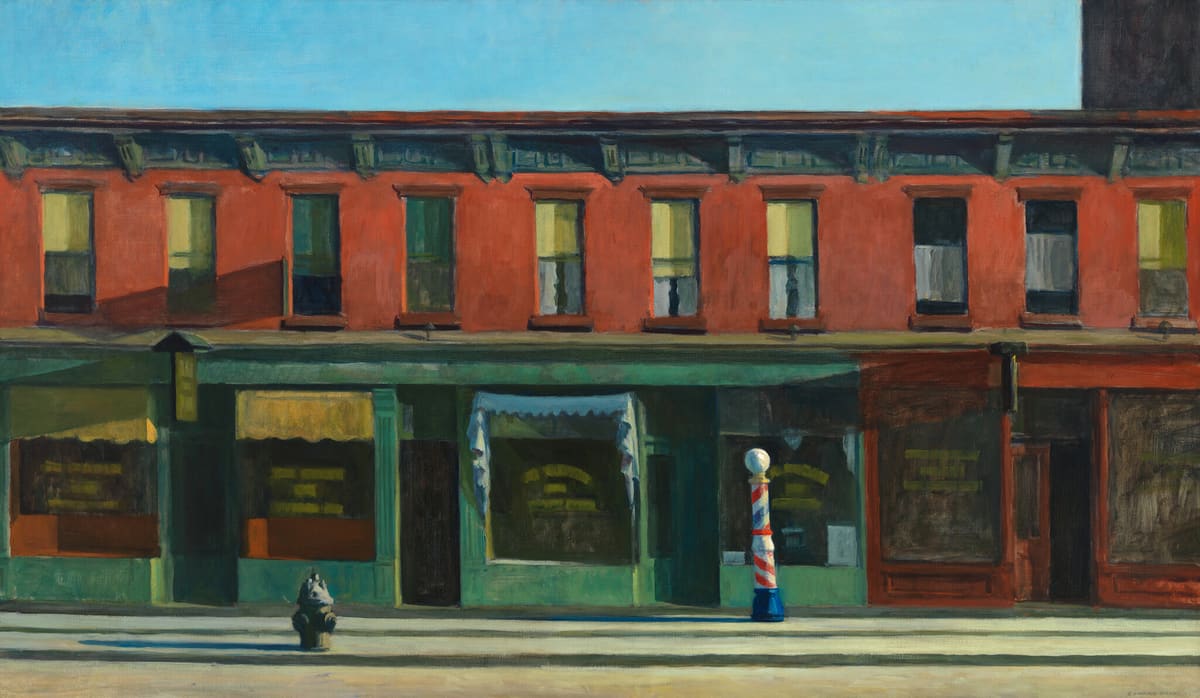
Early Sunday Morning
1930
Hopper's empty New York shopfront row of 1930.

Le Pont de l'Europe
1876
Caillebotte's iron bridge of 1876 — an earlier painter measuring people against the ironwork of the modern city.
More by Edward Hopper
East Wind Over Weehawken
Early Sunday Morning