East Wind Over Weehawken
A hilly street of houses in Weehawken, New Jersey, above the Hudson from Manhattan — an ordinary block that Hopper knew well.
Weehawken
A standpoint is recorded for this painting, but it has not been independently confirmed against a museum or scholarly source, so treat it as approximate.
East Wind Over Weehawken — at a glance
- Artist
- Edward Hopper (1882–1967)
- Year
- 1934
- Movement
- American Realism / American Scene
- Place
- Weehawken, New Jersey, USA — across the Hudson from Manhattan
- Viewpoint
- A sloping Weehawken street — simplified; no single confirmed address
- Medium
- Oil on canvas
- Now at
- Private collection (formerly Pennsylvania Academy of the Fine Arts)
Overview
East Wind Over Weehawken is an oil painting Edward Hopper made in 1934. It shows a block of houses on a hillside street under a low, cold light, with a lone figure and a ‘For Sale’ sign on the corner house. It is oil on canvas, about 87 by 128 cm.
For most of its life it belonged to the Pennsylvania Academy of the Fine Arts, which sold it at auction in 2013, to some controversy; it is now in a private collection.
Where was East Wind Over Weehawken painted?
Weehawken is a town on the New Jersey side of the Hudson River, on the bluffs directly across from midtown Manhattan.
Scholarship Hopper based the picture on a specific sloping street of nineteenth-century row and detached houses in the town, which he knew from years of crossing the river. As often with Hopper, the buildings are tightened and simplified and no single address has been fixed; the general character of the hilly Weehawken streets survives.
What is in the painting?
A street runs down and away to the left along a slope. On the right, a tall corner house with a bay window and a mansard roof carries a small ‘For Sale’ board. Other houses of different heights and styles line the block. A single figure in dark clothes walks the far pavement. There is no traffic, no foliage in leaf, and a raking light throws long shadows across the fronts.
Look closely
The ‘For Sale’ sign
A small board on the tall corner house — a note of emptiness on an already deserted block.
The corner house
A bay window and a mansard roof; it anchors the whole right side of the picture.
The lone walker
A single dark-clothed figure on the far pavement — the only person in the scene.
The raking light
A low, hard side light throws long blue shadows across the house fronts.
Analysis
Composition & perspective
The corner house dominates the right; the street falls away to the left on a strong diagonal, opening the space.
Scholarship Hopper balances the heavy, close block of the corner house against the downhill run of the street, cropping the row so it seems to continue past the frame. The verticals of the house fronts play against the diagonal of the slope and the horizontals of the shadows.
Colour and light
Muted brick reds, greys and creams under a cold, low, side light — the pale sun of a windy day.
The palette is subdued and the light hard and horizontal, picking out cornices and window frames and casting long blue shadows. The title's ‘east wind’ is felt in the bleached, blustery clarity rather than shown.
Meaning and interpretation
Interpretations differ. What the artist documented, what museums and scholars propose, and later or speculative theories are marked and kept separate.
The quiet American street
Like much of Hopper's work, the picture is read as a portrait of an unremarkable place at an empty moment, given a still, faintly melancholy weight — here sharpened by the lone walker and the ‘For Sale’ sign.
Hopper's reticence
Hopper resisted attaching stories to his pictures and offered no explanation of this one beyond its title.
History & provenance
The Pennsylvania Academy of the Fine Arts in Philadelphia owned the painting for decades. In 2013 the Academy sold it at auction to raise funds, a decision that drew criticism from parts of the museum world; it passed into a private collection.
Sources
- Edward Hopper catalogue raisonné (Gail Levin) — entry for ‘East Wind Over Weehawken’ (1934; oil on canvas, c. 87 × 128 cm)
- Contemporary reporting on the 2013 sale by the Pennsylvania Academy of the Fine Arts
Frequently asked
Where is the street in East Wind Over Weehawken?
In Weehawken, New Jersey, on the bluffs across the Hudson River from midtown Manhattan. Hopper based it on a specific sloping residential street there, though the buildings are simplified and no exact address is fixed.
Can you visit the spot?
The hilly streets of nineteenth-century houses in Weehawken survive in character, but Hopper's row is a tightened composite rather than one identifiable block.
What is the ‘For Sale’ sign about?
A small board on the corner house. It adds to the picture's sense of an emptied, slightly forlorn street; Hopper did not explain it.
Where is the painting now?
In a private collection. The Pennsylvania Academy of the Fine Arts sold it at auction in 2013.
Related paintings

More by Edward Hopper
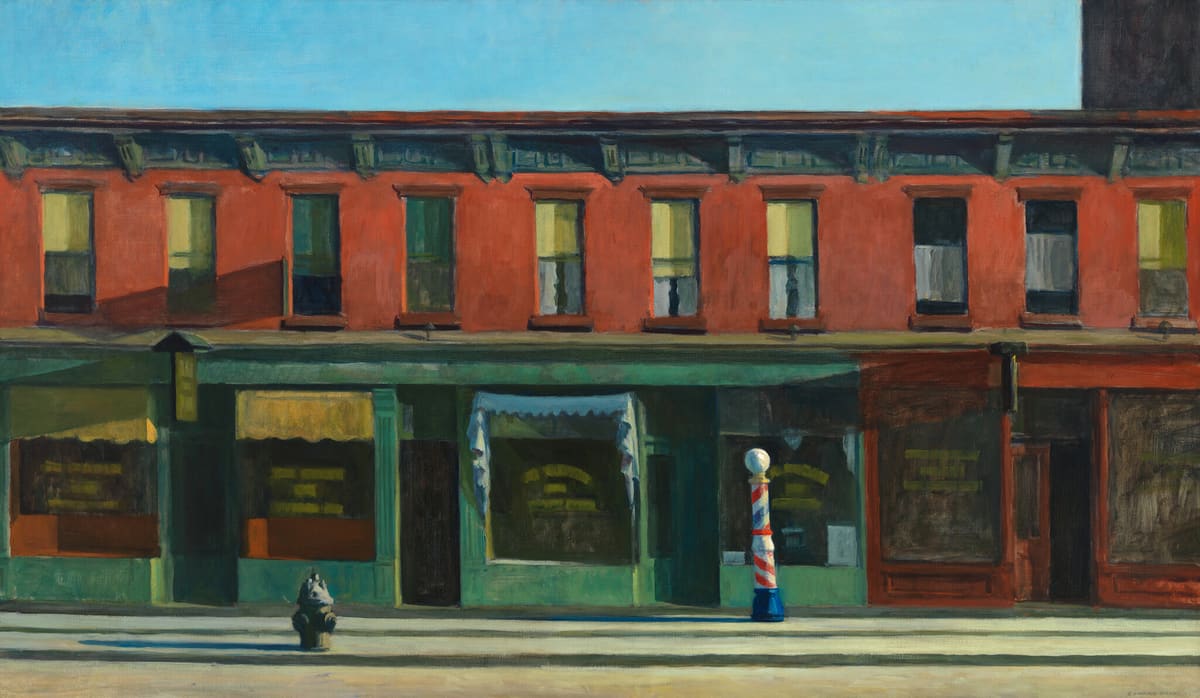
Early Sunday Morning

Coast Guard Station, Two Lights, Maine
