
Coast Guard Station, Two Lights, Maine
The white coastguard buildings on the bare headland at Two Lights, Cape Elizabeth, Maine, under hard clear light — the station still stands.
Cape Elizabeth Light
The painting shows a real, identified place that you can find today. The exact spot the artist worked from is not necessarily known.
Coast Guard Station, Two Lights, Maine — at a glance
- Artist
- Edward Hopper (1882–1967)
- Year
- 1927
- Movement
- American Realism / American Scene
- Place
- The Coast Guard station at Two Lights, Cape Elizabeth, Maine, USA
- Viewpoint
- The bare headland station — the buildings and the Two Lights lighthouses still stand (partly a state park)
- Medium
- Oil on canvas
- Dimensions
- c. 74 × 109 cm
- Now at
- Montclair Art Museum, New Jersey
Overview
Coast Guard Station is one of the Maine coast pictures Edward Hopper painted in the late 1920s. It shows the plain white clapboard buildings of a coastguard station — a house, a lookout tower, a boathouse — on a treeless grassy headland, under a bright, hard, raking light that throws crisp shadows and sharpens every edge against a clear sky. It is oil on canvas, about 74 by 109 cm, and it hangs in the Montclair Art Museum, New Jersey.
Where was Coast Guard Station, Two Lights, Maine painted?
Scholarship The station is at Two Lights on Cape Elizabeth, a rocky headland south of Portland on the coast of Maine named for its pair of lighthouses. Hopper spent the summers of 1927–29 nearby and painted the lighthouses, the station and the coastguard houses repeatedly. The former Coast Guard station buildings and the lighthouses at Two Lights still stand (the area is partly a state park), so the site is identifiable, though the immediate surroundings have some later building.
What is in the painting?
The white buildings sit on a low rise of pale grass, geometric and shadow-crisp: a two-storey house with a porch, a square lookout tower, a lower structure. A flagpole. No people, no movement. The sky is a clear, deep blue with a little cloud; the light is strong and comes from the side, modelling every wall and eave.
Look closely
The lookout tower
A square white tower rises among the low buildings — the station's watch point.
The crisp side light
Strong raking sun models every wall and eave and casts sharp shadows.
The bare headland
The buildings sit on a treeless rise of pale grass — no people, no movement.
Analysis
Composition and technique
Plain white geometric buildings on a bare rise, sharply lit and shadowed against a clear sky, with no figures.
Scholarship Hopper reduces the scene to a few clean volumes — cube, gable, tower — and lets the hard side light do the work, casting sharp shadows that make the shapes read almost abstractly. The emptiness and the strong architecture are entirely characteristic.
History & provenance
The painting is in the Montclair Art Museum, New Jersey.
Sources
- Montclair Art Museum, New Jersey — collection entry for Edward Hopper, ‘Coast Guard Station’ (1927)
- Gail Levin, ‘Edward Hopper: An Intimate Biography’ — the Maine summers
Related paintings

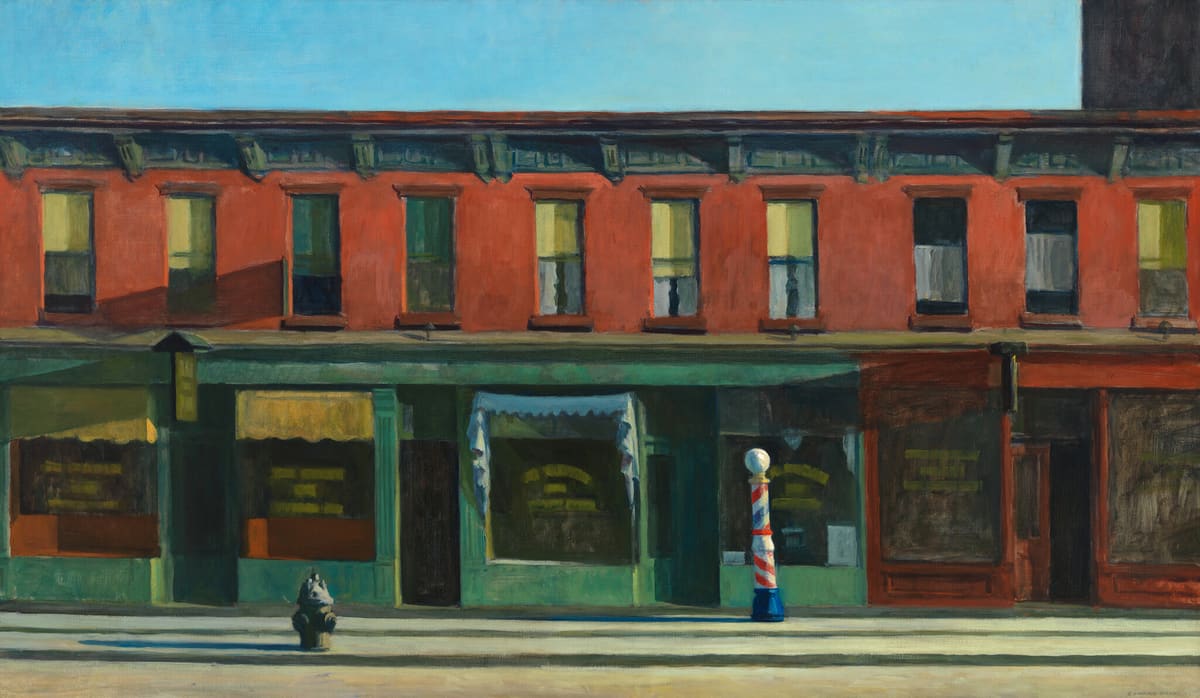
Early Sunday Morning
1930
Hopper's empty New York shopfront row of 1930 — the same clean geometry and absence of people.

Manhattan Bridge Loop
1928
Hopper's Manhattan bridge approach of 1928 — the city version of the same bare architecture.
East Wind Over Weehawken
1934
Hopper's New Jersey street of 1934 — hard light on plain American buildings.
More by Edward Hopper
East Wind Over Weehawken
Early Sunday Morning