A Sunday Afternoon on the Island of La Grande Jatte
Two years of work, dot by dot, built from studies made on a real island in the Seine that is now a Paris park.
Ile de la Grande Jatte, Neuilly-sur-Seine (Seine bank, looking to Courbevoie)
This is a documented exact viewpoint — you can stand roughly where the artist stood and look at the same scene.
A Sunday Afternoon on the Island of La Grande Jatte — at a glance
- Artist
- Georges Seurat (1859–1891)
- Year
- 1884–1886
- Movement
- Neo-Impressionism (Pointillism / Divisionism)
- Place
- Île de la Grande Jatte, Neuilly-sur-Seine, France
- Viewpoint
- A general stretch of the island's bank — composed from many studies, not one fixed spot
- Medium
- Oil on canvas
- Dimensions
- c. 208 × 308 cm
- Now at
- Art Institute of Chicago
Overview
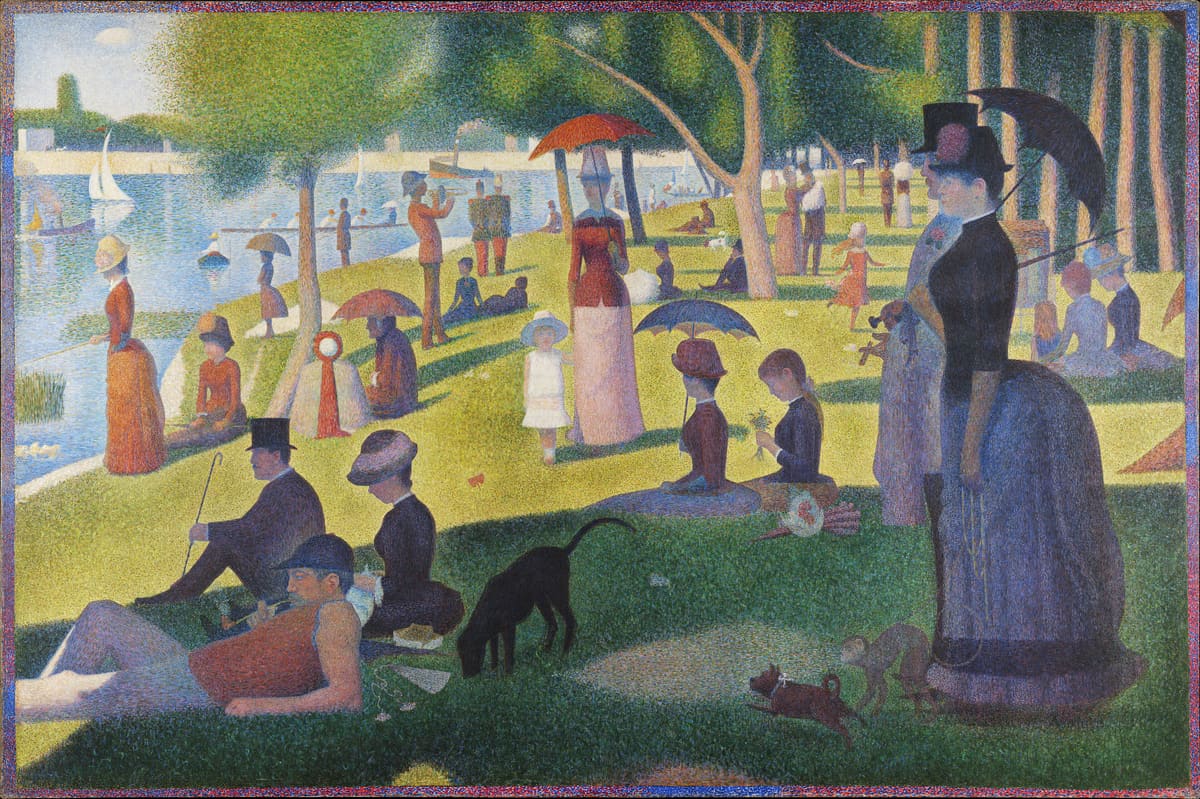
A Sunday on La Grande Jatte — 1884 is a very large painting by Georges Seurat, about 2 by 3 metres, built entirely from small separate touches of colour. It shows Parisians at leisure on a wooded riverbank on a bright afternoon. It is oil on canvas and has belonged to the Art Institute of Chicago since 1926.
Seurat worked on it for roughly two years, making about sixty preparatory studies. When he showed it at the eighth and last Impressionist exhibition in 1886 it split the group and launched what became known as Neo-Impressionism.
How it was made
Seurat spent the summer of 1884 on the Île de la Grande Jatte itself, making rapid oil sketches on small wood panels and conté-crayon drawings. Back in the studio he assembled and refined the composition over the following eighteen months, testing the placement of every figure.
Around 1888–89 he went back into the finished canvas and added a border of painted dots in complementary colours, so the picture would carry its own transition to the wall.
Where was A Sunday Afternoon on the Island of La Grande Jatte painted?
The island lies in the Seine between Neuilly-sur-Seine and Levallois-Perret and Courbevoie, just outside the western edge of Paris. In Seurat's day it was a popular spot for a Sunday outing — boating, walking, cafés.
Museum interpretation It is now built up with housing, but a long riverside public garden, the Parc de l'Île-de-la-Jatte, runs along roughly the stretch of bank Seurat painted, and the line of the river and the far shore still correspond. It is a general setting rather than a single fixed viewpoint — Seurat composed the scene from many studies.
How we know
- The island; the island and Seine bank still exist but are now parkland + housing, the riverside scene is idealised.
What is in the painting?
About fifty people take their ease on a tree-shaded lawn that slopes to the water. In the shaded foreground a man reclines with a pipe, a woman fishes, a couple stands at the right with a monkey on a leash and a small dog; in the sunlit middle ground figures stroll, sit and play. Sailing boats and a steam launch cross the bright river beyond.
The figures are stiff and still, shown in strict profile or full front, like cut-outs — a deliberately archaic, timeless look rather than a snapshot of movement.
Look closely
The leashed monkey
Held by the standing woman at the right; a much-discussed detail, since ‘singe’ also means to mimic.
The painted border
A band of small coloured dots runs around the whole canvas — Seurat added it a few years after finishing.
The woman fishing
At the far left, a woman holds a rod over the water — read by some as another wry touch.
Repeated poses
The same strict profile and frontal stances recur across the crowd, like figures in a frieze.
Boats on the river
Sailing boats and a small steam launch cross the sunlit water beyond the shaded bank.
Bands of light and shade
The lawn is divided into clear zones of sun and shadow that step the eye back into depth.
Details that are easy to miss. The monkey on a leash beside the standing couple at the right; the butterfly and the small dogs on the lawn; the woman fishing at the left edge; the trumpeter and the running girl in the middle distance; the painted border of coloured dots that frames the whole canvas; and the way the same profile pose recurs across the crowd.
Analysis
Composition & perspective
Seurat froze a modern crowd into a flat, rhythmic frieze, with figures repeated at set intervals like a classical relief.
Scholarship The lawn recedes in bands of light and shade; the figures are spaced across it in profile and frontal poses and scaled down with distance in near-mathematical steps. Verticals (people, tree trunks, the standing couple at the right) play against the horizontals of the bank and the river. Nothing is casual; the whole scene is measured.
Colour and light
The picture is built from tiny separate dabs of unmixed colour meant to blend in the eye — the method later called pointillism or divisionism.
Scholarship Seurat had read colour theorists — Chevreul, Ogden Rood, Charles Blanc — and set out to paint sunlight by juxtaposing small strokes of pure hue rather than mixing them on the palette, so that the mixture happens optically. Sunlit grass is stitched from yellows and greens; shadow from blues and oranges. Some pigments have since darkened, so the contrasts were once brighter.
Handling and technique
Every surface is covered in small, dense, deliberate touches, applied over months in the studio.
The touch is slow and systematic — the opposite of Impressionist speed. Seurat reworked areas repeatedly and added the dotted border directly onto the canvas. The scale is that of a Salon history painting, applied to a scene of ordinary Sunday leisure.
Meaning and interpretation
Interpretations differ. What the artist documented, what museums and scholars propose, and later or speculative theories are marked and kept separate.
Seurat's emphasis
Seurat said little about the picture's meaning and stressed method and harmony — the systematic use of line, tone and colour to produce a calm, ordered effect.
Modern life made monumental
The museum and many writers read it as a portrait of the mixed classes of modern Paris at leisure, given the permanence and dignity of classical art through its stillness and scale.
A cool eye on the bourgeoisie
Other scholars find a gentle irony in the rigid poses, the isolation of the figures from one another, and details such as the leashed monkey — ‘singe’ in French, which also means to ape or mimic. This reading is debated and not something Seurat set down.
History & provenance
- 1884–86Painted over about two years from studies made on the island.
- 1886Shown at the eighth and last Impressionist exhibition in Paris.
- c. 1888–89Seurat adds the painted dotted border.
- 1891Seurat dies suddenly, aged 31.
- 1924Bought by the collectors Frederic Clay Bartlett and Helen Birch Bartlett.
- 1926Given to the Art Institute of Chicago, where it has stayed since.
The Bartletts gave the painting to the Art Institute of Chicago in 1926 as part of the Helen Birch Bartlett Memorial Collection. The museum has never lent it since 1958, on conservation grounds.
Featured in Famous Painting Locations: 13 Real Places You Can Visit
Research Included in the Painting Location Precision Study
Sources
- Art Institute of Chicago — collection entry for ‘A Sunday on La Grande Jatte — 1884’ (Helen Birch Bartlett Memorial Collection, 1926.224)
- Robert L. Herbert, ‘Georges Seurat, 1859–1891’ (Metropolitan Museum of Art, 1991)
- Art Institute of Chicago — conservation and technical studies of the painting's pigments and dotted border
- Ville de Neuilly-sur-Seine — Parc de l'Île de la Jatte
Frequently asked
Is the island in the painting a real place?
Yes. The Île de la Grande Jatte is a real island in the Seine at Neuilly-sur-Seine, just west of Paris. Seurat made dozens of studies there before composing the picture in the studio.
Can you visit it today?
The island is now built up with housing, but a long riverside park, the Parc de l'Île-de-la-Jatte, runs along the stretch of bank Seurat painted, and the river and far shore still correspond.
How long did Seurat take to paint it?
About two years, from 1884 to 1886, with roughly sixty preparatory oil sketches and drawings. He later added a border of painted dots around 1888–89.
What is pointillism?
Seurat's method of building a picture from small separate touches of pure, unmixed colour placed side by side, so that they blend in the viewer's eye. It is also called divisionism, and the movement it launched is Neo-Impressionism.
Why do the people look so stiff?
The frozen profile and frontal poses are deliberate. Seurat wanted the permanence and calm of classical relief sculpture rather than the fleeting movement the Impressionists chased.
What is the monkey doing in it?
A leashed monkey sits beside the standing couple at the right. Some scholars read it as a sly touch — ‘singe’ in French also means to ape or imitate — but the reading is debated and Seurat did not explain it.
Have the colours changed?
Yes. Some of Seurat's pigments, particularly a zinc yellow, have darkened towards brown, so the contrasts in the sunlit passages were originally brighter.
Where is the painting now?
In the Art Institute of Chicago, which has held it since 1926 and does not lend it.