Bathers at Asnières
Working-class Parisians resting by the Seine at Asnières, with the factory chimneys of Clichy across the water — the river bend and the railway bridge are still there.
Asnières-sur-Seine
The painting depicts a real landscape or cityscape. The precise viewpoint the artist used may be unknown, so the marker shows the general area.
Bathers at Asnières — at a glance
- Artist
- Georges Seurat (1859–1891)
- Year
- 1884
- Movement
- Neo-Impressionism (early)
- Place
- The Seine at Asnières-sur-Seine, north-west of Paris
- Viewpoint
- The riverbank opposite La Grande Jatte — bridges and river bend survive; suburb now built up
- Medium
- Oil on canvas
- Dimensions
- c. 201 × 300 cm
- Now at
- The National Gallery, London
Overview
Bathers at Asnières is Georges Seurat's first large exhibition painting, made in 1884 when he was twenty-four. It shows a group of young working-class men and boys sitting and lying on a grassy riverbank, or wading and swimming in the Seine, on a hot, hazy afternoon in the industrial suburbs. It is oil on canvas, about 201 by 300 cm, and it hangs in the National Gallery, London.
Rejected by the official Salon, it was shown instead at the first exhibition of the Société des Artistes Indépendants, and it announced Seurat as the leader of a new, systematic kind of painting.
The story behind the painting
Scholarship Seurat prepared the picture with around a dozen small oil sketches (croquetons) painted on the spot and several conté drawings. He worked the huge canvas up in the studio, and a few years later reworked passages of it with small dots of contrasting colour, moving towards the pointillist technique he perfected in ‘A Sunday on La Grande Jatte’, which shows the opposite bank of the same stretch of river.
Where was Bathers at Asnières painted?
Scholarship Asnières-sur-Seine lies just north-west of Paris, on the right bank of the Seine, across the water from the Île de la Grande Jatte and the suburb of Courbevoie. In the 1880s it was a spot where factory workers and clerks came to cool off on the river, with the chimneys of Clichy and the new railway lines close by. The railway bridge of Asnières, the road bridge and the river bend all survive; the area is now dense inner suburb, so the openness is gone, but the topography can be followed.
What is in the painting?
On the near bank, a young man in a bowler sits with his back to us at the left; a reclining figure in an orange hat lies on the grass; a boy in red trunks stands in the shallows, and another, deeper in, cups his hands to shout, a red cap on his head. Clothes, boots and a straw hat lie on the grass. Across the pale blue-green river, a sailing boat and a ferry; behind, the railway bridge and, further off, the factory chimneys of Clichy trailing smoke under a bleached sky.
Look closely
The boy shouting in the water
A figure up to his chest in the river cups his hands to call out, a red cap on his head — the one active gesture.
The factory chimneys of Clichy
Smoking chimneys on the far bank locate the scene squarely in the industrial suburbs.
The railway bridge
The iron bridge of Asnières crosses the Seine behind the bathers; it still stands.
The heap of clothes
Boots, a jacket and a straw hat lie on the grass beside the seated men.
The later dots
Small stippled touches of orange and blue in the red cap and the grass — Seurat's first move towards pointillism.
Analysis
Composition & perspective
A calm frieze of still, rounded figures along a horizontal bank, each isolated, with the river and the bridge carrying the eye back.
Scholarship Seurat arranges the bathers in a slow, deliberate rhythm across the foreground, every figure self-contained and almost motionless, modelled in simple curves. The diagonal of the bank and the line of the bridge lead into depth; the stillness and the careful spacing give a monumental, classical calm to an ordinary riverside scene.
Colour and light
Sun-bleached greens, blues and warm flesh tones under a hazy industrial light, with small complementary touches added later.
Scholarship The palette is high and slightly dusty — the heat-haze of a factory suburb — with the orange hat and red cap and trunks as sharp accents against the green bank and blue water. In later reworking Seurat stippled small dots of orange and blue into the boy's cap and the grass, an early trial of divided colour.
Meaning and interpretation
Interpretations differ. What the artist documented, what museums and scholars propose, and later or speculative theories are marked and kept separate.
Dignity for modern labour
The picture is usually read as Seurat giving the monumental scale and classical composure of history painting to a scene of ordinary working people at leisure in an unlovely industrial landscape — a deliberate, almost political choice of subject.
Companion to La Grande Jatte
‘A Sunday on La Grande Jatte’ shows the middle-class promenade on the island directly across this water. The two large canvases are often paired as Seurat's contrasting portraits of the two classes using the same river.
History & provenance
The painting passed to Seurat's family after his early death, was bought by the dealer Félix Fénéon and later by the collector Sir Hugh Lane, and entered the National Gallery, London, through the Lane bequest.
Sources
- The National Gallery, London — collection entry for Georges Seurat, ‘Bathers at Asnières’ (1884; oil on canvas, c. 201 × 300 cm; Lane Bequest)
- John Leighton and Richard Thomson, ‘Seurat and The Bathers’ (National Gallery, 1997)
Frequently asked
Where is Bathers at Asnières set?
On the right bank of the Seine at Asnières-sur-Seine, just north-west of Paris, across the water from the Île de la Grande Jatte, with the railway bridge of Asnières and the factory chimneys of Clichy behind.
Can you visit the spot?
The railway bridge, the road bridge and the river bend all survive, so the topography can be followed, but Asnières is now dense inner suburb and the open riverbank of the 1880s is gone.
Who are the bathers?
Working-class Parisians — factory hands and clerks — cooling off in the river on a hot afternoon, in the industrial suburbs where they lived and worked.
How does it relate to ‘A Sunday on La Grande Jatte’?
La Grande Jatte shows the middle-class Sunday crowd on the island directly across this stretch of river. Seurat painted the two large canvases as a contrasting pair — the two classes on the same Seine.
Where is the painting now?
In the National Gallery, London (Lane Bequest).
Related paintings


More by Georges Seurat
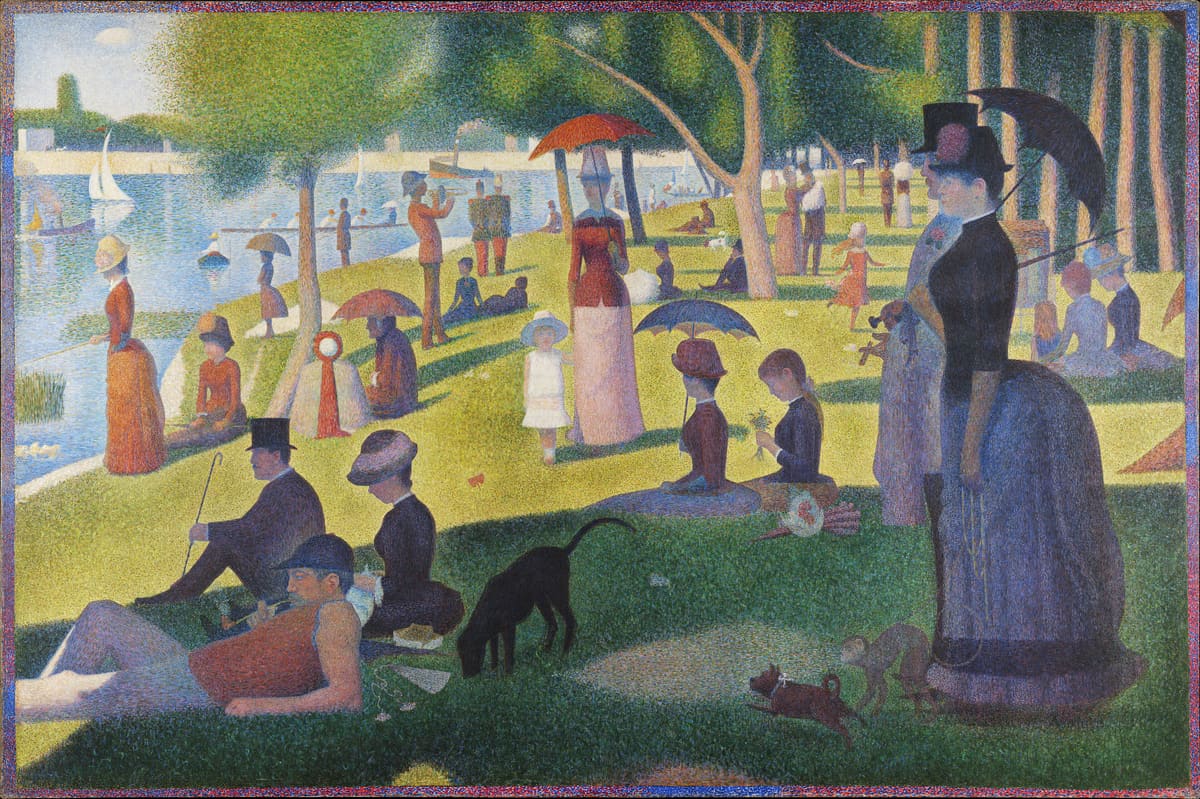
A Sunday Afternoon on the Island of La Grande Jatte