Famous work · not an exact-location map point
Le Chahut
A high-kicking stage dance in a Paris café-concert — a scene from the entertainment world of the 1880s, not a documented venue.
No real-world viewpoint
This work does not depict a place you can visit — see the notes below.
Le Chahut — at a glance
- Artist
- Georges Seurat (1859–1891)
- Year
- 1889–1890
- Movement
- Neo-Impressionism (Pointillism)
- Place
- The Paris café-concert world (Montmartre / the boulevards)
- Viewpoint
- A generalised entertainment scene — not a documented single venue
- Medium
- Oil on canvas
- Dimensions
- c. 170 × 141 cm
- Now at
- Kröller-Müller Museum, Otterlo
Overview
Le Chahut is one of the last large canvases Georges Seurat completed before his death at thirty-one. Painted in 1889–90 in his pointillist technique, it shows two male and two female dancers on a lamplit stage, legs kicked high in unison in the boisterous dance called the chahut, with a double-bass player in the pit and a moustached man watching from the lower right. It is oil on canvas, about 170 by 141 cm, and it hangs in the Kröller-Müller Museum at Otterlo in the Netherlands.
The setting: the Paris café-concert
Scholarship The chahut was danced in the café-concerts and dance halls of Montmartre and the grands boulevards in the 1880s — venues such as the Moulin Rouge, the Élysée-Montmartre and the Divan Japonais. Seurat's picture is a distilled image of that world rather than a record of a particular hall: the architecture is generalised, the gas globes and stage edge stand for the type. It is placed on the map by that broad association with Paris entertainment, not by a fixed address.
What is in the painting?
Four dancers are seen from below and behind, ranked on a diagonal, right legs and pointed toes swung up together; a woman's frilled skirts and dark stockings fill the centre. The bandmaster or bass player leans in from the lower left; the spectator's grinning face is at the lower right. Gas lamps with radiating haloes line the top; everything — faces, bows, ribbons, moustaches — is tipped upward at the same jaunty angle.
Look closely
The unison kick
Four right legs and pointed toes swung up together on a diagonal — the signature move of the chahut.
The bass player
A musician leans in from the lower left, scroll and bow raised at the same upward angle.
The grinning spectator
A moustached man's face fills the lower right corner, watching.
The haloed gas lamps
A row of lights across the top, each with radiating dots — pointillism used for glare.
Analysis
Composition and theory
Almost every line points upward and to the right, a deliberate diagram of ‘gaiety’ built from rising diagonals.
Artist's own account Seurat had been reading Charles Henry's theories that upward, rightward lines and warm colours express joy, downward lines sadness. Le Chahut is a test of that idea: the kicked legs, the bow, the moustaches, the lamp flames and the skirt frills all repeat the same upward diagonal, so the composition itself is meant to feel merry.
Scholarship The fixed grins and mechanical unison have often been read as a cool, faintly mocking view of commercial entertainment, though Seurat left no statement to that effect.
History & provenance
The painting was bought by Helene Kröller-Müller in the early twentieth century and is in the Kröller-Müller Museum, Otterlo.
Sources
- Kröller-Müller Museum, Otterlo — collection entry for Georges Seurat, ‘Le Chahut’ (1889–90; oil on canvas, c. 170 × 141 cm)
- Robert L. Herbert, ‘Georges Seurat, 1859–1891’ (Metropolitan Museum of Art, 1991)
Related paintings

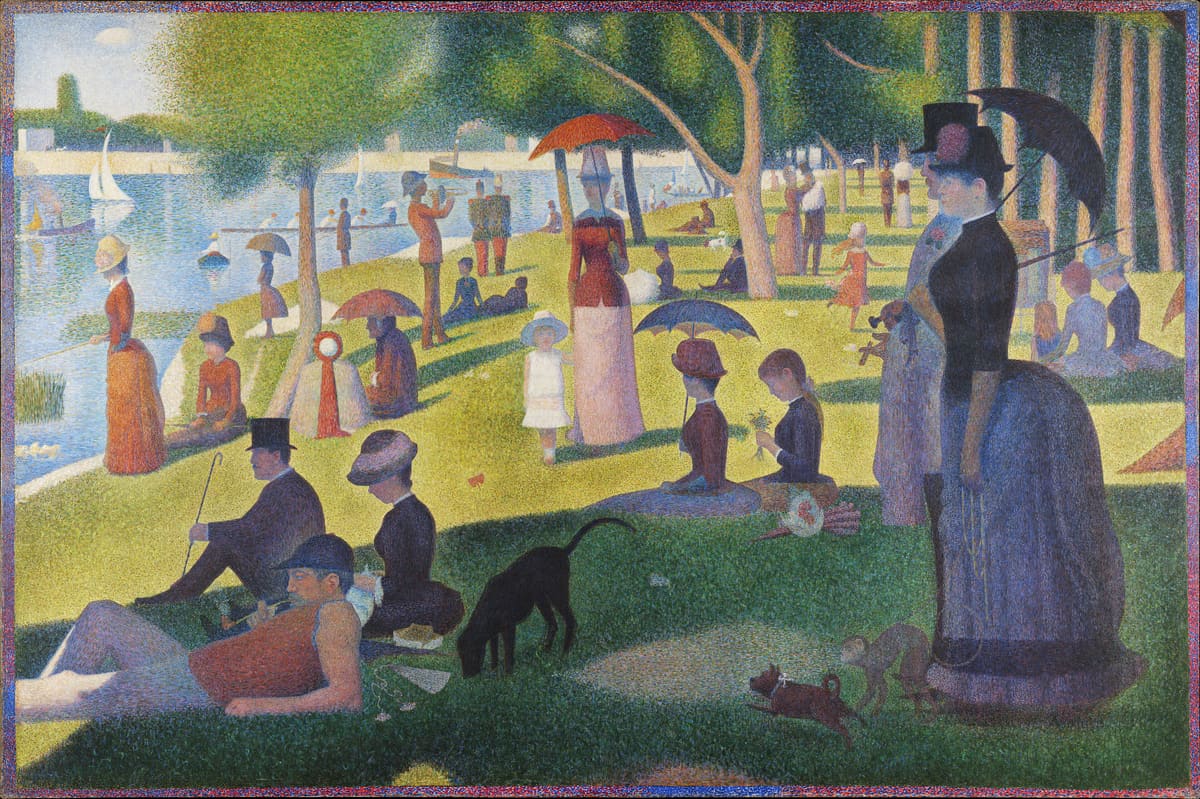
A Sunday Afternoon on the Island of La Grande Jatte
1884
Seurat's monumental daylight crowd — the same technique and theory applied to leisure out of doors.

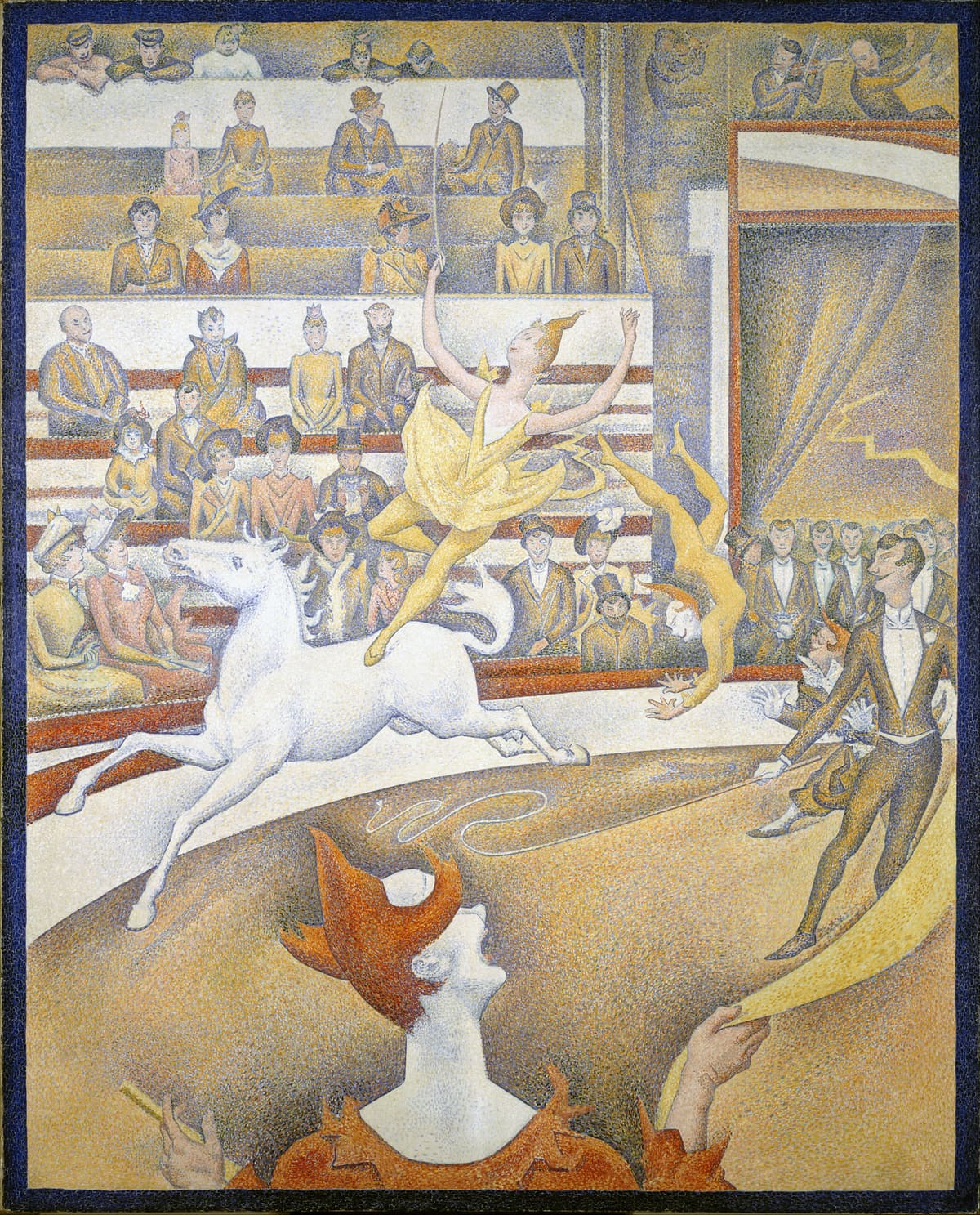
The Circus
1891
Seurat's unfinished last canvas — the same upward diagonals and popular-entertainment subject.

Bal du moulin de la Galette
1876
Renoir's Montmartre dance of 1876 — the same neighbourhood's nightlife, painted with warmth instead of theory.
More by Georges Seurat
A Sunday Afternoon on the Island of La Grande Jatte