The Circus
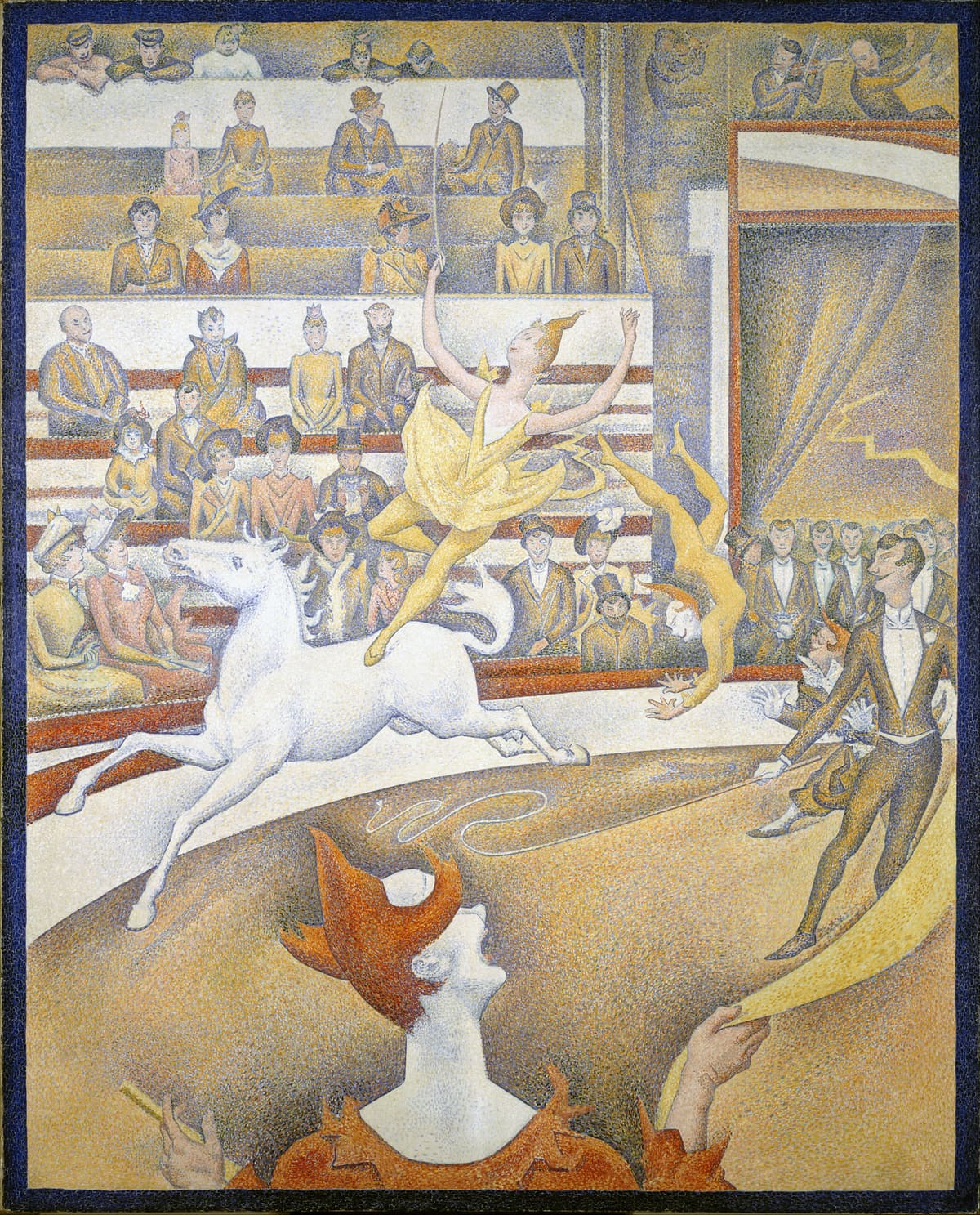
A circus ring on Montmartre — the Cirque Fernando, later the Cirque Medrano — in Seurat's last, unfinished painting.
Cirque Medrano
The painting shows a real, identified place that you can find today. The exact spot the artist worked from is not necessarily known.
The Circus — at a glance
- Artist
- Georges Seurat (1859–1891)
- Year
- 1890–1891 (unfinished)
- Movement
- Neo-Impressionism
- Place
- Cirque Fernando / Medrano, boulevard de Rochechouart, Paris 18e
- Viewpoint
- The circus ring — the building stood until 1972; a modern building is on the site
- Medium
- Oil on canvas
- Dimensions
- c. 185 × 152 cm
- Now at
- Musée d'Orsay, Paris
Overview
The Circus is the last painting Georges Seurat worked on, in 1890–91, and it was left unfinished at his sudden death in March 1891, aged 31. It shows a bareback rider, a clown, an acrobat and a tiered audience in a circus ring, built entirely from small dots of colour. It is oil on canvas, about 185 by 152 cm, and it hangs in the Musée d'Orsay, Paris.
Seurat's last work
By 1890 Seurat had moved beyond simply painting light with dots and was trying to make line and colour carry emotion directly, following the theories of Charles Henry: rising lines and warm colours for gaiety, falling lines and cool colours for calm or sadness.
He showed The Circus, unfinished, at the Salon des Indépendants in the spring of 1891 and died a few days after the opening, of an illness that also killed his infant son.
Where was The Circus painted?
The permanent circus building on the boulevard de Rochechouart, in the 18th arrondissement of Paris, opened in 1875 as the Cirque Fernando and was renamed the Cirque Medrano in 1897, after a clown who took it over.
Museum interpretation It was a favourite subject for the Montmartre painters — Degas, Renoir and Toulouse-Lautrec all painted its ring. The building stood until 1972; a modern building now occupies the site, and the corner is still known locally by the circus's name.
What is in the painting?
A white horse gallops round a sawdust ring carrying a standing bareback rider in white. A ringmaster in dark clothes cracks a long whip at the right; an acrobat tumbles through the air above the horse's back. In the foreground, a clown with a mane of orange hair holds aside a yellow curtain, seen from behind.
Behind the ring, rows of stylised spectators bank up steeply, the front rows in detail, the back rows reduced to repeated shapes.
Look closely
The clown from behind
In the foreground, a clown with orange hair holds aside a yellow curtain like a stage flat, his back to us.
The tumbling acrobat
Caught in mid-somersault above the galloping horse's back.
The rows of spectators
The front rows are detailed; the back rows are reduced to repeated, stiff shapes.
The rising lines
The horse's arc, the whip, the ringmaster's arm and the tiered seats all sweep upward — the picture's ‘gay’ geometry.
The unfinished areas
Parts of the canvas are only thinly covered — Seurat was still working on it when he died.
Details that are easy to miss. The picture was left unfinished, and parts of the canvas are only thinly painted; the clown in the foreground is seen from behind, holding a curtain aside like a stage flat; the acrobat is caught in mid-somersault above the horse; and a painted border of contrasting dots frames the whole scene, as in Seurat's other late works.
Analysis
Composition & perspective
Everything is built from upward-sweeping curves and diagonals — the horse, the acrobat, the whip, the ringmaster's arm — a design meant to read as gaiety.
Scholarship Seurat pitches the ring up towards the viewer and fills the picture with rising lines: the arc of the galloping horse, the flung acrobat, the ringmaster's raised whip, the tiers of seats. The foreground clown and curtain frame it all like a proscenium. The construction follows a theory that particular line directions and colours produce particular feelings.
Colour and light
Warm yellow, orange and red — the ‘gay’ end of the spectrum — worked in dots against a pale ground, with a painted border of complementary colour.
Scholarship The palette is dominated by yellows and oranges, chosen for their supposed cheerful effect, with cooler notes in the spectators. As in his earlier work, Seurat builds every area from small separate touches of unmixed colour and surrounds the scene with a border of dots in contrasting hues.
Handling and technique
Divisionist dots throughout, but left visibly incomplete — parts of the canvas are still thinly covered.
Seurat was still working on the picture when he died, and areas of it remain sketchy or unfinished. The dotted technique is looser and more open here than in the tightly worked Grande Jatte of six years earlier.
Meaning and interpretation
Interpretations differ. What the artist documented, what museums and scholars propose, and later or speculative theories are marked and kept separate.
A demonstration of a theory
The Circus is usually read less as a scene than as a test of Seurat's late idea that a picture's lines and colours can be engineered to produce a specific emotion — here, energy and gaiety — independent of subject.
Performers and audience
Some writers also note the contrast Seurat sets up between the dynamic, curving performers and the stiff, blank rows of paying spectators — a cool observation of modern entertainment, though Seurat left nothing to confirm this was intended.
History & provenance
- 1890–91Seurat's last painting, left unfinished.
- Spring 1891Shown unfinished at the Salon des Indépendants; Seurat dies days later.
- 1900s–20sOwned by the American collector John Quinn.
- 1927Enters the French national collections under the terms of Quinn's bequest; now in the Musée d'Orsay.
The painting was bought by the New York collector John Quinn, who arranged for it to go to France; it entered the national collections in the 1920s and hangs in the Musée d'Orsay.
Sources
- Musée d'Orsay, Paris — collection entry for ‘Le Cirque’ (oil on canvas, c. 185 × 152 cm)
- Robert L. Herbert, ‘Georges Seurat, 1859–1891’ (Metropolitan Museum of Art, 1991)
- Charles Henry, ‘Introduction à une esthétique scientifique’ (1885) — the line-and-emotion theory Seurat drew on
Frequently asked
Where is the circus in Seurat's The Circus?
The Cirque Fernando, a permanent circus building that opened in 1875 on the boulevard de Rochechouart in Montmartre. It was renamed the Cirque Medrano in 1897.
Can you visit it?
The building stood until 1972; a modern building now occupies the site on the boulevard de Rochechouart, though the corner is still associated with the circus's name.
Why is the picture unfinished?
Seurat was still working on it when he died suddenly in March 1891, aged 31. He had shown it, incomplete, at the Salon des Indépendants a few days earlier.
Why are all the lines sweeping upward?
Seurat was applying a theory — associated with Charles Henry — that rising lines and warm colours produce a feeling of gaiety. The whole design is built to test that idea.
Did other painters use the same circus?
Yes. The Cirque Fernando's ring was painted by Degas, Renoir and Toulouse-Lautrec as well.
Where is the painting now?
In the Musée d'Orsay, Paris.
Related paintings

A Sunday Afternoon on the Island of La Grande Jatte
1884
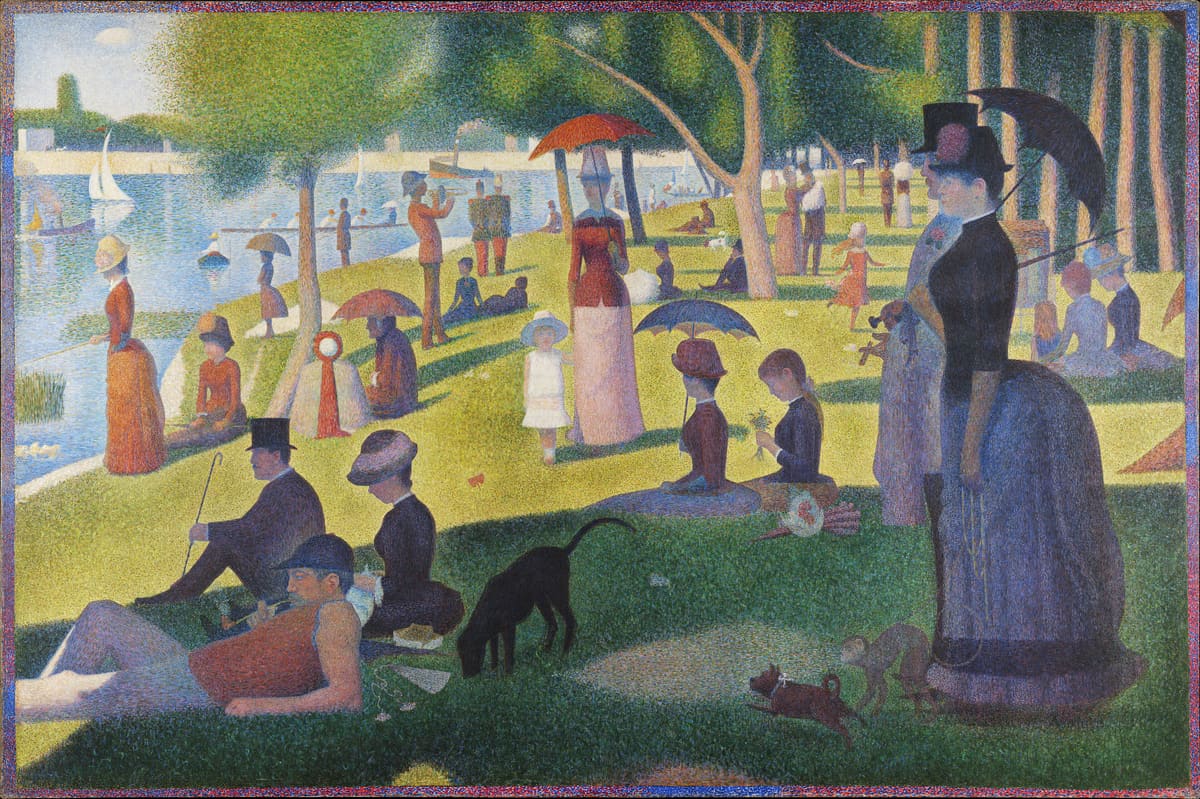
Seurat's great picture of six years earlier — the same dot technique, applied to stillness rather than motion.

Bal du moulin de la Galette
1876
Renoir's Montmartre entertainment of 1876 — the warm, loose Impressionist version of the same nightlife district.
More by Georges Seurat
A Sunday Afternoon on the Island of La Grande Jatte

