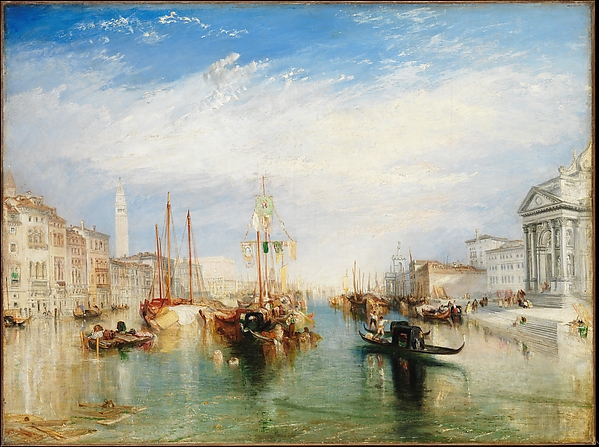
Venice, from the Porch of Madonna della Salute
The Grand Canal and the Molo of Venice seen from the steps of Santa Maria della Salute — Turner's shimmering answer to Canaletto.
Grand Canal
The painting shows a real, identified place that you can find today. The exact spot the artist worked from is not necessarily known.
Venice, from the Porch of Madonna della Salute — at a glance
- Artist
- J. M. W. Turner (1775–1851)
- Year
- c. 1835
- Movement
- English Romanticism
- Place
- The mouth of the Grand Canal, Venice, Italy
- Viewpoint
- The steps of Santa Maria della Salute toward the Molo — the view is unchanged and matchable
- Medium
- Oil on canvas
- Dimensions
- c. 91 × 122 cm
- Now at
- Metropolitan Museum of Art, New York
Overview
Venice, from the Porch of Madonna della Salute is one of the Venice pictures J. M. W. Turner exhibited at the Royal Academy after his stays in the city in the 1830s. From the steps of Baldassare Longhena's great domed church, past a foreground of boats and figures, the eye travels across the water to the pale mass of the Doge's Palace, the Campanile, the Piazzetta and the buildings of the Molo, all half-dissolved in bright, humid light. It is oil on canvas, about 91 by 122 cm, and it hangs in the Metropolitan Museum of Art, New York.
Where was Venice, from the Porch of Madonna della Salute painted?
Scholarship Santa Maria della Salute stands at the entrance of the Grand Canal, on the Dorsoduro side. From its steps and the adjoining fondamenta the view opens across the canal mouth and the Bacino to the Molo, the Doge's Palace and the Campanile — a stable, unchanged Venetian prospect that can be matched almost exactly today. Turner keeps the topography broadly right but blurs and heightens it in the interest of light and atmosphere.
What is in the painting?
In the shadowed foreground, the edge of the church steps, moored gondolas and a scatter of figures in Venetian and Eastern dress. Beyond, the wide bright water; across it, the long, pale, indistinct line of the Molo — palace, columns, Campanile, domes — melting into a warm, luminous sky. Warm creams, golds and blues dominate; hard edges are few.
Look closely
The church steps
The shadowed edge of the Salute's steps, moored gondolas and figures, launch the view.
The melting Molo
The Doge's Palace, columns and Campanile are a pale line barely separated from the sky.
The Eastern dress
Some foreground figures wear Ottoman and Levantine costume — Venice as a crossroads.
Analysis
Composition and technique
A dark, populated foreground opening onto a brilliant, near-dissolved view of the city across the water.
Scholarship Turner uses the classic repoussoir — dark near steps and boats — to launch the eye into a flood of light where the famous buildings are barely more than tinted haze. It is a deliberate contrast with Canaletto's hard-edged Venice: the same view, made of air.
History & provenance
The painting is in the Metropolitan Museum of Art, New York (Bequest of Cornelius Vanderbilt).
Sources
- The Metropolitan Museum of Art, New York — collection entry for J. M. W. Turner, ‘Venice, from the Porch of Madonna della Salute’ (c. 1835)
- Ian Warrell, ‘Turner and Venice’ (Tate, 2003)
Related paintings

The Entrance to the Grand Canal, Venice
1730
Canaletto's hard-edged version of the same canal mouth, a century earlier.

Juliet and her Nurse
1836
Turner's other Venice picture — the Piazza San Marco turned into a Shakespearean night.

The Grand Canal
1908
Monet's Venice of 1908 — the next step in dissolving the city into colour.
More by J. M. W. Turner
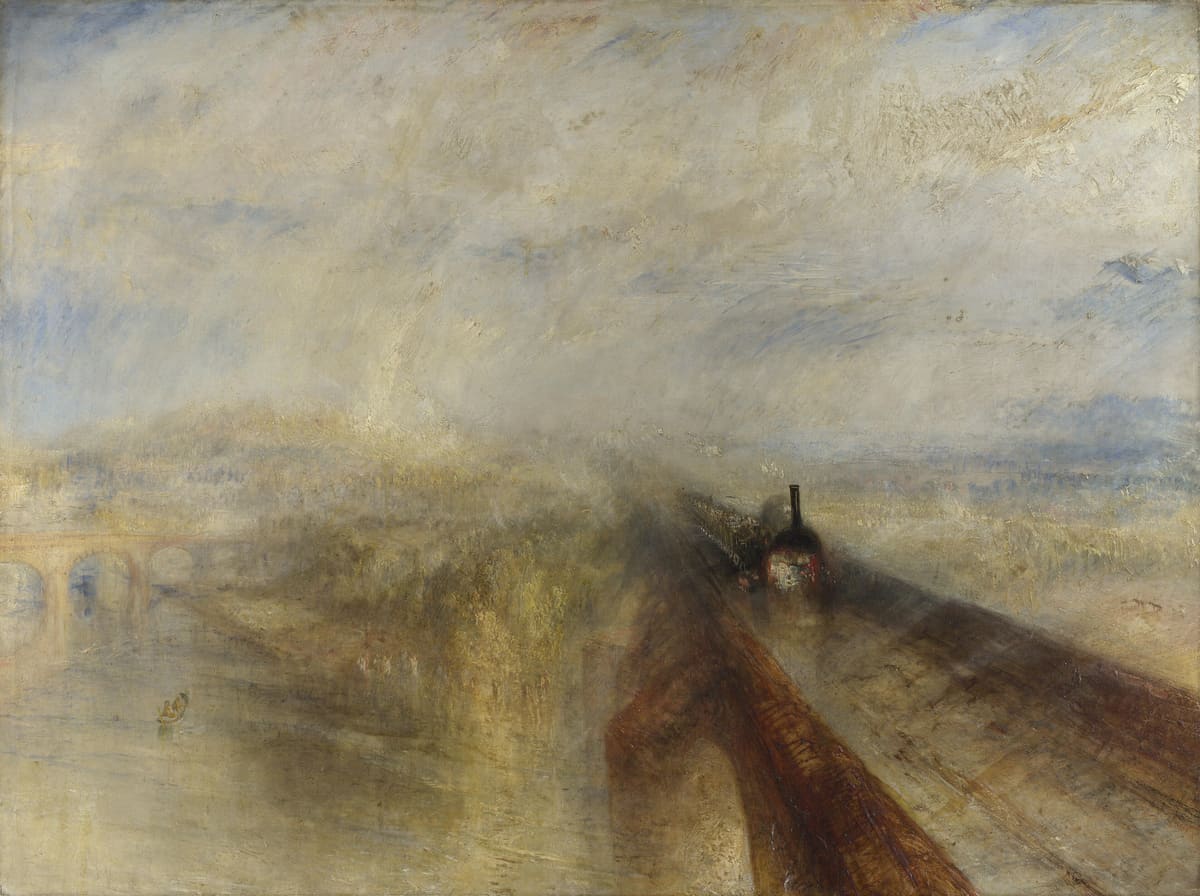
Rain, Steam and Speed – The Great Western Railway

Dido building Carthage

Dolbadarn Castle
