
Juliet and her Nurse
Shakespeare's Juliet transplanted to a moonlit, firework-lit Piazza San Marco in Venice — a picture the young Ruskin defended in print.
Piazza San Marco
The painting shows a real, identified place that you can find today. The exact spot the artist worked from is not necessarily known.
Juliet and her Nurse — at a glance
- Artist
- J. M. W. Turner (1775–1851)
- Year
- 1836
- Movement
- English Romanticism
- Place
- The Piazza San Marco, Venice, Italy (at night)
- Viewpoint
- An impossibly high, tilted view over the real square — the Piazza is unchanged and matchable
- Medium
- Oil on canvas
- Dimensions
- c. 92 × 123 cm
- Now at
- Private collection (formerly Fortabat collection, Buenos Aires)
Overview
Juliet and her Nurse is a Venice night-scene J. M. W. Turner exhibited at the Royal Academy in 1836. It moves Shakespeare's Juliet — whose play is set in Verona — onto a high terrace above the Piazza San Marco, which spreads out below at night, thronged with tiny figures, lit by moonlight and bursting fireworks. It is oil on canvas, about 92 by 123 cm, and it is in a private collection (long in the Fortabat collection, Buenos Aires).
The story behind the painting
Scholarship Critics attacked the picture for its ‘wrong’ location (Juliet belongs in Verona) and for its blazing, indistinct colour. In reply, the seventeen-year-old John Ruskin wrote a passionate defence of Turner — his first substantial piece of art criticism, and the seed of ‘Modern Painters’. The magazine that had published the attack declined to print Ruskin's reply, but Turner saw it.
Where was Juliet and her Nurse painted?
Scholarship The square below is unmistakably the Piazza San Marco in Venice: the domes and façade of the Basilica, the Campanile, the arcaded ranges of the Procuratie, the flagstaffs. The Piazza is essentially unchanged and one of the most recognisable public spaces in the world, so the setting can be matched precisely — though Turner tilts and elevates the viewpoint impossibly, and floods the whole scene with theatrical light.
What is in the painting?
High on a terrace or rooftop at the right, two small figures — Juliet in white, the Nurse beside her — look out. Below and beyond, the Piazza San Marco opens up at a dizzying angle: the Basilica and Campanile lit gold, the Procuratie ranges receding, the pavement swarming with minute figures, and rockets bursting in a smoky, moonlit sky. The colour is all warm gold, cream and blue-grey, edges lost in glow.
Look closely
Juliet and the Nurse
Two small figures on a high terrace at the right, Juliet in white, looking down at the square.
The tilted Piazza
The square yawns open below at a dizzying, impossible angle.
The Basilica and Campanile
Lit gold against the smoky sky — recognisable, but half-dissolved in glow.
The bursting rockets
Fireworks explode over the moonlit square, swarming with minute figures.
Analysis
Composition and technique
An impossibly high, tilted view down into the lit square, with the tiny literary figures perched at the edge.
Scholarship Turner elevates and tilts the viewpoint far beyond any real terrace, so the Piazza yawns open below; the fireworks, moon and lit façades dissolve architecture into light. The Shakespearean figures are almost incidental — a pretext for a nocturne of the real square.
Meaning and interpretation
Interpretations differ. What the artist documented, what museums and scholars propose, and later or speculative theories are marked and kept separate.
Poetry over topography
The picture is read as Turner asserting that a painter may borrow a literary title and a real place and fuse them into something new — mood and light above accuracy. Ruskin's defence made exactly this argument, and it shaped Victorian art criticism.
History & provenance
The painting was long in the collection of Amalia Lacroze de Fortabat in Argentina and remains in private hands.
Sources
- Ian Warrell, ‘Turner and Venice’ (Tate, 2003) — ‘Juliet and her Nurse’ and its reception
- John Ruskin, draft reply to ‘Blackwood's Magazine’ (1836), and ‘Modern Painters’ I (1843)
Frequently asked
Isn't Romeo and Juliet set in Verona?
Yes — which is why critics attacked the picture in 1836. Turner deliberately moved Juliet and her Nurse onto a terrace above the Piazza San Marco in Venice, borrowing the title and the real square for a night-scene of light and mood.
Is the square real?
Unmistakably — the Basilica, Campanile and Procuratie of the Piazza San Marco. The Piazza is essentially unchanged, so it can be matched precisely, though Turner elevates and tilts the viewpoint impossibly.
What is the Ruskin connection?
When a magazine attacked the painting, the seventeen-year-old John Ruskin wrote a fervent defence of Turner — his first serious art criticism and the germ of ‘Modern Painters’.
What is happening in the square?
A night festival: the Piazza swarms with tiny figures, the façades are lit gold, and fireworks burst in a moonlit, smoky sky.
Where is the painting now?
In a private collection; it was long held in the Fortabat collection in Buenos Aires.
Related paintings
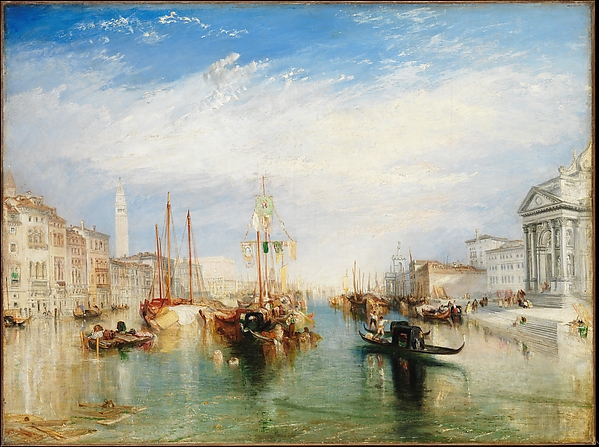
Venice, from the Porch of Madonna della Salute
1835
Turner's other Venice picture of the mid-1830s — the daytime canal mouth in humid light.

Nocturne in Black and Gold – The Falling Rocket
1875
Whistler's fireworks over the Thames — another night square-and-rockets picture that provoked a critical storm.
More by J. M. W. Turner
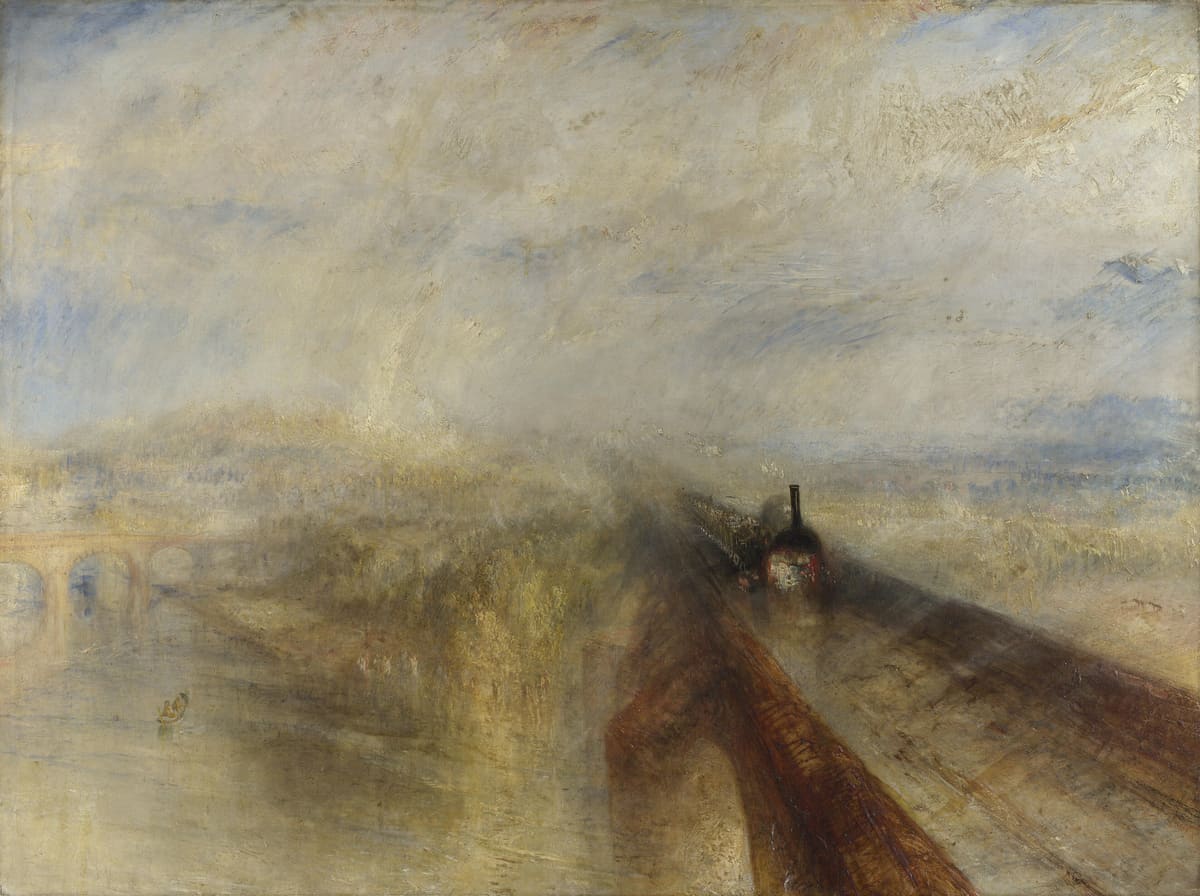
Rain, Steam and Speed – The Great Western Railway

Dido building Carthage

Dolbadarn Castle
