San Giorgio Maggiore at Dusk
The island church of San Giorgio Maggiore in Venice, a violet silhouette against a burning sunset sky.
San Giorgio Maggiore
The painting depicts a real landscape or cityscape. The precise viewpoint the artist used may be unknown, so the marker shows the general area.
San Giorgio Maggiore at Dusk — at a glance
- Artist
- Claude Monet (1840–1926)
- Year
- 1908 (reworked to 1912)
- Movement
- Impressionism
- Place
- San Giorgio Maggiore, Venice, Italy
- Viewpoint
- Across the water toward the island church at sunset — the church and campanile are unchanged
- Medium
- Oil on canvas
- Dimensions
- c. 66 × 92 cm
- Now at
- National Museum Cardiff
Overview
San Giorgio Maggiore at Dusk is one of the Venice paintings Claude Monet made in the autumn of 1908 and finished in his studio over the following years. It shows the Benedictine island church of San Giorgio Maggiore, with its classical front and tall brick campanile, as a dark blue-violet shape against a sky and lagoon flooded with the orange, pink and gold of sunset. It is oil on canvas, about 66 by 92 cm, and it hangs in the National Museum Cardiff, part of Amgueddfa Cymru – National Museum Wales.
The story behind the painting
Scholarship Monet, aged sixty-eight, spent about three months in Venice — his only visit — as the guest of a friend, and painted a strict daily round of the same motifs at the same hours: the Doge's Palace, the Grand Canal, the Salute and San Giorgio. He brought the canvases home unfinished and reworked them before showing the series in Paris in 1912. This picture came to Cardiff through the collection of the Welsh sisters Gwendoline and Margaret Davies.
Where was San Giorgio Maggiore at Dusk painted?
Scholarship San Giorgio Maggiore is the island directly across the Bacino di San Marco from the Piazzetta, its church designed by Andrea Palladio in the sixteenth century. Monet painted it looking east or south-east from near the mouth of the Grand Canal, with the low sun behind it. The church, its façade and its campanile (which can be climbed by lift for one of the best views in Venice) are unchanged, so the silhouette in the painting is exactly matchable; only the colour is Monet's transient effect.
What is in the painting?
The church sits just left of centre on the horizon, reduced to a flat, dark shape — the pediment of the façade, the drum, and the thin vertical of the campanile. Around and behind it the sky burns orange and rose, paling to green-blue above; the lagoon repeats the fire in broken horizontal strokes. A few mooring posts lean in the water. There is no detail, only the shape and the light.
Look closely
The flattened church
Reduced to a dark shape — façade pediment, drum and the thin line of the campanile.
The burning sky
Orange and rose around the church, paling to green-blue higher up — looking into a low sun.
The mirrored lagoon
The sunset colour repeated in broken horizontal strokes on the water.
The leaning posts
A few mooring poles in the foreground give the only sense of near distance.
Analysis
Composition & perspective
A single silhouetted building on a low horizon, with sky and its reflection taking up almost the whole canvas.
Scholarship Monet centres the dark mass of the church against the brightest part of the sky and gives everything else to colour: an upper band of sky, a lower band of water, joined by the vertical of the campanile. The mooring posts supply the only near-scale.
Colour and light
Sunset orange, rose and gold against a violet-blue church, laid in loose, separate strokes.
Scholarship The church is built from cool blues and violets; the sky and water from warm oranges, pinks and yellows, with touches of green where the two meet. The complementary contrast makes the silhouette vibrate — the effect of looking straight into a low sun.
History & provenance
The painting was bought by Gwendoline Davies in 1912 and given, with the rest of the Davies sisters' collection, to the National Museum of Wales; it hangs in National Museum Cardiff.
Sources
- Amgueddfa Cymru – National Museum Wales, Cardiff — collection entry for Claude Monet, ‘San Giorgio Maggiore at Dusk’ (1908)
- Philippe Piguet, ‘Monet et Venise’; National Museum Wales, the Davies sisters' collection
Frequently asked
What building is in the painting?
The church of San Giorgio Maggiore, on its own island across the water from St Mark's in Venice, designed by Andrea Palladio in the sixteenth century, with a tall brick campanile.
Can you see the same view?
Yes. The church, its façade and its campanile are unchanged, and the campanile can be climbed by lift for one of the best views in Venice. The silhouette in the painting is exactly matchable; only the sunset colour is Monet's fleeting effect.
When did Monet paint it?
During his only visit to Venice, a three-month stay in autumn 1908, working to a fixed daily timetable. He finished the canvases in his studio and exhibited the Venice series in Paris in 1912.
How did it get to Wales?
It was bought by Gwendoline Davies in 1912 and given, with her sister Margaret's, to the National Museum of Wales.
Where is the painting now?
In National Museum Cardiff (Amgueddfa Cymru – National Museum Wales).
Related paintings

The Doge's Palace Seen from San Giorgio Maggiore
1908
Monet's view the other way, from the island, in the same 1908 campaign.

The Grand Canal
1908
Monet's Grand Canal towards the Salute — the third of his great Venice motifs.

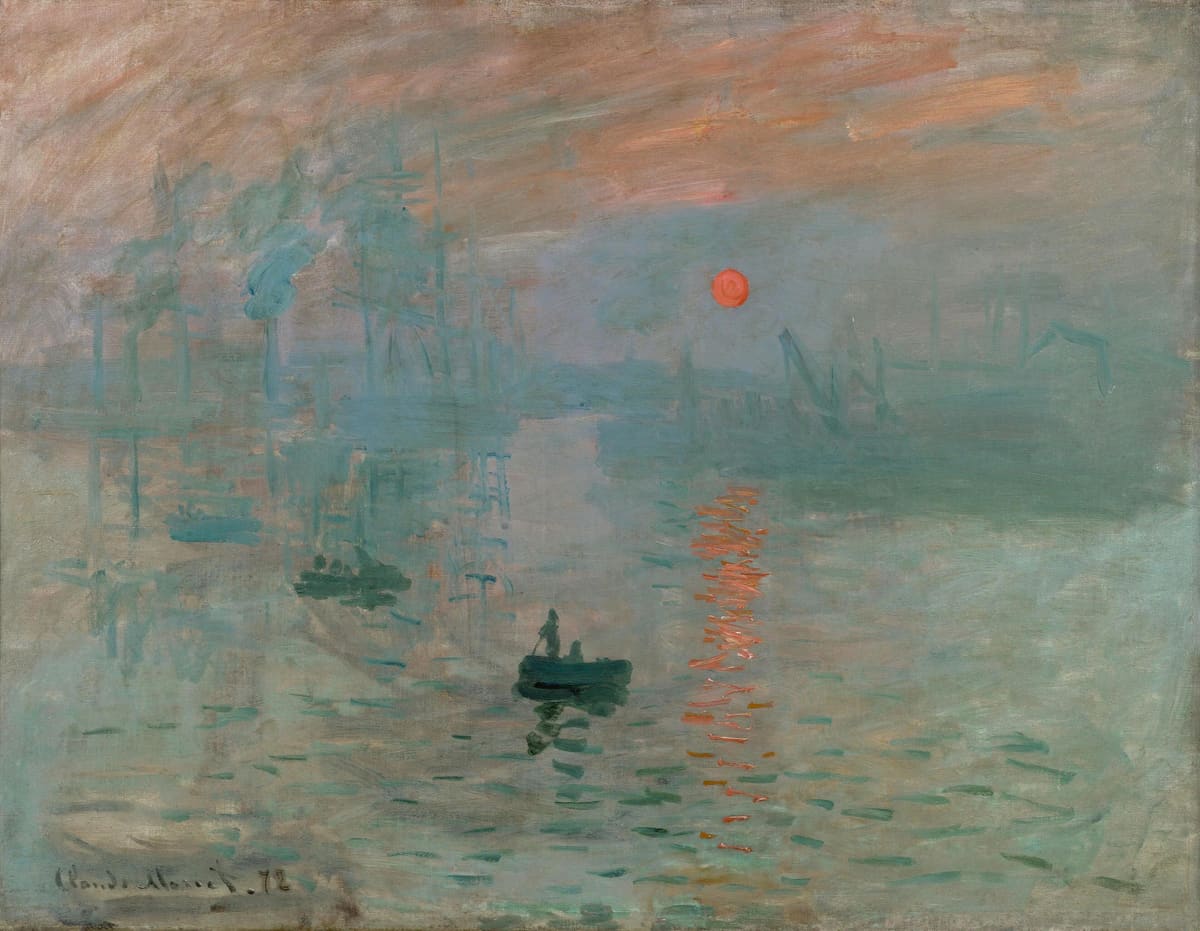
Impression, Sunrise
1872
Monet's Le Havre sunrise of 1872 — the same silhouette-against-a-low-sun idea, 36 years earlier.
More by Claude Monet
Impression, Sunrise
Woman with a Parasol – Madame Monet and Her Son

Houses on the Achterzaan