
Le Déjeuner sur l'herbe
A picnic in a clearing of the forest of Fontainebleau near Chailly — Monet's huge, unfinished answer to Manet, now surviving only in fragments.
Chailly-en-Bière
The painting depicts a real landscape or cityscape. The precise viewpoint the artist used may be unknown, so the marker shows the general area.
Le Déjeuner sur l'herbe — at a glance
- Artist
- Claude Monet (1840–1926)
- Year
- 1865–1866 (unfinished)
- Movement
- Impressionism (early)
- Place
- The forest of Fontainebleau near Chailly-en-Bière, France
- Viewpoint
- A forest clearing — the woodland survives; the picnic is a composed scene
- Medium
- Oil on canvas (surviving in fragments)
- Now at
- Musée d'Orsay, Paris (fragments); Pushkin Museum, Moscow (small version)
Overview
Le Déjeuner sur l'herbe was meant to be Claude Monet's breakthrough: a picnic of a dozen life-size, fashionably dressed figures in a sunlit forest glade, painted largely from nature, to be shown at the Salon. He worked on it in 1865–66 but never completed it. Left rolled up as security with a landlord, the huge canvas was damaged by damp; Monet later cut out the parts he could save. Two large fragments are in the Musée d'Orsay, Paris; a smaller, finished version of the whole composition is in the Pushkin State Museum of Fine Arts, Moscow.
The story behind the painting
Scholarship The title and the theme deliberately echo Édouard Manet's scandalous ‘Le Déjeuner sur l'herbe’ of 1863 — but Monet replaced Manet's nude and studio artifice with clothed figures and real outdoor light. He made oil studies in the forest near Chailly in the summer of 1865, with his friend Frédéric Bazille and Camille Doncieux among the models, then worked the large canvas in a Paris studio. Money problems and dissatisfaction stopped him finishing it for the 1866 Salon.
Where was Le Déjeuner sur l'herbe painted?
Scholarship The setting is a clearing in the forest of Fontainebleau, near the village of Chailly-en-Bière on the edge of the Barbizon painters' country, south-east of Paris. Monet and his friends lodged at Chailly and painted among the oaks and beeches and the sandstone boulders of the forest, which is a protected woodland and still much as it was; the picnic scene is a composed one set in that forest rather than a marked spot.
What is in the painting?
In the two surviving Orsay fragments: on the left, figures standing and seated by the trunks of tall trees, a woman in a striped grey dress, a man beyond; in the central fragment, a group around a white picnic cloth spread on the grass, laden with a pie, fruit, bottles and a roast fowl, a bearded man (based on Courbet) reclining, women in bright summer dresses, dappled light falling through the canopy. The Pushkin version shows the whole intended scene in miniature.
Look closely
The picnic cloth
A white cloth spread on the grass, laid with a pie, fruit, bottles and a roast fowl — the bright centre of the design.
The reclining bearded man
A figure based on Gustave Courbet lies propped on one elbow among the seated women.
The framing trunks
Tall tree trunks rise like columns through the scene, structuring the groups.
The sun-flecks
Sharp patches of light and blue shadow fall through the canopy across dresses and cloth.
Analysis
Composition and technique
Life-size figures grouped under and between big trees, with sunlight broken into patches across dresses and cloth.
Scholarship Monet arranges the picnic as overlapping standing and seated groups framed by vertical trunks, the white cloth a bright anchor at the centre. The real ambition is the light: sun filtering through leaves and scattering sharp bright spots and blue shadows over the whole scene, painted broadly and at full scale.
Colour and light
Bright greens and forest browns, with white cloth and pale dresses catching sun-flecks and cool shadow.
The palette is fresh and outdoor — leaf-green, bark-brown, the white and blue of the cloth and dresses — with the dappled light rendered in crisp patches rather than blended, an early statement of the Impressionist method.
History & provenance
Monet gave up the big canvas as security for rent; recovering it damaged years later, he cut out and kept two sections, now in the Musée d'Orsay, Paris. The smaller complete study is in the Pushkin State Museum of Fine Arts, Moscow.
Sources
- Musée d'Orsay, Paris — collection entries for Claude Monet, ‘Le Déjeuner sur l'herbe’ (fragments, 1865–66)
- Pushkin State Museum of Fine Arts, Moscow — Monet, ‘Luncheon on the Grass’ (reduced version)
- House, John, ‘Monet: Nature into Art’ (Yale University Press, 1986)
Frequently asked
Is this the same as Manet's ‘Le Déjeuner sur l'herbe’?
No. Monet's picture, begun in 1865, deliberately took Manet's title and picnic theme but replaced the nude and studio setting with clothed figures in real outdoor light. They are two different paintings.
Where is it set?
In a clearing of the forest of Fontainebleau, near the village of Chailly-en-Bière, south-east of Paris, where Monet and his friends lodged and painted in the summer of 1865.
Can you visit the forest?
Yes — the forest of Fontainebleau is a protected woodland and still much as it was, with the oaks, beeches and sandstone boulders Monet painted among. The picnic itself is a composed scene, not a marked spot.
Why does the painting survive only in fragments?
Monet never finished it, left the huge canvas as security for unpaid rent, and found it damaged by damp when he recovered it. He cut out and kept the two best sections; a smaller finished version survives separately.
Where are the pieces now?
The two large fragments are in the Musée d'Orsay, Paris; the smaller complete version is in the Pushkin State Museum of Fine Arts, Moscow.
Related paintings


More by Claude Monet
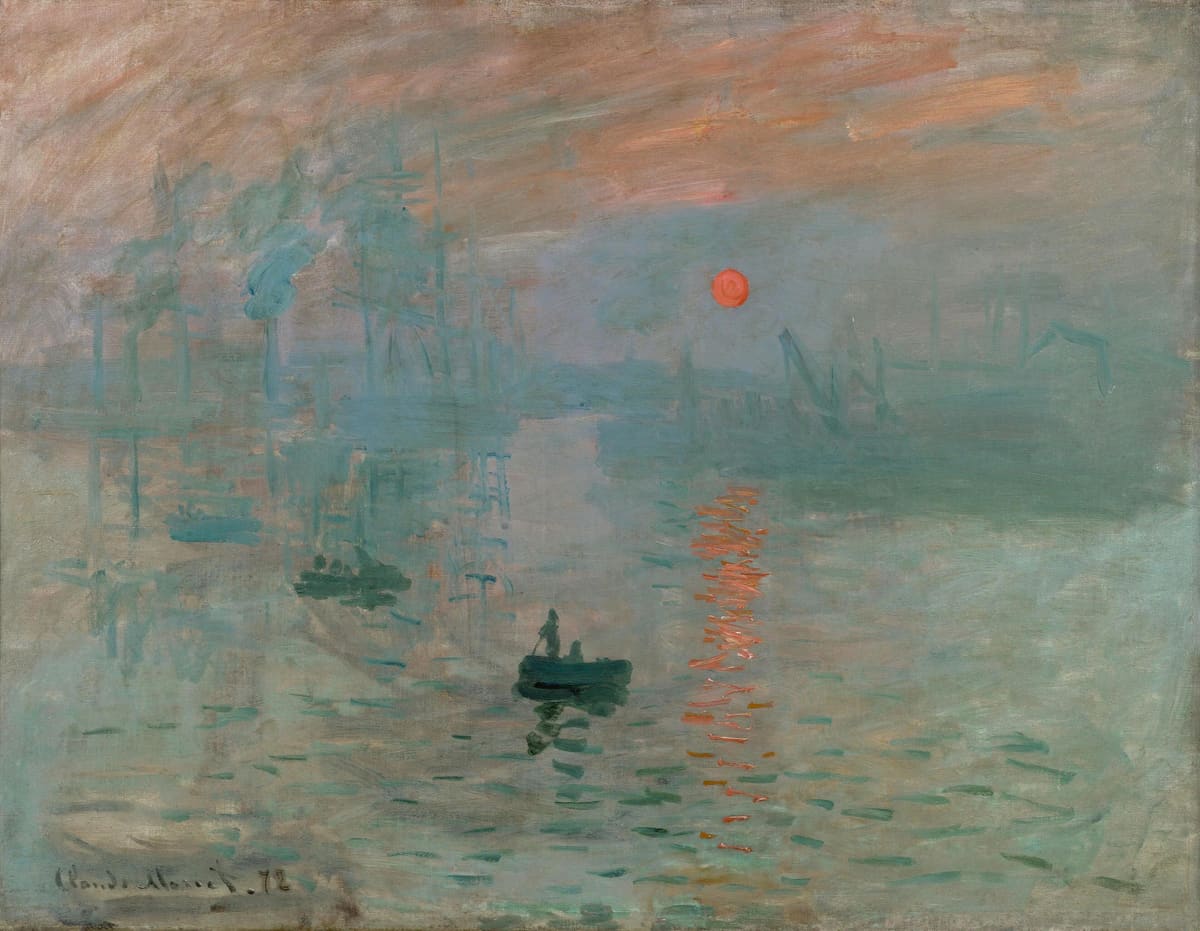
Impression, Sunrise
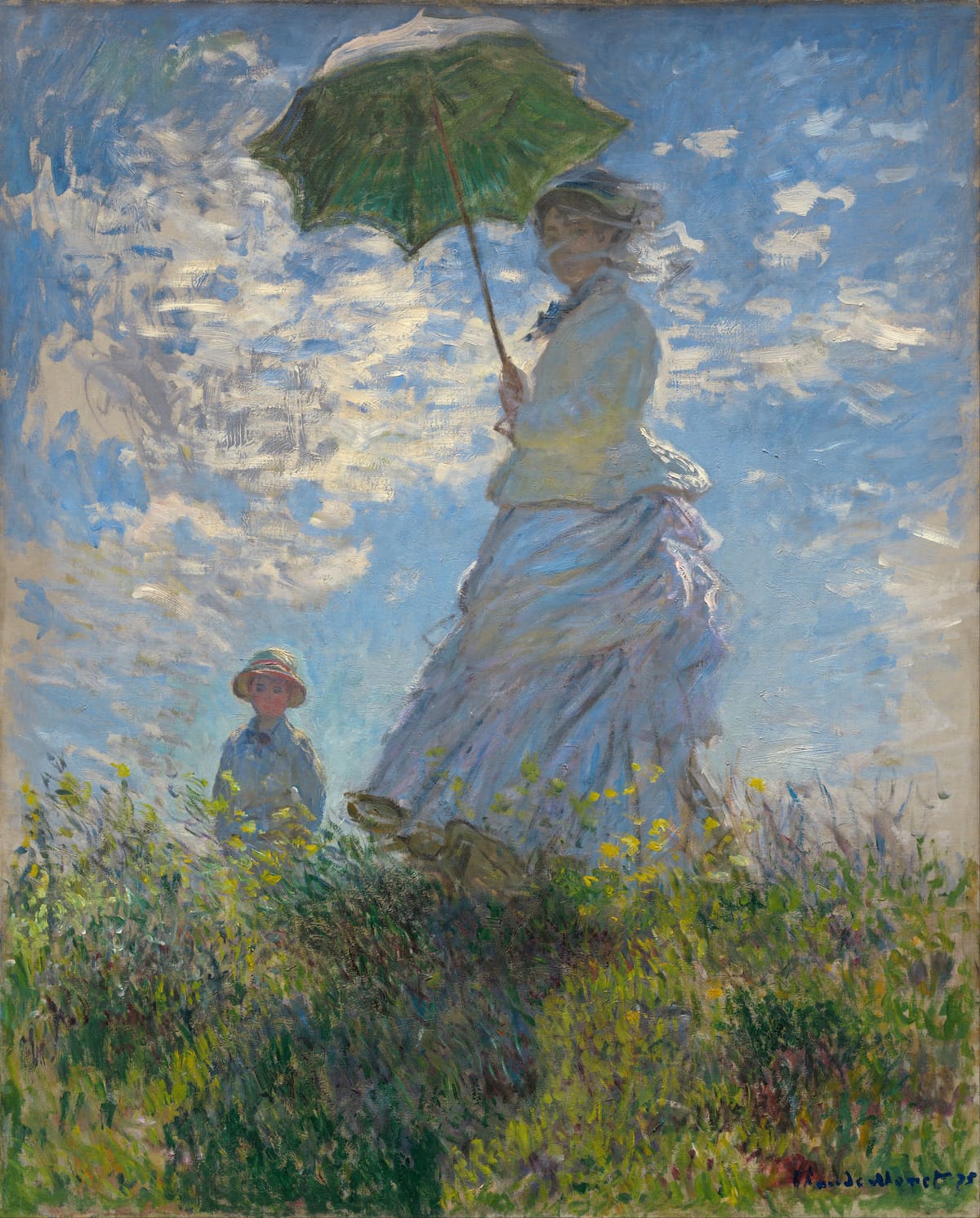
Woman with a Parasol – Madame Monet and Her Son

Houses on the Achterzaan
Also connected to Chailly-en-Bière

