La Grenouillère
The floating café and bathing place of La Grenouillère on an island in the Seine at Bougival — where Monet and Renoir invented Impressionism side by side in 1869.
Seine
The painting depicts a real landscape or cityscape. The precise viewpoint the artist used may be unknown, so the marker shows the general area.
La Grenouillère — at a glance
- Artist
- Auguste Renoir (1841–1919)
- Year
- 1869
- Movement
- Impressionism (founding work)
- Place
- La Grenouillère, Île de Croissy, Seine, near Bougival, France
- Viewpoint
- A river resort demolished before 1900 — island and banks remain; a partial reconstruction stands at Croissy
- Medium
- Oil on canvas
- Dimensions
- c. 66 × 86 cm
- Now at
- Nationalmuseum, Stockholm
Overview
La Grenouillère (‘the frog pond’) was a commercial bathing and boating spot on the Seine, with a café built on a moored barge, a small round tree-topped island reached by gangplanks, changing huts and boats for hire. In the late summer of 1869 Auguste Renoir and Claude Monet set up their easels there side by side and painted the same views in rapid, broken strokes of bright colour. Those canvases — Renoir's is in the Nationalmuseum, Stockholm; Monet's main version is in the Metropolitan Museum, New York — are often called the first true Impressionist paintings. Renoir's is oil on canvas, about 66 by 86 cm.
The story behind the painting
Scholarship Both painters were nearly penniless that summer; Renoir was living with his parents nearby at Voisins, Monet at Bougival, and Renoir is said to have brought bread from his family's table to share. Working fast, outdoors, at the same motifs, they abandoned careful drawing and finish for dabs and dashes that caught the flicker of sun on moving water and the bustle of a Sunday crowd. Monet described the canvases as mere ‘bad sketches’ in a letter, but hoped to work up a large Salon picture from them; he never did.
Where was La Grenouillère painted?
Scholarship La Grenouillère stood on the arm of the Seine between the Île de Croissy and the right bank, near Bougival and Croissy-sur-Seine, about 12 km west of central Paris and easy to reach by train. It was fashionable from the 1850s to the 1880s — Maupassant set stories there, and the future Edward VII visited. The establishment closed and was demolished before the end of the century; the little island (the ‘camembert’ or ‘flowerpot’) and the riverbanks remain, and a modern reconstruction of part of the bathing house stands on the Croissy side, but the resort Renoir and Monet painted is gone.
What is in the painting?
The little round island with its single tree sits at the centre, joined to the café barge (right) and the bank by narrow plank walkways crowded with figures in summer dress. Rowing boats and skiffs are moored and moving all around; bathers are in the water; the far bank is a screen of trees. The Seine fills the foreground, worked in horizontal strokes of blue, green, white and black that break up every reflection.
Look closely
The round island
A tiny circular island with one tree — nicknamed the ‘camembert’ or ‘flowerpot’ — joined to the café and bank by plank walkways.
The café barge
A floating café built on a moored barge at the right, crowded with figures.
The hire boats
Rowing skiffs moored and moving all through the scene — this was a boating as well as a bathing spot.
The broken water
The Seine is painted in short horizontal dashes of blue, green, white and black, mixing in the eye.
Analysis
Composition and technique
A crowded floating scene seen from a boat, with the water — flickering, unblended — taking up the whole foreground.
Scholarship Renoir places the viewer out on the river looking back at the island and café, and gives half the canvas to water painted in separate, visible touches. Figures are notated with a few strokes; nothing is finished in the Salon sense. The aim is the overall impression of light, movement and holiday noise.
Colour and light
Bright, broken colour throughout — blue-green water, white and pink dresses, dark boats — with no smooth transitions.
Scholarship Renoir keeps his touch softer and warmer than Monet's, with more pink and gold in the figures, but both painters lay pure colours side by side and let the eye mix them. The dazzle of sun on disturbed water is built from short horizontal dashes of contrasting hue.
History & provenance
The pair painted several canvases each at La Grenouillère. Renoir's best-known version is in the Nationalmuseum, Stockholm; Monet's is in the Metropolitan Museum of Art, New York, with related works in London and elsewhere.
Sources
- Nationalmuseum, Stockholm — collection entry for Auguste Renoir, ‘La Grenouillère’ (1869; oil on canvas, c. 66 × 86 cm)
- The Metropolitan Museum of Art / National Gallery, London — literature on the Monet and Renoir Grenouillère canvases
Frequently asked
What was La Grenouillère?
A commercial bathing and boating resort on the Seine — a café on a moored barge, a tiny tree-topped island joined by gangplanks, changing huts and hire boats — near Bougival and Croissy, about 12 km west of central Paris. It was fashionable from the 1850s to the 1880s.
Can you visit the spot?
The little island and the riverbanks remain, and there is a modern partial reconstruction of the bathing house on the Croissy side, but the resort itself was demolished before 1900. The scene Renoir and Monet painted is gone.
Why is this painting important?
In the late summer of 1869 Renoir and Monet painted here side by side in quick, broken, bright strokes, abandoning academic finish. The canvases they made are often called the first true Impressionist paintings.
Are Renoir's and Monet's versions the same?
They painted the same motifs at the same time from almost the same spots, but they are separate paintings. Renoir's is warmer and softer; Monet's water is more broken. Renoir's is in Stockholm, Monet's in New York.
Where is Renoir's painting now?
In the Nationalmuseum, Stockholm.
Related paintings

Dance at Bougival
1883
Renoir back at Bougival in 1883 — the same riverside resort world, a dance instead of the water.

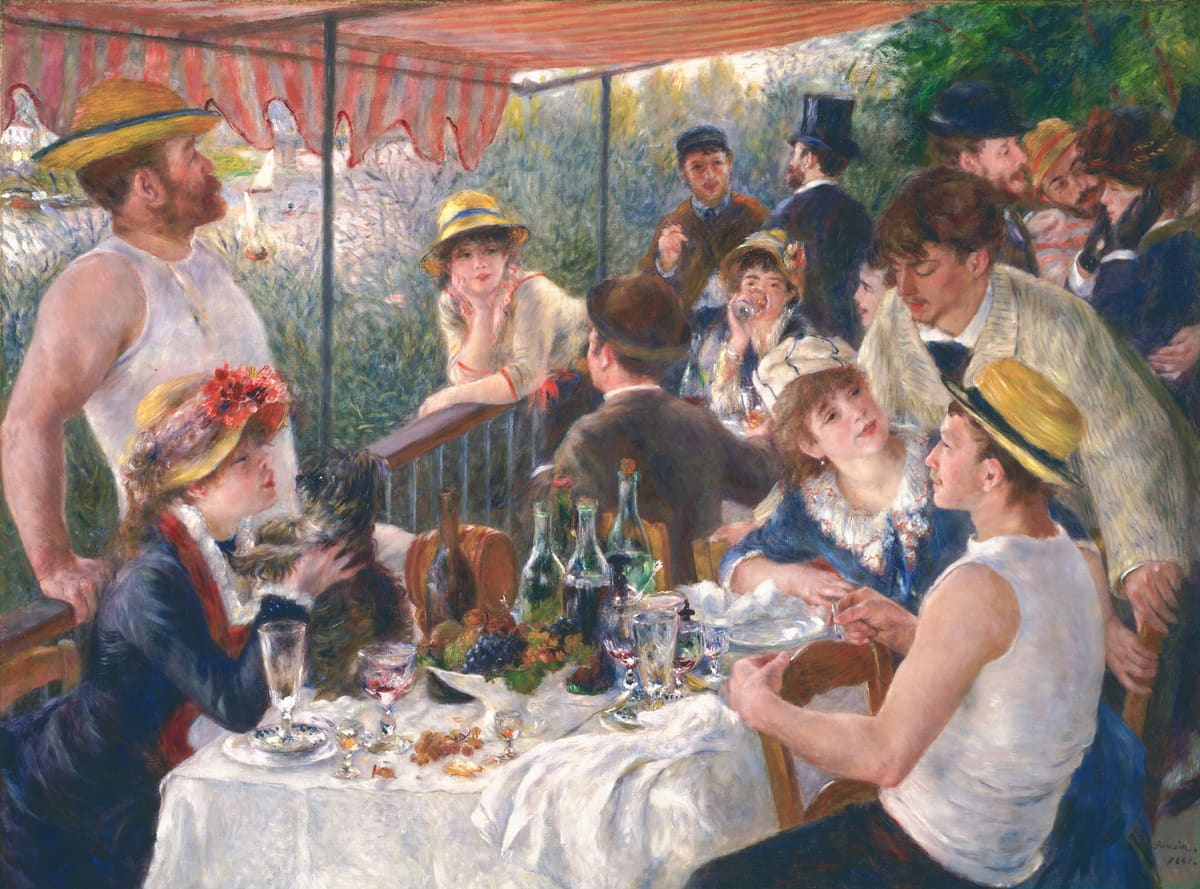
Luncheon of the Boating Party
1880
Renoir at the Maison Fournaise, a little downstream — the boating crowd a decade on.

Impression, Sunrise
1872
Monet's 1872 harbour — the picture that gave Impressionism its name, built on the method tried out here.
More by Pierre-Auguste Renoir
Bal du moulin de la Galette
Luncheon of the Boating Party

Also connected to Seine