Luncheon of the Boating Party
The terrace of the Maison Fournaise restaurant at Chatou, on the Seine — restored, and open again.
maison Fournaise
The painting shows a real, identified place that you can find today. The exact spot the artist worked from is not necessarily known.
Luncheon of the Boating Party — at a glance
- Artist
- Pierre-Auguste Renoir (1841–1919)
- Year
- 1880–1881
- Movement
- Impressionism
- Place
- Maison Fournaise, Île des Impressionnistes, Chatou, France
- Viewpoint
- The restaurant's balcony over the Seine — restored and open
- Medium
- Oil on canvas
- Dimensions
- c. 130 × 176 cm
- Now at
- The Phillips Collection, Washington, D.C.
Overview
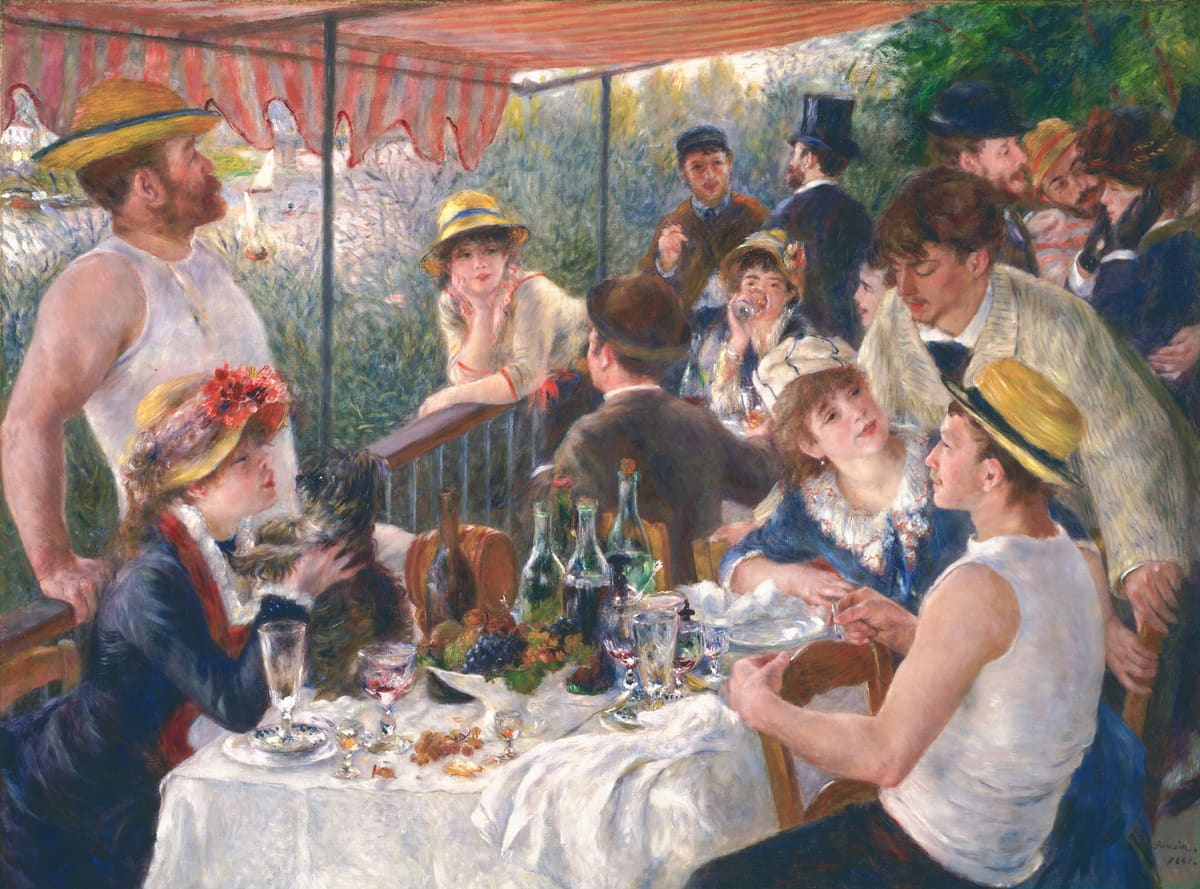
Luncheon of the Boating Party is a large painting Pierre-Auguste Renoir made over the summer and autumn of 1880 and into 1881. It shows a lunch party lingering on a shaded balcony above the Seine, the table still covered with the debris of the meal. It is oil on canvas, about 130 by 176 cm, and it has been the centrepiece of The Phillips Collection in Washington since 1923.
The setting is a real restaurant, and most of the fourteen people in it are identifiable friends of Renoir.
How it was made
Renoir worked on the picture across several weekends, bringing friends out from Paris to pose on the terrace of the Fournaise restaurant. Among them: his future wife Aline Charigot, in the foreground playing with a small dog; the painter and patron Gustave Caillebotte, seated at the right, straddling a chair; the actress Ellen Andrée; the collector Charles Ephrussi in a top hat at the back; and members of the Fournaise family, who ran the place.
It is a transitional work. Renoir was beginning to feel that Impressionism had led him away from drawing, and over the next few years he tightened his handling; this picture still has the loose Impressionist touch but a firmer structure than his work of the mid-1870s.
Where was Luncheon of the Boating Party painted?
The Maison Fournaise stands on what is now called the Île des Impressionnistes, a Seine island at Chatou, about 12 km west of central Paris. The Fournaise family ran a restaurant and hired out rowing boats there; it was a favourite spot for the Impressionists and their circle.
Museum interpretation The building was later abandoned, then restored in the 1980s: the striped-awning balcony was rebuilt, and it operates again as a restaurant with a small museum, the Musée Fournaise. The stretch of river and the island are still recognisable.
What is in the painting?
A group of young men and women sits and stands around a table on a balcony under a red-and-white striped awning. The meal is over: bottles, glasses, grapes and a heap of napkins litter the cloth. Aline Charigot lifts a little dog to her face in the foreground; a man in a singlet and straw hat leans on the rail at the left; a woman drinks at the right; two men talk at the back.
Through the railing, boats and the far bank of the Seine are visible in bright afternoon light.
Look closely
Aline and the dog
The young woman lifting a small dog to her face in the foreground is Aline Charigot, Renoir's future wife.
Caillebotte on his chair
The man in a singlet and straw hat seated backwards at the right is the painter and patron Gustave Caillebotte.
The top hat at the back
The formally dressed figure among the shirtsleeves is the collector Charles Ephrussi.
The wrecked table
Bottles, glasses, grapes and a pile of napkins — the lunch is finished and the party is lingering.
The striped awning
The red-and-white awning has been rebuilt on the actual balcony at Chatou.
Boats through the rail
The Seine and its far bank show between the railing posts in bright afternoon light.
Details that are easy to miss. Aline Charigot, playing with the dog, would marry Renoir in 1890; Caillebotte, seated backwards on his chair at the right, was a painter and the group's chief patron; the man in the top hat at the back is the collector Charles Ephrussi, out of place in his formal dress; the table still holds the wreck of the lunch; and the same striped awning has been rebuilt on the real balcony at Chatou.
Analysis
Composition & perspective
Fourteen figures are packed onto a small balcony and knitted together by glances, gestures and the diagonal of the awning and rail.
Scholarship Renoir builds depth with overlapping figures rather than perspective lines: the standing man at the left and the seated Caillebotte at the right frame the group like bookends, and the awning and railing run back on a diagonal to open the river view. The still life of the abandoned table anchors the foreground.
Colour and light
Warm sunlight filtered through the awning, scattered across white shirts, straw hats and skin in flecks of pink, blue and gold.
Scholarship The light is dappled and mobile — Renoir's specialty — breaking over the tablecloth and the figures in small touches of complementary colour, with cool blue-violet shadows. The striped awning glows; the bottles and glasses catch points of light.
Handling and technique
Soft, feathery brushwork throughout, but with more drawing and structure than Renoir's work of a few years earlier.
The touch is loose and blended, especially in the faces and the foliage, yet the figures are more firmly modelled and placed than in Renoir's mid-1870s pictures — the point at which he was starting to pull back from pure Impressionism.
Meaning and interpretation
Interpretations differ. What the artist documented, what museums and scholars propose, and later or speculative theories are marked and kept separate.
Modern leisure among friends
The museum reads it as a celebration of a particular world — the boating, dining and flirtation of Renoir's circle at the riverside restaurants outside Paris — painted with real people at a real table.
A turning point for Renoir
Art historians also treat it as the last great statement of Renoir's Impressionist phase, on the edge of the more classical, drawn manner he adopted after visiting Italy in 1881.
History & provenance
- 1880–81Painted on the terrace of the Maison Fournaise at Chatou.
- 1881Bought by the dealer Paul Durand-Ruel from Renoir.
- 1923Acquired by Duncan Phillips for his new museum in Washington.
- TodayThe signature work of The Phillips Collection.
Durand-Ruel bought the painting in 1881; Duncan Phillips acquired it in 1923, calling it one of the greatest paintings in the world. It has been the anchor of The Phillips Collection ever since.
Sources
- The Phillips Collection, Washington, D.C. — collection entry for ‘Luncheon of the Boating Party’ (acquired 1923; oil on canvas, c. 130 × 176 cm)
- Musée Fournaise, Chatou — history of the Maison Fournaise and the identification of the sitters
- John House, ‘Renoir’ (Hayward Gallery, 1985)
Frequently asked
Where was Luncheon of the Boating Party painted?
On the balcony of the Maison Fournaise, a riverside restaurant on a Seine island at Chatou, about 12 km west of central Paris.
Can you visit the restaurant?
Yes. The building was restored in the 1980s, the striped-awning balcony rebuilt, and it operates again as a restaurant with a small museum, the Musée Fournaise.
Who are the people in it?
Mostly Renoir's friends. They include his future wife Aline Charigot (with the dog), the painter Gustave Caillebotte (seated at the right), the actress Ellen Andrée, the collector Charles Ephrussi (top hat, background), and members of the Fournaise family.
How long did it take?
Renoir worked on it across several weekends over the summer and autumn of 1880 and into 1881, posing friends on the terrace in turn.
Is it an Impressionist painting?
It is one of the last great works of Renoir's Impressionist phase. Within a year or two he moved towards firmer drawing and a more classical manner.
Where is the painting now?
In The Phillips Collection in Washington, D.C., which acquired it in 1923.
Related paintings

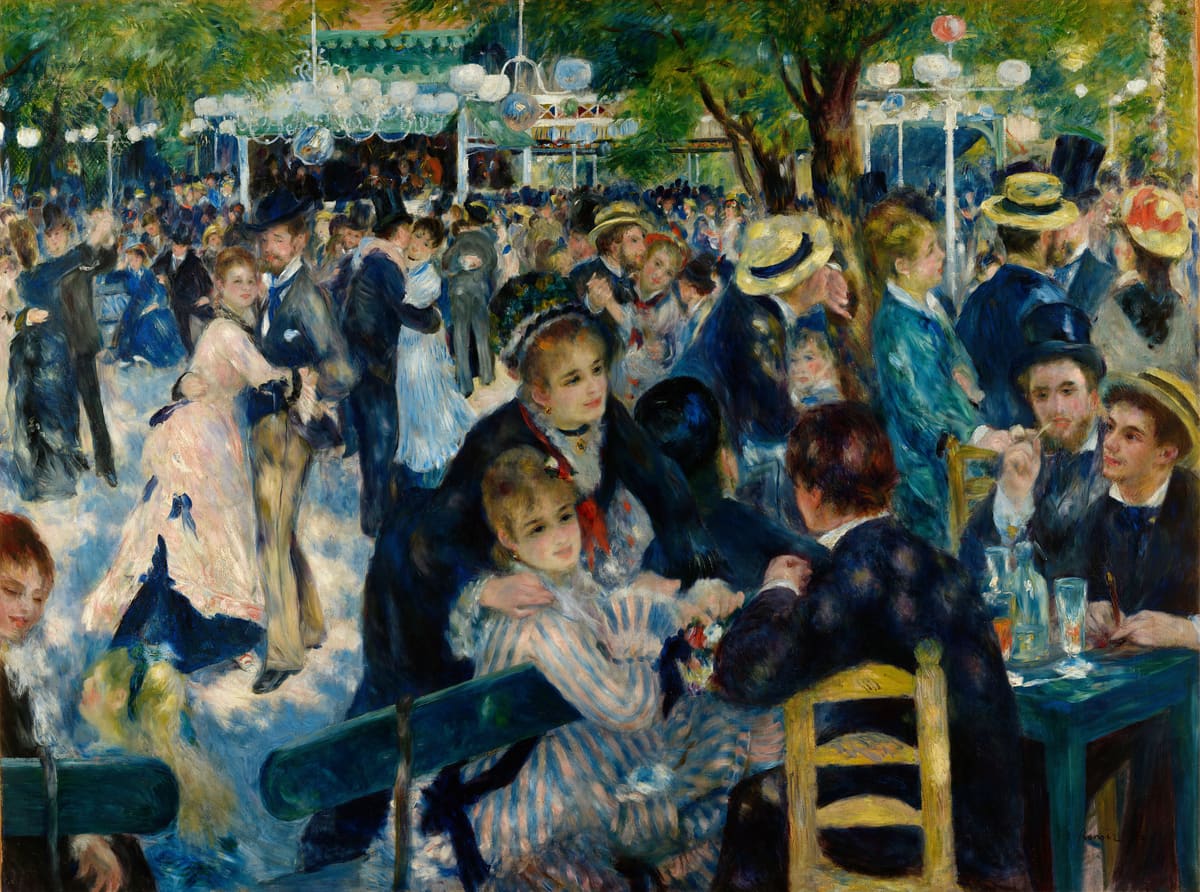
Bal du moulin de la Galette
1876
Renoir's Montmartre dance of 1876 — the same dappled light and circle of friends, on the hill instead of the river.

A Sunday Afternoon on the Island of La Grande Jatte
1884
Seurat's island of leisure a few kilometres downriver — the same subject, frozen and systematised.
More by Pierre-Auguste Renoir
Bal du moulin de la Galette


Also connected to maison Fournaise
