
Dance at Bougival
A couple dancing at an open-air café at Bougival, on the Seine west of Paris — the riverside guinguette world the Impressionists loved.
Bougival
The painting depicts a real landscape or cityscape. The precise viewpoint the artist used may be unknown, so the marker shows the general area.
Dance at Bougival — at a glance
- Artist
- Auguste Renoir (1841–1919)
- Year
- 1883
- Movement
- Impressionism
- Place
- Bougival, on the Seine west of Paris
- Viewpoint
- A riverside open-air café — the Seine and banks remain; the café is unidentified, the guinguette era gone
- Medium
- Oil on canvas
- Dimensions
- c. 182 × 98 cm
- Now at
- Museum of Fine Arts, Boston
Overview
Dance at Bougival is one of a trio of near-life-size dancing couples Renoir painted in 1883 (with Dance in the City and Dance in the Country). It shows a young woman in a white dress and red bonnet swept round the floor by a partner in a straw boater, at an open-air café, with other drinkers at tables among the trees behind. It is oil on canvas, about 182 by 98 cm, and it hangs in the Museum of Fine Arts, Boston.
The story behind the painting
Scholarship The woman is generally identified as Suzanne Valadon, then an artists' model and later a painter herself; the man is often said to be Renoir's friend Paul Lhôte. Renoir made the three ‘Dance’ panels as a set contrasting settings and moods — city ballroom, country guinguette, and this riverside dance hall.
Where was Dance at Bougival painted?
Scholarship Bougival is a village on the Seine about 15 km west of central Paris, between Chatou and Louveciennes. In the 1860s–80s its riverbanks and islands were crowded with guinguettes — open-air cafés with dancing — reached by train for a Sunday out; the nearby bathing and boating spot of La Grenouillère on the Île de Croissy had been painted by Monet and Renoir a decade earlier. Bougival is now a quiet suburb; the Seine and the wooded banks remain, but the specific café is not identified and the guinguette culture is gone.
What is in the painting?
The dancing couple fills the canvas. The woman leans back slightly in her partner's arms, face turned down and away under a red bonnet, one gloved hand in his; her white dress swings out. The man, bearded, in a blue jacket, yellow straw hat and dark trousers, bends his head towards her. At their feet lie a discarded bouquet and a spent match; behind, blurred figures sit at tables with drinks under the trees, and a woman in a straw hat laughs.
Look closely
The red bonnet
The one hot colour in the picture, turning the woman's downturned face into its focus.
The straw boater
The man's yellow hat — the standard headgear of the Seine Sunday crowd.
The dropped bouquet and match
A discarded posy and a spent match lie at the dancers' feet, small signs of the evening's passage.
The blurred café behind
Drinkers at tables among the trees, painted loose and out of focus so the couple stays sharp.
Analysis
Composition & perspective
A single tall couple caught mid-turn, filling the frame, with the café crowd dissolved into loose colour behind.
Scholarship Renoir sets the dancers on a slight diagonal and crops close, so their movement fills the narrow upright canvas; the background is painted freely and out of focus, throwing all the sharpness onto the woman's face, her dress and the man's hat. The pose holds a split-second of the dance.
Colour and light
The woman's white dress and red bonnet glow against the greens and browns of the shaded café garden.
Dappled outdoor light falls through the trees; Renoir keeps the strongest lights and the one hot red on the woman, and lets the man and the background settle into warm shadow. The touch is quick and feathery, especially in the foliage and the crowd.
History & provenance
The painting passed through French and American collections and was acquired by the Museum of Fine Arts, Boston, where it is one of the best-loved Impressionist works.
Sources
- Museum of Fine Arts, Boston — collection entry for Auguste Renoir, ‘Dance at Bougival’ (1883; oil on canvas, c. 182 × 98 cm)
- Colin B. Bailey, ‘Renoir's Dancers’ literature
Frequently asked
Where is Dance at Bougival set?
At an open-air café with dancing (a guinguette) at Bougival, a village on the Seine about 15 km west of central Paris that was a popular Sunday destination in the 1880s.
Can you go there?
Bougival is now a quiet suburb. The Seine and its wooded banks remain, but the specific café in the painting is not identified and the riverside dance-garden culture has gone.
Who are the dancers?
The woman is generally identified as Suzanne Valadon, then a model and later a painter; the man is often said to be Renoir's friend Paul Lhôte.
Is it part of a series?
Yes — one of three near-life-size dancing couples Renoir made in 1883: Dance in the City, Dance in the Country and Dance at Bougival, contrasting settings and moods.
Where is the painting now?
In the Museum of Fine Arts, Boston.
Related paintings

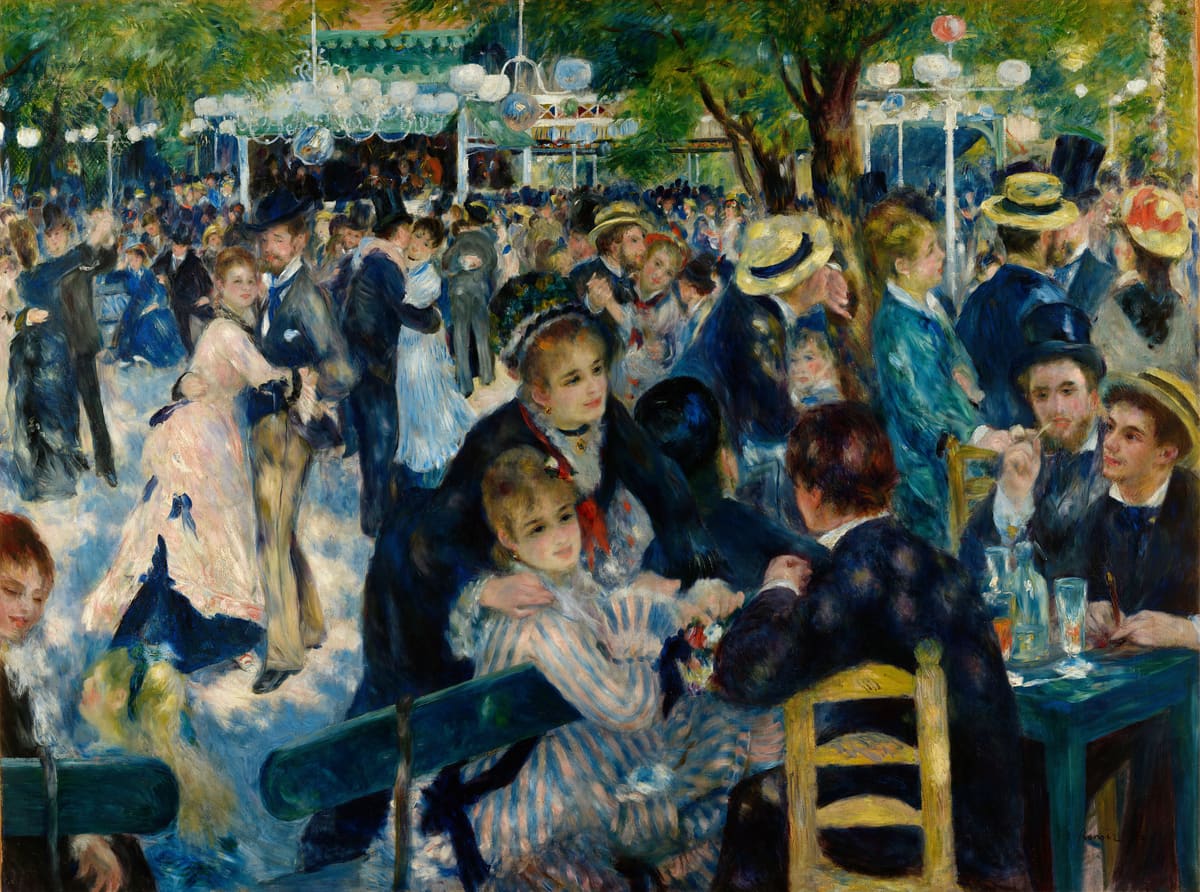
Bal du moulin de la Galette
1876
Renoir's crowded Montmartre dance of 1876 — the city counterpart to this riverside one.

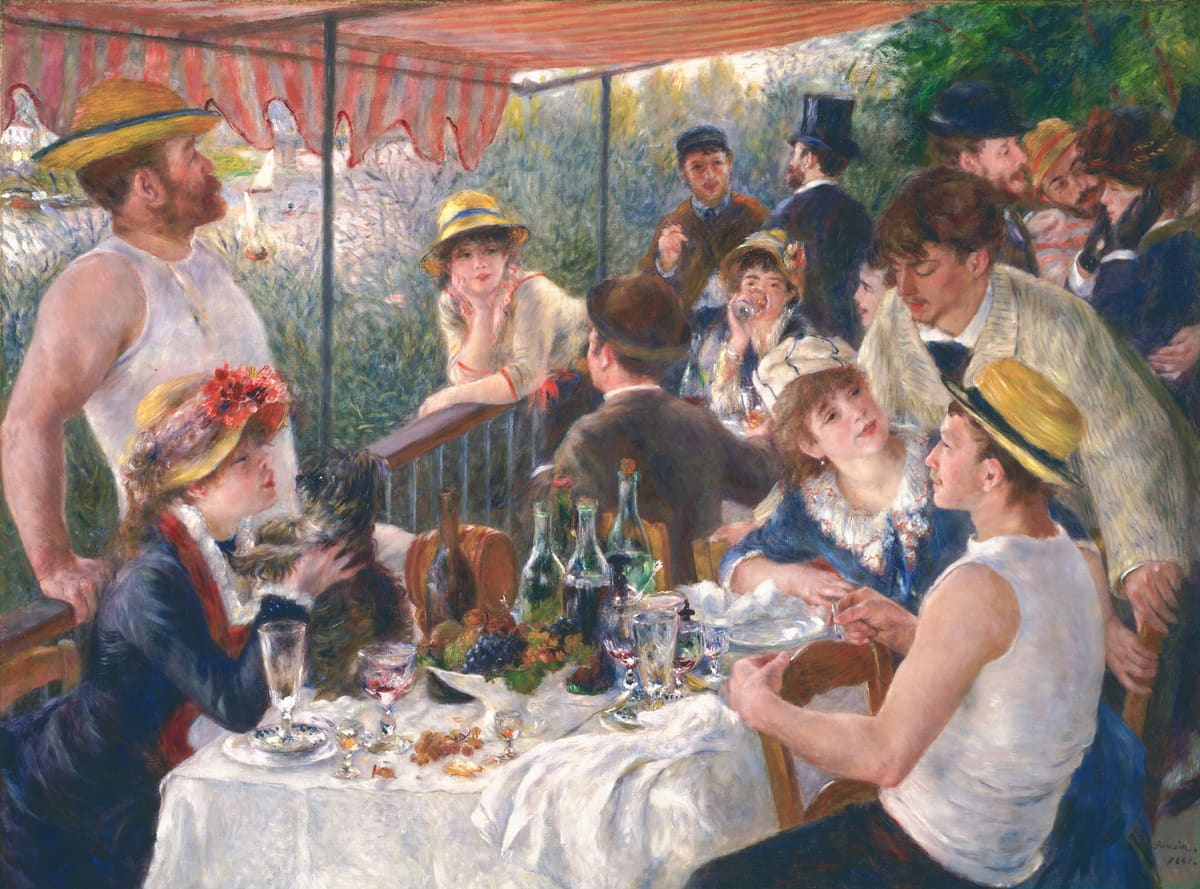
Luncheon of the Boating Party
1880
Renoir at the Maison Fournaise, a short way downstream — the same Seine leisure world.

Lunch at the Restaurant Fournaise
1875
The earlier Fournaise terrace picture — same river, same boating crowd.
More by Pierre-Auguste Renoir
Bal du moulin de la Galette
Luncheon of the Boating Party

Also connected to Bougival
