
Salisbury Cathedral from the Meadows
Salisbury Cathedral seen across the water meadows of the Avon — the view is still open from the same fields.
Salisbury Cathedral
The painting shows a real, identified place that you can find today. The exact spot the artist worked from is not necessarily known.
Salisbury Cathedral from the Meadows — at a glance
- Artist
- John Constable (1776–1837)
- Year
- 1831
- Movement
- English Romantic landscape
- Place
- The Avon water meadows, Harnham, Salisbury, England
- Viewpoint
- The meadows across the Avon by Long Bridge — the view is still open
- Medium
- Oil on canvas
- Dimensions
- c. 152 × 190 cm
- Now at
- Tate Britain, London
Overview
Salisbury Cathedral from the Meadows is one of John Constable's ‘six-footers’ — the large exhibition landscapes on which he staked his reputation — shown at the Royal Academy in 1831. It shows the tallest medieval spire in Britain across the wet meadows south-west of the city, with a farm cart fording a stream, a dog, a broken sky and a rainbow. It is oil on canvas, about 152 by 190 cm, and it hangs in Tate Britain, London.
It is often read as Constable's most personal landscape, painted in the years after his wife's death and during a bitter public argument over the Church.
The story behind the painting
Scholarship Constable's close friend John Fisher was Archdeacon of Salisbury, and Constable stayed often at Fisher's house in the cathedral close. He made oil sketches in the meadows over several summers and worked the large canvas up in London.
Scholarship The picture was made while the Reform crisis had the Church of England under attack; Constable, a conservative Anglican, is usually thought to have meant the storm-lit cathedral with its rainbow as an image of the Church weathering the times. The rainbow's foot falls near Fisher's house.
Where was Salisbury Cathedral from the Meadows painted?
Scholarship The viewpoint is the low water-meadow ground on the far side of the River Avon, roughly by the Long Bridge in what is now Harnham, looking north-east to the cathedral. The meadows are still open grazing land, protected from building, and the framed view of the spire from the Town Path and Long Bridge is one of the most closely matched of any English landscape painting — allowing for Constable's heightened sky and adjusted trees.
What is in the painting?
The spire rises at the centre-left, pale against dark cloud. In the foreground a stream runs across the picture; a hay wagon with three horses fords it, a dog watches from the near bank, and a broken tree leans in from the left. A rainbow arcs down from the right through the storm light. Trees and the roofs of Harnham fill the middle distance.
Look closely
The spire
At 123 m the tallest medieval spire in Britain, lit white against the darkest cloud.
The fording wagon
A hay wagon and three horses cross the stream in the foreground, echoing ‘The Hay Wain’ of a decade before.
The rainbow
It arcs down from the right through the storm light; its foot falls near Archdeacon Fisher's house in the close.
The broken tree
A shattered, leaning trunk frames the left edge — a Romantic note of loss and struggle.
Constable's snow
Flecks of pure white are scattered over grass, water and foliage to keep the light restless.
Analysis
Composition & perspective
The spire is set off-centre under the darkest cloud, with the fording cart and the leaning tree framing it in the foreground.
Scholarship Constable balances the vertical of the spire against the horizontal sweep of the meadows and the diagonal of the broken tree and the rainbow. The eye is led in over the stream and the cart to the sunlit cathedral, the one bright, still point in a turning sky.
Colour and light
Storm greens and greys with sudden sunlight on the cathedral and the vivid band of the rainbow.
Scholarship The palette is dark and wet — bruised cloud, soaked grass, brown water — broken by the white light on the spire and the prismatic arc of the rainbow. Constable works the whole surface with flecks of white (‘Constable's snow’) to keep the light moving.
Meaning and interpretation
Interpretations differ. What the artist documented, what museums and scholars propose, and later or speculative theories are marked and kept separate.
The Church in the storm
The standard reading is that the sunlit cathedral under threatening cloud, with a rainbow of covenant, stands for the endurance of the Church of England through the political attacks of 1830–31.
A picture of grief
Painted after the death of Maria Constable in 1828, the dark mood and the lonely grandeur of the spire are also often taken as an expression of the artist's own loss. Constable did not spell this out.
History & provenance
The painting stayed with Constable's family, passed through collections, and was acquired jointly for the nation in 1983 after an export campaign; it is held by Tate and normally shown at Tate Britain, London.
Sources
- Tate — collection entry for John Constable, ‘Salisbury Cathedral from the Meadows’ (1831; oil on canvas, c. 152 × 190 cm)
- Anne Lyles et al., ‘Constable: The Great Landscapes’ (Tate, 2006)
Frequently asked
Can you still see this view of Salisbury Cathedral?
Yes. The water meadows south-west of the city are protected open land, and the framed view of the spire from the Town Path and Long Bridge in Harnham is one of the most closely matched of any English landscape painting.
Where exactly did Constable stand?
On the low meadow ground across the River Avon from the cathedral, roughly by the Long Bridge in Harnham, looking north-east. He made oil sketches there over several summers while staying with his friend Archdeacon John Fisher in the close.
What does the rainbow mean?
It is generally read as a sign of hope and covenant: the sunlit cathedral under storm cloud stands for the Church of England enduring the political attacks of the Reform years. The rainbow's foot falls near Fisher's house.
Is the painting connected to Constable's grief?
It was made after the death of his wife Maria in 1828, and many writers see the dark sky and the isolated spire as an expression of that loss, though Constable did not say so directly.
Where is the painting now?
It belongs to Tate and is normally on view at Tate Britain, London.
Related paintings


More by John Constable
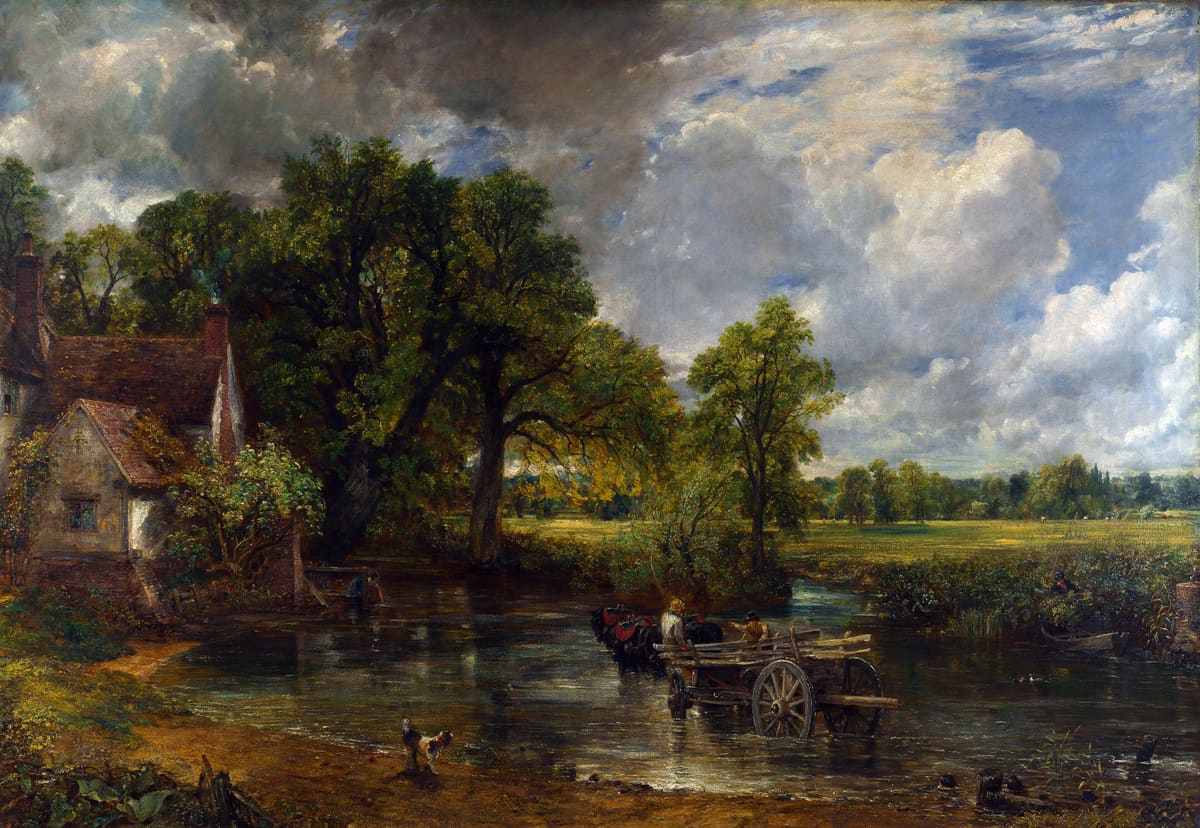
The Hay Wain
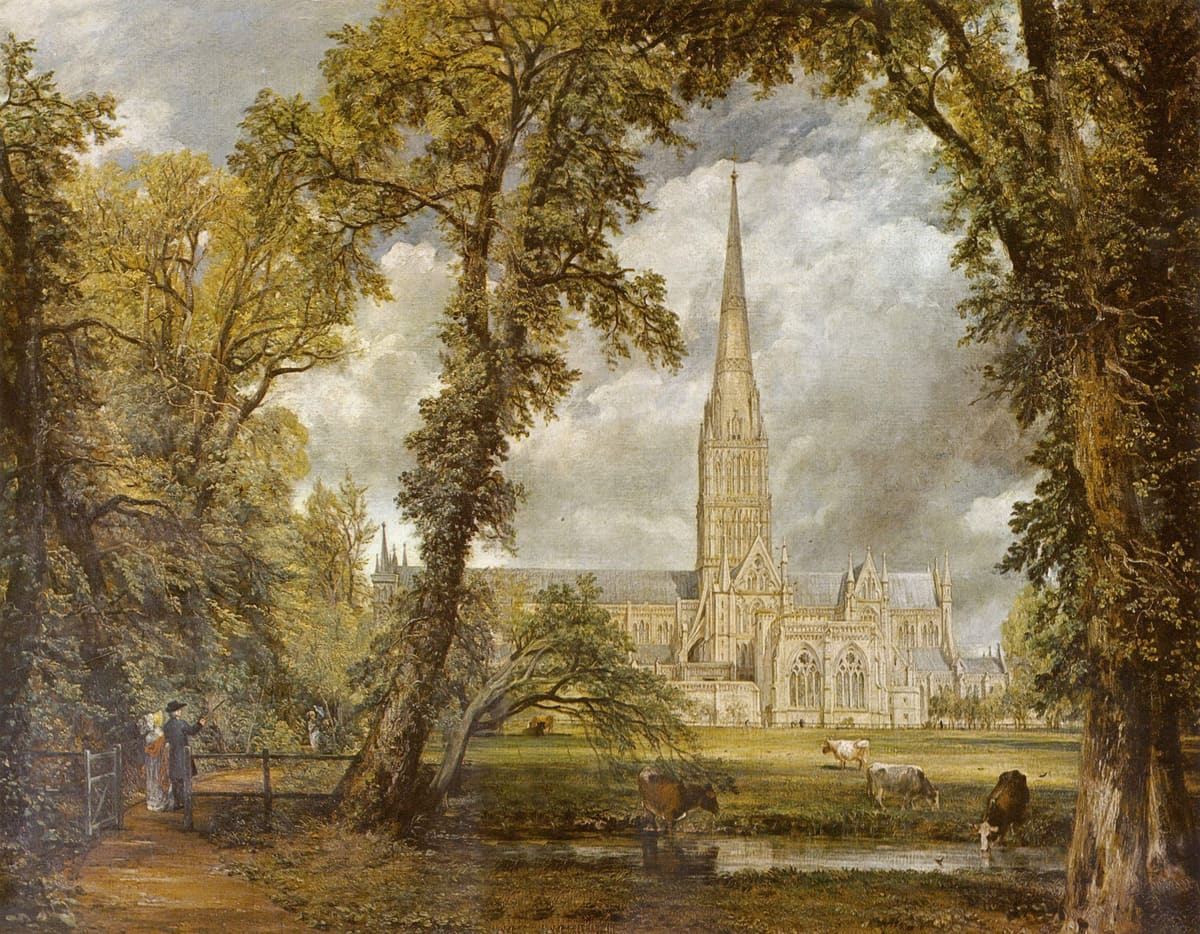
Salisbury Cathedral from the Bishop's Grounds


The Vale of Dedham
Also connected to Salisbury Cathedral