
The Canal du Loing at Moret
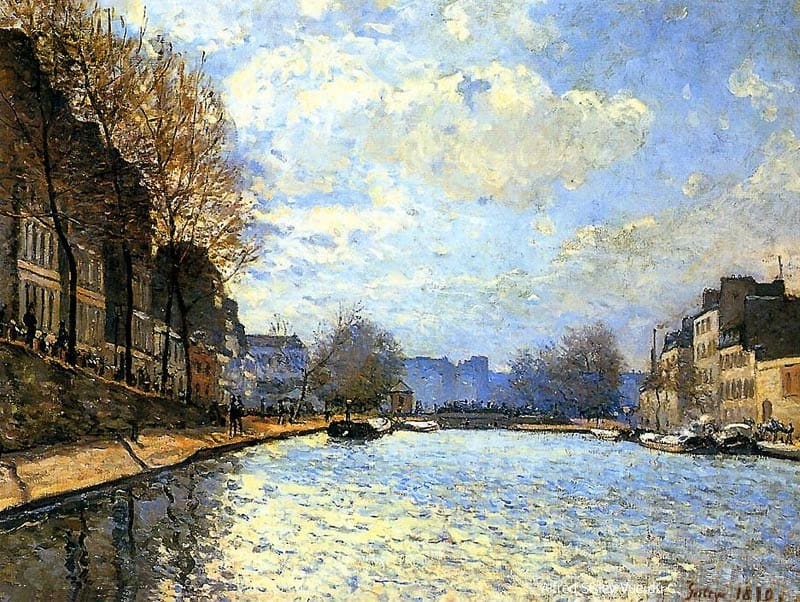
The tree-lined towpath of the Canal du Loing at Moret-sur-Loing, the small Seine-et-Marne town where Sisley spent his last years.
Canal du Loing
The painting depicts a real landscape or cityscape. The precise viewpoint the artist used may be unknown, so the marker shows the general area.
The Canal du Loing at Moret — at a glance
- Artist
- Alfred Sisley (1839–1899)
- Year
- 1880s–1890s
- Movement
- Impressionism
- Place
- The Canal du Loing at Moret-sur-Loing, Seine-et-Marne, France
- Viewpoint
- The canal towpath and tree avenues — canal, towpath, locks and town all survive, little changed
- Medium
- Oil on canvas
- Dimensions
- c. 38 × 55 cm
- Now at
- Musée d'Orsay and other collections
Overview
From 1880 Alfred Sisley lived at Moret-sur-Loing, a small walled town on the river Loing near its junction with the Seine, and painted it and its surroundings for the rest of his life. The Canal du Loing, which runs beside the river, and its long straight towpath lined with tall poplars and plane trees, was one of his most repeated motifs. The pictures are oil on canvas, about 38 by 55 cm; examples are in the Musée d'Orsay and other collections.
Where was The Canal du Loing at Moret painted?
Scholarship Moret-sur-Loing is on the southern edge of the forest of Fontainebleau, in Seine-et-Marne, about 70 km south-east of Paris. The Canal du Loing, an eighteenth-century navigation, runs past the town; its towpath, avenues of trees, locks and the town's medieval gates and church survive and are little changed, and Moret markets a Sisley trail. The canal views can be matched closely today.
What is in the painting?
The canal runs back on a strong diagonal or straight into the distance, its water still and reflecting. A towpath edges it; tall trees — poplars, planes — line the bank in a receding row, their trunks and reflections regular. Barges or a boat may lie on the water; low buildings or a lock show far off. The light is soft and the colour a range of greens, blue-greys and cream.
Look closely
The colonnade of trees
Tall poplars and planes line the towpath in a regular receding row.
The still canal
The water repeats the trees and sky almost exactly, upside down.
The distant lock or town
Low buildings or a lock close the perspective far off.
Analysis
Composition and technique
A straight canal and a regular colonnade of trees receding to a low point, doubled in still water.
Scholarship Sisley uses the ruled line of the canal and the even spacing of the trees to drive a calm perspective, and the still water to repeat it upside down. The mood is quiet and ordered; the brushwork is light, especially in the foliage and sky.
History & provenance
Sisley's Moret and Canal du Loing pictures are in the Musée d'Orsay and many other museums and private collections.
Sources
- Musée d'Orsay, Paris — collection entries for Alfred Sisley's Canal du Loing / Moret pictures
- Office de tourisme, Moret-sur-Loing — the Sisley trail
Related paintings

More by Alfred Sisley
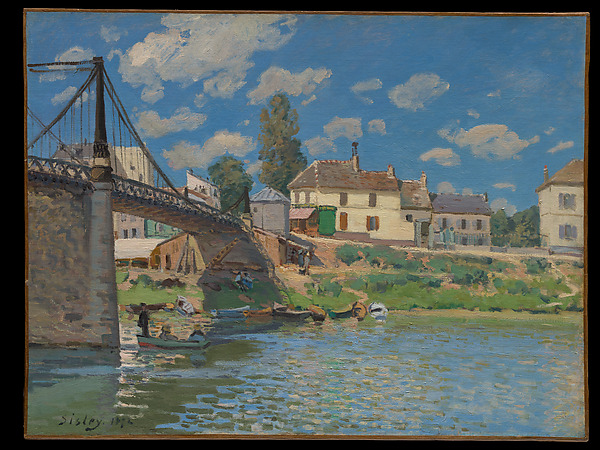
The Bridge at Villeneuve-la-Garenne

