
A Cart on the Snowy Road at Honfleur
A horse and cart on a snow-covered country road near Honfleur, on the Normandy estuary — an early Monet snow scene.
Honfleur
The painting depicts a real landscape or cityscape. The precise viewpoint the artist used may be unknown, so the marker shows the general area.
A Cart on the Snowy Road at Honfleur — at a glance
- Artist
- Claude Monet (1840–1926)
- Year
- c. 1865–1867
- Movement
- Impressionism (early)
- Place
- A country lane near Honfleur, Normandy, France
- Viewpoint
- A farm lane behind the port — the countryside has largely changed; a general viewpoint
- Medium
- Oil on canvas
- Dimensions
- c. 65 × 92 cm
- Now at
- Musée d'Orsay, Paris
Overview
A Cart on the Snowy Road at Honfleur is one of the earliest of Claude Monet's many snow pictures, painted in the mid-1860s when he worked repeatedly around Honfleur. It shows a rutted country road under fresh snow, a horse and cart moving away from the viewer, thatched farm buildings and bare trees along the way, and a grey, snow-laden sky. It is oil on canvas, about 65 by 92 cm, and it hangs in the Musée d'Orsay, Paris.
Where was A Cart on the Snowy Road at Honfleur painted?
Museum interpretation Honfleur is a small port on the south side of the Seine estuary in Normandy, opposite Le Havre, long favoured by painters. In the 1860s Monet, Boudin and Jongkind worked there, often lodging at the Ferme Saint-Siméon on the hill above the town. This scene is one of the farm lanes in the wooded country behind the port. Honfleur's old harbour survives as a tourist town; the surrounding lanes and farms have largely been built up or changed, so the picture records the 1860s countryside rather than a marked spot.
What is in the painting?
The road runs back on a gentle curve, deep in snow, its ruts showing brown. A dark horse pulls a two-wheeled cart away down it. Snow-laden thatched roofs and a fence stand to one side; bare trees lean over the road; the sky is a heavy uniform grey. The palette is greys, browns and off-whites with a few dark accents.
Look closely
The horse and cart
A dark horse pulls a two-wheeled cart away down the curving road — the only movement.
The snow-laden thatch
Thick snow lies on the thatched farm roofs beside the lane.
The brown ruts
Wheel ruts show brown through the fresh white on the road.
Analysis
Composition and technique
A curving snow road with the cart as the single moving accent, under a flat grey sky.
Scholarship Monet uses the curve of the road to give depth, keeps the horizon low, and paints the muffled light in close-valued greys and browns with quick, broken strokes for the snow and the trees. It is an early study of low-contrast winter atmosphere.
History & provenance
The painting entered the French national collections and hangs in the Musée d'Orsay, Paris.
Sources
- Musée d'Orsay, Paris — collection entry for Claude Monet, ‘La Charrette. Route sous la neige à Honfleur’ (c. 1865–67)
- House, John, ‘Monet: Nature into Art’ (Yale University Press, 1986)
Related paintings


More by Claude Monet
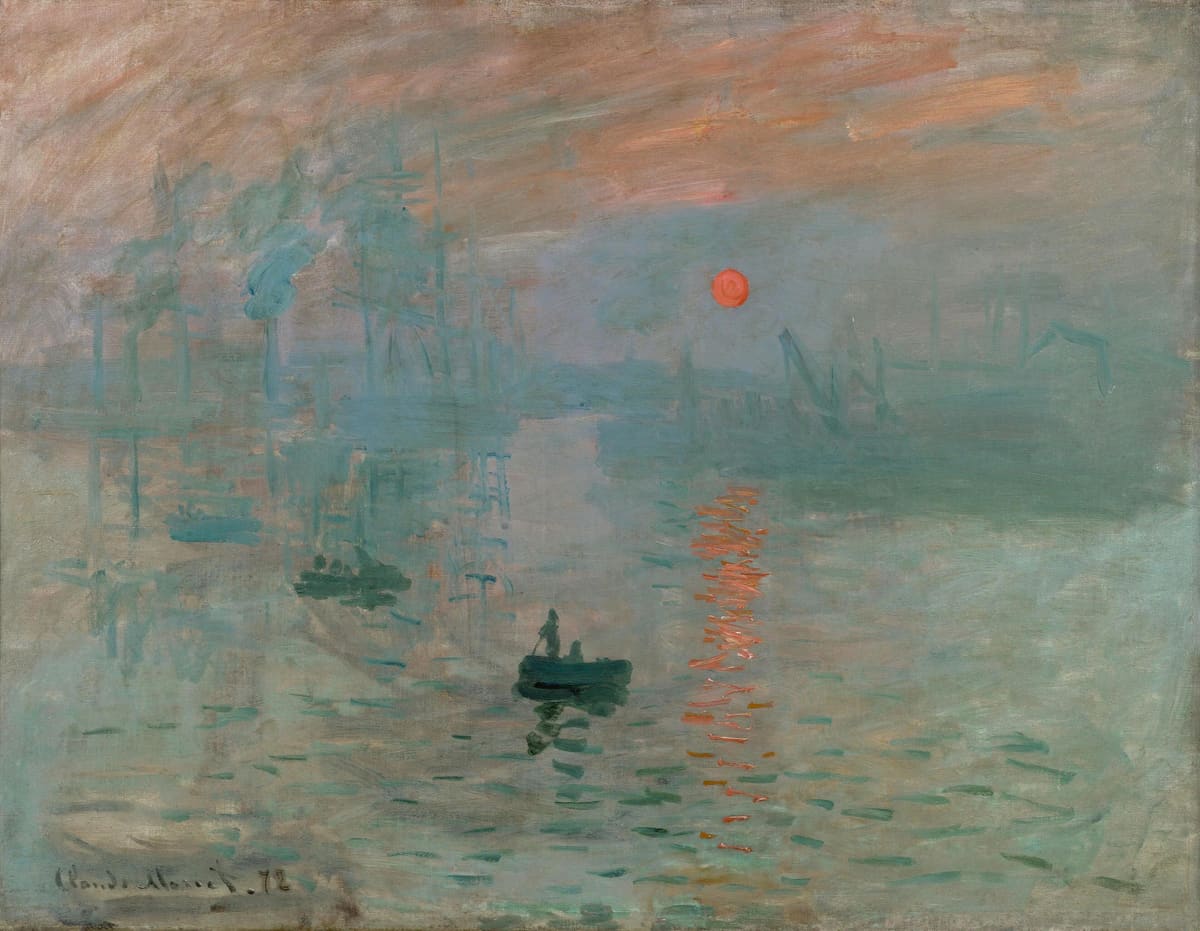
Impression, Sunrise
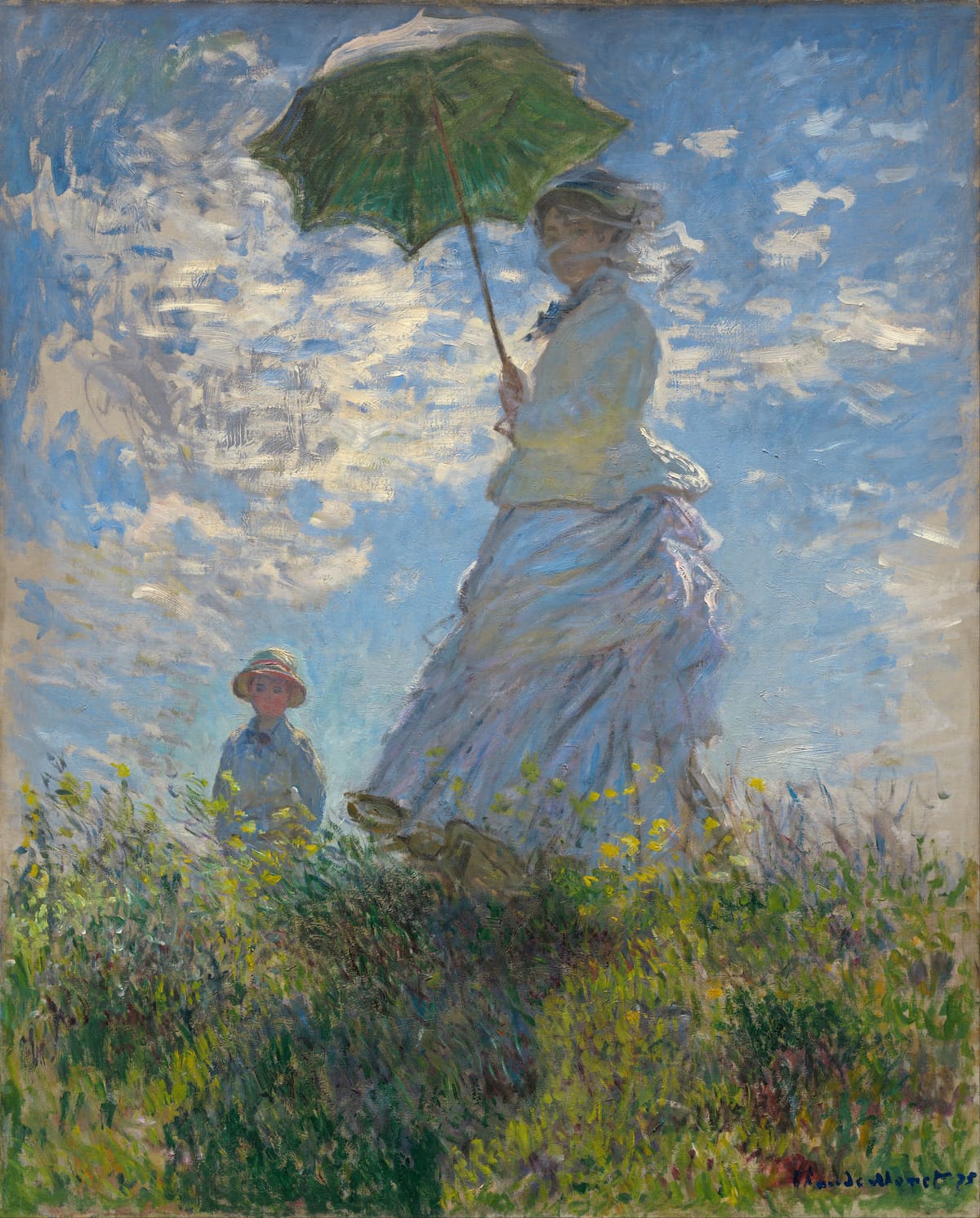
Woman with a Parasol – Madame Monet and Her Son

Houses on the Achterzaan
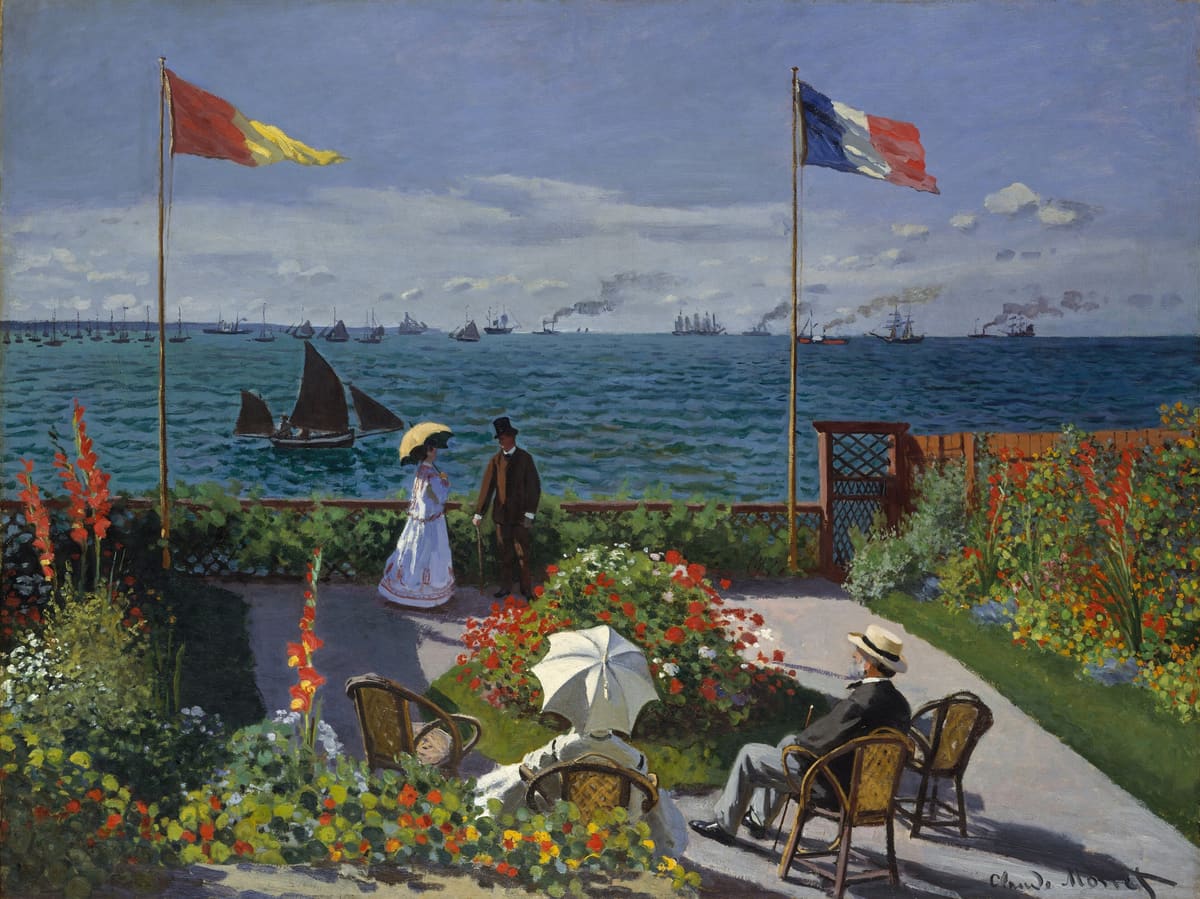
Also connected to Honfleur
