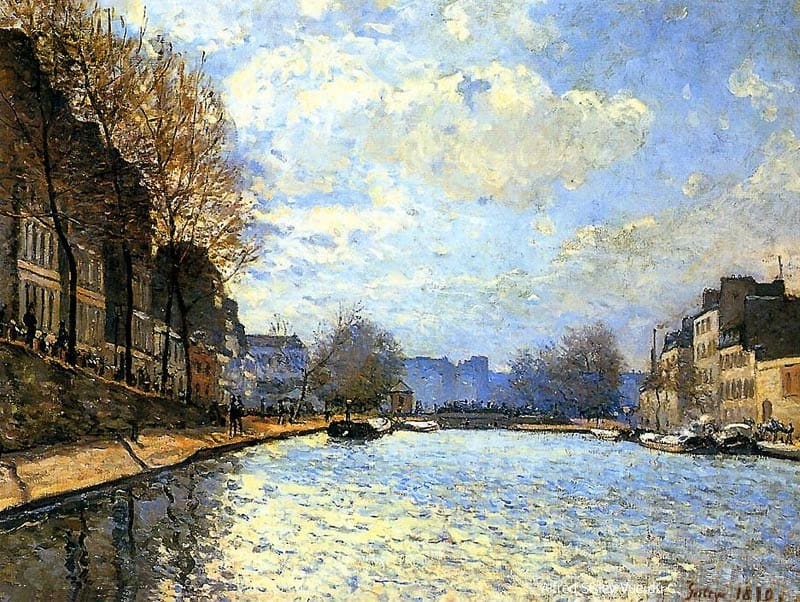
Vue du canal Saint-Martin
The Canal Saint-Martin in Paris, painted from a quay near the Récollets lock — the water, the locks and an iron footbridge are still there.
Canal Saint-Martin
A standpoint is recorded for this painting, but it has not been independently confirmed against a museum or scholarly source, so treat it as approximate.
Vue du canal Saint-Martin — at a glance
- Artist
- Alfred Sisley (1839–1899)
- Year
- 1870
- Movement
- Impressionism
- Place
- Canal Saint-Martin, Paris 10e
- Viewpoint
- A quay near the Écluse des Récollets — canal, locks and footbridges survive
- Medium
- Oil on canvas
- Now at
- Musée d'Orsay, Paris
Overview
View of the Canal Saint-Martin is an early Impressionist landscape Alfred Sisley painted in 1870, the year before the Franco-Prussian War scattered the group. It shows the working canal in the north-east of Paris on an ordinary grey-bright day, with barges, strollers and a lock. It is oil on canvas and hangs in the Musée d'Orsay, Paris.
Sisley showed it, with another canal view, at the Salon of 1870 — one of the last times he exhibited there before committing to independent shows.
Where was Vue du canal Saint-Martin painted?
The Canal Saint-Martin was cut in the 1820s to bring water and freight into the city; it runs from the Bassin de la Villette down to the Seine near the Bastille, dropping through a series of locks.
Museum interpretation Sisley's viewpoint is a quay in the stretch near the Écluse des Récollets, looking along the open water. This part of the canal was never roofed over — unlike the section further south — so the water, the lock chambers and the tall, arched iron footbridges that cross it are still there, and the framing can be matched closely from the quayside today.
What is in the painting?
The canal runs back from the foreground between stone quays lined with young trees. Barges are moored and moving on the water; figures walk the towpath; a lock and its gates cross the middle distance, with a footbridge beyond. Plain apartment blocks and warehouses close the view, under a wide sky of moving cloud.
Look closely
The lock
A lock and its timber gates cross the middle distance — part of the chain of locks that steps the canal down to the Seine.
The iron footbridge
A high arched pedestrian bridge crosses beyond the lock; several like it still span this stretch.
The moored barges
Freight barges lie along the quays and move on the water — the canal was a working waterway.
The young trees
Newly planted saplings line the stone quays, thin against the sky.
Analysis
Composition & perspective
A simple one-point perspective runs the quays and the water straight back to a low vanishing point, with the lock as a horizontal stop.
Scholarship Sisley sets the canal on the central axis and lets the receding quays, tree lines and moored barges carry the eye back to the lock and bridge. The sky takes up the top half; the composition is calm, symmetrical and almost topographical.
Colour and light
Cool greys, greens and stone tones under a soft, silvery Paris light, with the water reflecting the sky.
The palette is restrained — grey-green water, pale stone, the fresh green of the saplings — with small warm notes in the barges and figures. Sisley works the changeable cloudy light in broken strokes, especially in the sky and its reflection.
History & provenance
The painting passed through private collections and entered the French national collections in the twentieth century; it hangs in the Musée d'Orsay, Paris, among the early Impressionist landscapes.
Featured in Famous Painting Locations: 13 Real Places You Can Visit
Sources
- Musée d'Orsay, Paris — collection entry for Alfred Sisley, ‘Vue du canal Saint-Martin’ (oil on canvas)
- MaryAnne Stevens (ed.), ‘Alfred Sisley’ (Royal Academy, 1992)
Frequently asked
Where did Sisley paint View of the Canal Saint-Martin?
From a quay in the north-east of Paris on the stretch of the Canal Saint-Martin near the Écluse des Récollets, looking along the open water towards a lock and a footbridge.
Can you find the spot today?
Yes. This part of the canal was never roofed over, so the water, the lock chambers and the high arched iron footbridges are still there and the view can be matched from the quayside.
When was it painted?
In 1870, and shown at the Paris Salon that year — shortly before the Franco-Prussian War and Sisley's move to independent exhibitions.
Where is the painting now?
In the Musée d'Orsay, Paris.
Related paintings

More by Alfred Sisley
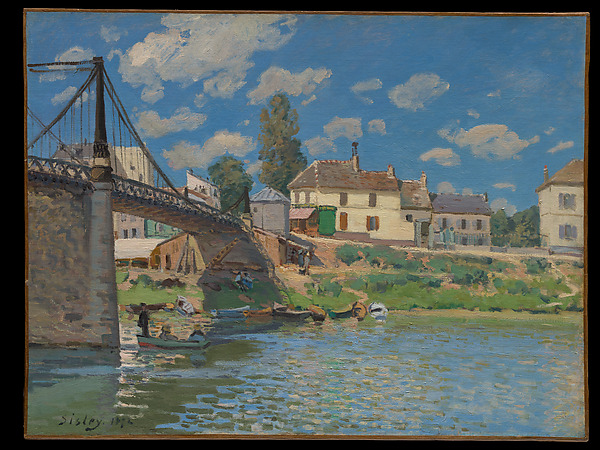
The Bridge at Villeneuve-la-Garenne


