The Bridge at Villeneuve-la-Garenne
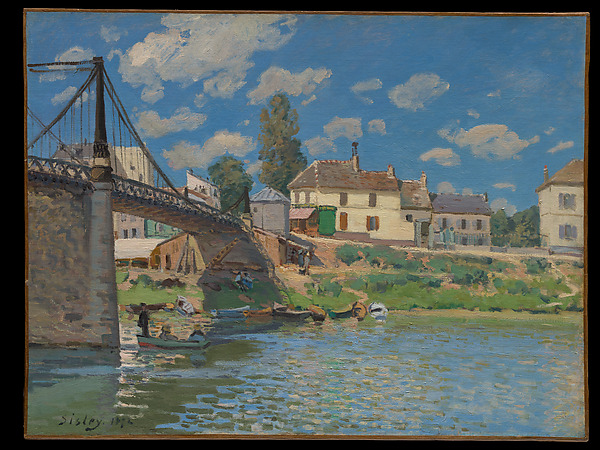
The road bridge over the Seine at Villeneuve-la-Garenne, just north of Paris — an early, sunlit Impressionist river view.
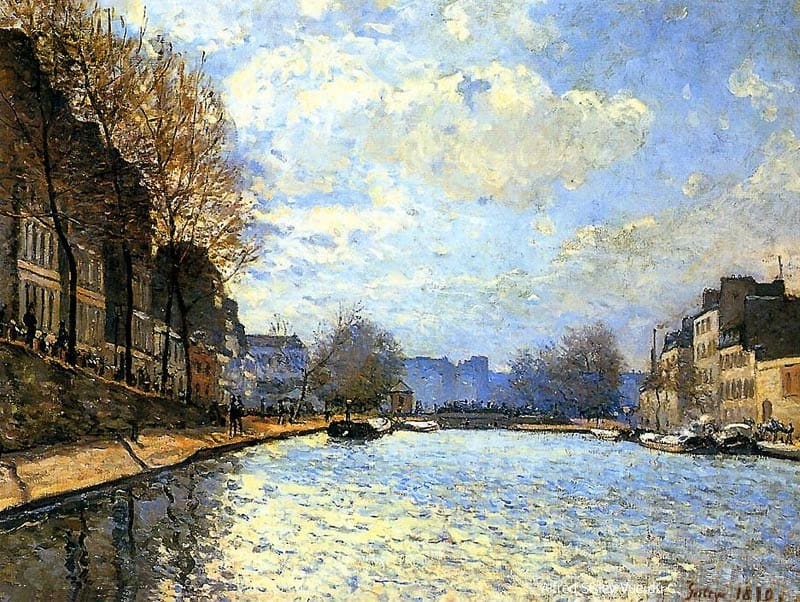
Pont de l'île Saint-Denis
The painting shows a real, identified place that you can find today. The exact spot the artist worked from is not necessarily known.
The Bridge at Villeneuve-la-Garenne — at a glance
- Artist
- Alfred Sisley (1839–1899)
- Year
- 1872
- Movement
- Impressionism
- Place
- Villeneuve-la-Garenne, on the Seine just north of Paris
- Viewpoint
- From the riverbank towards the road bridge — the village is now a suburb; the bridge has been replaced
- Medium
- Oil on canvas
- Dimensions
- c. 49 × 65 cm
- Now at
- Metropolitan Museum of Art, New York
Overview
The Bridge at Villeneuve-la-Garenne is a bright, confident river landscape by Alfred Sisley, painted in 1872, at the moment Impressionism was taking shape. It shows a road bridge crossing the Seine on tall pale piers, with a rowing boat, a moored barge, small figures on the bank and a riverside house among trees. It is oil on canvas, about 49 by 65 cm, and it hangs in the Metropolitan Museum of Art, New York.
Where was The Bridge at Villeneuve-la-Garenne painted?
Museum interpretation Villeneuve-la-Garenne lies on the Seine just north of Paris, opposite the Île Saint-Denis. In 1872 it was a riverside village popular for boating; it is now a dense inner suburb. The specific bridge Sisley painted has been replaced, but the Seine still runs on the same line and is still crossed here, so the setting survives in outline rather than in detail.
What is in the painting?
The bridge crosses from the right on two or three tall, light-coloured arches or piers; the roadway and its parapet run off the top right of the canvas. Below and beyond, the Seine is bright blue-green with reflections; a man rows a small boat, a barge is moored, and a white house with green shutters stands among trees on the far bank under a summer sky of light cloud.
Look closely
The pale bridge piers
Tall light-coloured piers carry the roadway across from the right; the parapet runs off the top of the canvas.
The rowing boat
A man rows a small boat on the bright water below the bridge.
The house with green shutters
A white riverside house stands among trees on the far bank.
The worked water
Short horizontal strokes of blue, green and white catch the reflections and the current.
Analysis
Composition and light
The bridge cuts a strong shape across the upper right; the open river and its reflections fill the rest.
Scholarship Sisley uses the pale mass of the bridge to anchor one corner and lets the river open out from it, carrying the eye to the house and trees on the far bank. The colour is high and clear, the water worked in short horizontal strokes; the whole picture is full of moving summer light.
History & provenance
The painting entered the Havemeyer collection and, with it, the Metropolitan Museum of Art, New York.
Sources
- The Metropolitan Museum of Art, New York — collection entry for Alfred Sisley, ‘The Bridge at Villeneuve-la-Garenne’ (1872; H. O. Havemeyer Collection; oil on canvas, c. 49 × 65 cm)
- MaryAnne Stevens (ed.), ‘Alfred Sisley’ (Royal Academy, 1992)
Related paintings


More by Alfred Sisley