
Le chemin de la Machine, Louveciennes
A straight tree-lined road at Louveciennes, west of Paris — named for the great royal water-pumping machine at the foot of the hill.
Louveciennes
The painting depicts a real landscape or cityscape. The precise viewpoint the artist used may be unknown, so the marker shows the general area.
Le chemin de la Machine, Louveciennes — at a glance
- Artist
- Alfred Sisley (1839–1899)
- Year
- 1873
- Movement
- Impressionism
- Place
- Louveciennes, near Marly-le-Roi, west of Paris
- Viewpoint
- A straight walled road named for the Machine de Marly — the village and road line survive as leafy suburb
- Medium
- Oil on canvas
- Dimensions
- c. 55 × 73 cm
- Now at
- Musée d'Orsay, Paris
Overview
Le Chemin de la Machine (‘the road of the machine’) is one of the pictures Alfred Sisley painted at Louveciennes in the early 1870s, where he lived for a time. It shows a straight, empty road running away from the viewer between walls, fences and rows of trees, with a few small figures and a bright, breezy sky. It is oil on canvas, about 55 by 73 cm, and it hangs in the Musée d'Orsay, Paris.
Where was Le chemin de la Machine, Louveciennes painted?
Scholarship Louveciennes is a village on the wooded hills above the Seine near Marly-le-Roi, west of Paris. The ‘chemin de la Machine’ took its name from the Machine de Marly, the huge seventeenth-century pumping engine on the river below that raised water for the fountains of Versailles and Marly. Pissarro and Renoir also painted at Louveciennes; the village and many of its walled roads survive as a leafy suburb, and the line of this road can be broadly matched, though the trees and villas have changed.
How we know
- A real village road; keep at settlement precision.
What is in the painting?
The road runs dead ahead to a low vanishing point, its pale surface between shadowed verges. Stone walls, wooden fences and slender trees line both sides; a house or two show above the walls. Two or three small figures are on the road. The trees are in fresh leaf; the sky is blue with moving white cloud.
Look closely
The vanishing point
The pale road runs dead ahead to a small distant point between the walls.
The walls and fences
Stone walls and wooden fences line both sides, with a house or two showing above.
The small figures
Two or three walkers on the road give its scale and emptiness.
Analysis
Composition and technique
A strong central one-point perspective down a straight road, framed by walls and trees.
Scholarship Sisley centres the road and lets the converging walls and tree lines drive the perspective to a small distant point — a favourite Impressionist device for a quiet suburban lane. The light is clear and the touch quick, especially in the foliage and sky.
History & provenance
The painting entered the French national collections and hangs in the Musée d'Orsay, Paris.
Sources
- Musée d'Orsay, Paris — collection entry for Alfred Sisley, ‘Le Chemin de la Machine, Louveciennes’ (1873)
- MaryAnne Stevens (ed.), ‘Alfred Sisley’ (Royal Academy, 1992)
Related paintings

The Avenue at Middelharnis
1689
Hobbema's dead-straight avenue of 1689 — the model for a road driven hard into depth.

The road from Sèvres to Paris
1855
Corot's country road near his family home, west of Paris.

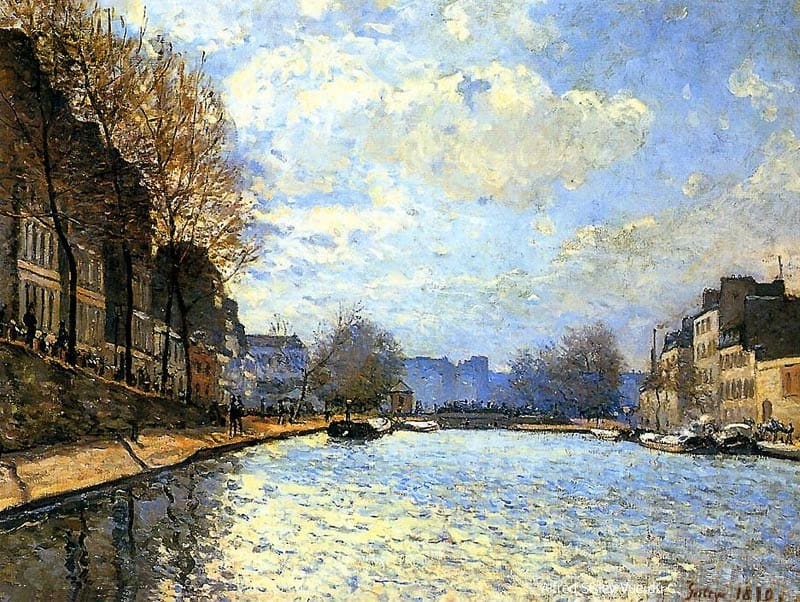
Vue du canal Saint-Martin
1870
Sisley's Paris canal of 1870 — the same calm, near-topographic manner.
More by Alfred Sisley
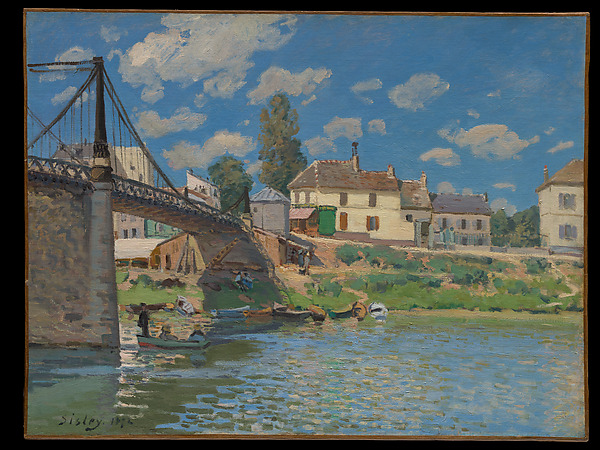
The Bridge at Villeneuve-la-Garenne

